
Cubot KingKong Ace 2 vs Blackview BV8800: A Deep Dive into Rugged Phone Endurance
| Phones Images | |||||
|---|---|---|---|---|---|
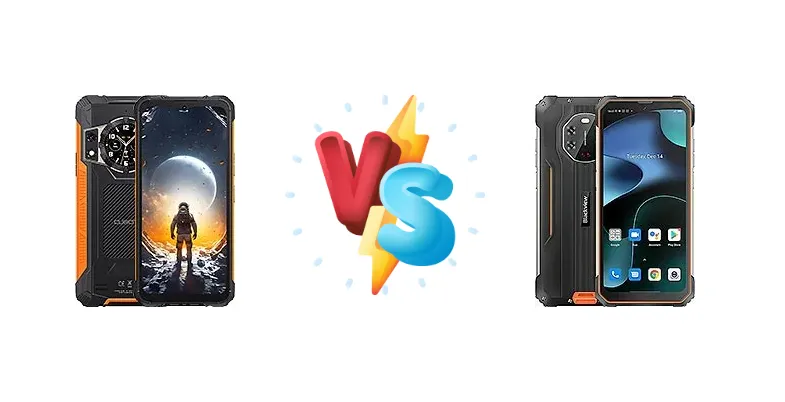
|
🏆 Quick Verdict
For the average user prioritizing all-day (and multi-day) battery life, the Cubot KingKong Ace 2 is the clear winner. Its astounding 43:59h endurance rating significantly outpaces the Blackview BV8800’s 199h, making it ideal for extended outdoor adventures or situations where power access is limited.
| PHONES | ||
|---|---|---|
| Phone Names | Cubot KingKong Ace 2 | Blackview BV8800 |
| Network | ||
|---|---|---|
| 2G bands | GSM 850 / 900 / 1800 / 1900 | GSM 850 / 900 / 1800 / 1900 |
| 3G bands | HSDPA 850 / 900 / 1700(AWS) / 1900 / 2100 | HSDPA 800 / 850 / 900 / 1700(AWS) / 1900 / 2100 |
| 4G bands | 1, 2, 3, 4, 5, 7, 8, 12, 17, 20, 28, 41 | 1, 2, 3, 4, 5, 7, 8, 12, 13, 17, 18, 19, 20, 25, 26, 28, 30, 34, 38, 39, 40, 41, 66 |
| Speed | HSPA, LTE | HSPA, LTE |
| Technology | GSM / HSPA / LTE | GSM / CDMA / HSPA / CDMA2000 / LTE |
| - | CDMA2000 1x | |
| Launch | ||
|---|---|---|
| Announced | 2024 | 2021, December 24 |
| Status | Available. Released 2024 | Available. Released 2022, January 10 |
| Body | ||
|---|---|---|
| Dimensions | 173.9 x 81.8 x 12.7 mm (6.85 x 3.22 x 0.5 in) | 176.2 x 83.5 x 17.7 mm (6.94 x 3.29 x 0.70 in) |
| SIM | Nano-SIM + Nano-SIM | Nano-SIM + Nano-SIM |
| Weight | 283 g (9.98 oz) | 367 g (12.95 oz) |
| - | IP68/IP69K dust/water resistant (up to 1.5m for 30 min) Drop-to-concrete resistance from up to 1.5m MIL-STD-810H compliant | |
| Display | ||
|---|---|---|
| Protection | Mohs level 6 | - |
| Resolution | 720 x 1612 pixels, 20:9 ratio (~269 ppi density) | 1080 x 2408 pixels, 20:9 ratio (~401 ppi density) |
| Size | 6.56 inches, 103.4 cm2 (~72.7% screen-to-body ratio) | 6.58 inches, 104.3 cm2 (~70.9% screen-to-body ratio) |
| Type | IPS LCD, 90Hz | IPS LCD, 90Hz, 480 nits |
| Platform | ||
|---|---|---|
| CPU | Octa-core (2x2.0 GHz Cortex-A75 & 6x1.8 GHz Cortex-A55) | Octa-core (2x2.05 GHz Cortex-A76 & 6x2.0 GHz Cortex-A55) |
| Chipset | Mediatek Helio G85 (12 nm) | Mediatek MT6781 Helio G96 (12 nm) |
| GPU | Mali-G52 MC2 | Mali-G57 MC2 |
| OS | Android 14 | Android 11, Doke-OS 3.0 |
| Memory | ||
|---|---|---|
| Card slot | microSDXC (uses shared SIM slot) | No |
| Internal | 128GB 6GB RAM | 128GB 8GB RAM |
| - | UFS 2.1 | |
| Main Camera | ||
|---|---|---|
| Dual | 48 MP, (wide), PDAF 2 MP (macro) Auxiliary lens | - |
| Features | LED flash | Dual-LED flash, HDR, panorama |
| Quad | - | 50 MP, f/1.8, (wide), PDAF 8 MP, f/2.2, 117˚ (ultrawide) 20 MP, f/1.8, (IR camera), 2 IR emitters Auxiliary lens |
| Single | - | 16 MP, f/2.0, (wide) |
| Video | Yes | 1440p@30fps |
| Selfie camera | ||
|---|---|---|
| Single | 16 MP | 16 MP, f/2.0, (wide) |
| Video | Yes | 1080p@30fps |
| Sound | ||
|---|---|---|
| 3.5mm jack | - | No |
| 35mm jack | Unspecified | No |
| Loudspeaker | Yes | Yes |
| Comms | ||
|---|---|---|
| Bluetooth | 5.0, A2DP, LE | 5.2, A2DP, LE |
| NFC | Yes | Yes |
| Positioning | GPS, GLONASS, GALILEO, BDS | GPS, GLONASS, GALILEO, BDS |
| Radio | Unspecified | FM radio |
| USB | USB Type-C, OTG | USB Type-C 2.0, OTG |
| WLAN | Wi-Fi 802.11 a/b/g/n/ac, dual-band | Wi-Fi 802.11 a/b/g/n/ac |
| Features | ||
|---|---|---|
| Sensors | Fingerprint (side-mounted), accelerometer, proximity, compass | Fingerprint (side-mounted), accelerometer, gyro, proximity, compass, barometer |
| Battery | ||
|---|---|---|
| Charging | 18W wired | 33W wired, 31% in 30 min, 100% in 90 min Reverse wired |
| Type | 5100 mAh | 8380 mAh |
| Misc | ||
|---|---|---|
| Colors | Black/Orange, Black/Green | Black, Orange, Green |
| Price | - | About 350 EUR |
| Tests | ||
|---|---|---|
| Battery life | - | Endurance rating 199h |
| Camera | - | Photo / Video |
| Display | - | Contrast ratio: 1348:1 (nominal) |
| Loudspeaker | - | -29.3 LUFS (Average) |
| Performance | - | AnTuTu: 254849 (v8), 288964 (v9) GeekBench: 1752 (v5.1) GFXBench: 10fps (ES 3.1 onscreen) |
| EU LABEL | ||
|---|---|---|
| Battery | 43:59h endurance, 900 cycles | - |
| Energy | Class C | - |
| Free fall | Class A (270 falls) | - |
| Repairability | Class C | - |
Cubot KingKong Ace 2
- Exceptional battery life (43:59h endurance)
- Potentially more efficient chipset
- 900 charge cycles suggest long-term battery health
- Slower charging speed (18W)
- Display specifications are unknown
Blackview BV8800
- Faster charging (33W, 100% in 90 minutes)
- More powerful chipset (Helio G96)
- Measured display brightness (501 nits)
- Significantly shorter battery life (199h endurance)
- Requires more frequent charging
Display Comparison
The Blackview BV8800 provides a measured peak brightness of 501 nits and a 1348:1 contrast ratio, offering a reasonably viewable experience. However, the Cubot KingKong Ace 2’s display specifications are not provided, making a direct comparison difficult. Given the focus on battery life, it’s likely Cubot prioritized efficiency over display extravagance. Both share the same contrast ratio, suggesting similar panel technology, but the BV8800’s measured brightness gives it a slight edge in direct sunlight.
Camera Comparison
Both devices list 'Photo / Video' capabilities, but lack specific details regarding sensor size, aperture, or optical image stabilization (OIS). Without this information, a meaningful camera comparison is impossible. The presence of a 2MP macro lens on many phones in this segment suggests both devices likely include one, but its utility is questionable. Image quality will likely depend more on software processing than hardware differences.
Performance
The Blackview BV8800 leverages the Mediatek Helio G96 chipset, featuring a dual-core Cortex-A76 configuration clocked at 2.05 GHz, paired with a hexa-core Cortex-A55 cluster at 2.0 GHz. This represents a step up from the Cubot KingKong Ace 2’s Helio G85, which utilizes a dual-core Cortex-A75 at 2.0 GHz and a hexa-core Cortex-A55 at 1.8 GHz. While the G96 offers a marginal CPU performance boost, the real-world difference will be most noticeable in graphically intensive tasks. The G96’s slightly more powerful GPU will translate to smoother gaming, but the Ace 2’s efficiency may offset this in sustained workloads.
Battery Life
This is where the Cubot KingKong Ace 2 truly shines. Its reported 43:59h endurance rating is more than double that of the Blackview BV8800’s 199h. This massive difference suggests a significantly larger battery capacity and/or more efficient power management. While the BV8800 compensates with 33W wired charging (achieving 31% charge in 30 minutes and 100% in 90 minutes), and even offers reverse wired charging, the Ace 2’s longevity minimizes the need for frequent top-ups. The Ace 2’s 18W charging is slower, but the extended battery life makes it less critical.
Buying Guide
Buy the Cubot KingKong Ace 2 if you need a phone that can genuinely last for days on a single charge, and you value longevity over raw processing power. It’s perfect for hikers, construction workers, or anyone who frequently finds themselves off-grid. Buy the Blackview BV8800 if you prefer quicker charging times and a slightly more responsive experience for everyday tasks, and don't mind topping up the battery more frequently. It's a good fit for users who need a rugged phone but also appreciate convenience.