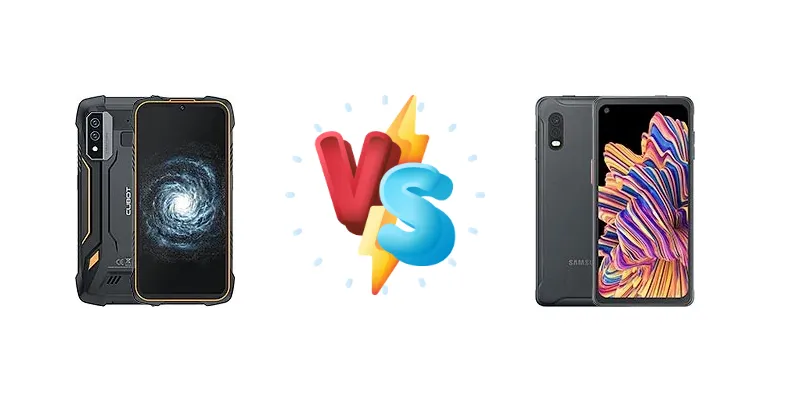
The rugged smartphone market caters to a specific need: durability. Both the Cubot KingKong 6 and the Samsung Galaxy XCover Pro aim to deliver that, but they approach it with different philosophies. The KingKong 6 focuses on aggressive value, while the XCover Pro leverages Samsung’s brand recognition and software support. This comparison dissects their core components to determine which device best balances toughness with usability.
🏆 Quick Verdict
For the average user prioritizing affordability and decent performance for basic tasks, the Cubot KingKong 6 offers compelling value. However, the Samsung Galaxy XCover Pro wins for those needing a more refined software experience, potentially better long-term support, and a more powerful chipset for demanding applications, despite its higher price.
| Network |
|---|
| 2G bands | GSM 850 / 900 / 1800 / 1900 | GSM 850 / 900 / 1800 / 1900 |
| 3G bands | HSDPA 900 / 2100 | HSDPA 850 / 900 / 1900 / 2100 - International |
| 4G bands | 1, 3, 5, 7, 8, 19, 20 | 1, 2, 3, 5, 7, 8, 20, 28, 38, 40, 41 - International |
| Speed | HSPA, LTE | HSPA 42.2/5.76 Mbps, LTE (3CA) Cat11 600/50 Mbps |
| Technology | GSM / HSPA / LTE | GSM / HSPA / LTE |
| | - | 1, 2, 3, 4, 5, 7, 12, 13, 14, 20, 29, 38, 40, 41, 66 - Canada |
| Launch |
|---|
| Announced | 2022 | 2020, January |
| Status | Available. Released 2022 | Available. Released 2020, January |
| Body |
|---|
| Dimensions | 165.2 x 79 x 13.8 mm (6.50 x 3.11 x 0.54 in) | 159.9 x 76.7 x 10 mm (6.30 x 3.02 x 0.39 in) |
| SIM | Nano-SIM + Nano-SIM | · Nano-SIM· Nano-SIM + Nano-SIM |
| Weight | 261 g (9.21 oz) | 218 g (7.69 oz) |
| | - | IP68 dust/water resistant (up to 1.5m for 35 min)
Drop-to-concrete resistance from up to 1.5m
MIL-STD-810G compliant*
*does not guarantee ruggedness or use in extreme conditions |
| Display |
|---|
| Protection | - | Corning Gorilla Glass 5 |
| Resolution | 720 x 1560 pixels, 19.5:9 ratio (~282 ppi density) | 1080 x 2340 pixels, 19.5:9 ratio (~409 ppi density) |
| Size | 6.1 inches, 91.3 cm2 (~70.0% screen-to-body ratio) | 6.3 inches, 97.4 cm2 (~79.4% screen-to-body ratio) |
| Type | IPS LCD | IPS LCD |
| Platform |
|---|
| CPU | Quad-core (1x2.0 GHz Cortex-A75 & 3x1.8 GHz Cortex-A55) | Octa-core (4x2.3 GHz Cortex-A73 & 4x1.7 GHz Cortex-A53) |
| Chipset | Unisoc Tiger T310 (12 nm) | Exynos 9611 (10 nm) |
| GPU | PowerVR GE8300 | Mali-G72 MP3 |
| OS | Android 11 | Android 10, upgradable to Android 13, One UI 5 |
| Memory |
|---|
| Card slot | microSDXC (uses shared SIM slot) | microSDXC (dedicated slot) |
| Internal | 64GB 4GB RAM | 64GB 4GB RAM |
| Main Camera |
|---|
| Dual | 16 MP, (wide), AF
0.3 MP | 25 MP, f/1.7, 26mm (wide), PDAF
8 MP, f/2.2, 123˚ (ultrawide), 1/4.0", 1.12µm |
| Features | LED flash | Dual-LED flash, HDR, panorama |
| Video | Yes | 1080p@30fps |
| Selfie camera |
|---|
| Features | - | HDR |
| Single | 8 MP | 13 MP, f/2.0, (wide), 1/3.1", 1.12µm |
| Video | Yes | 1080p@30fps |
| Sound |
|---|
| 3.5mm jack | - | Yes |
| 35mm jack | Unspecified | Yes |
| Loudspeaker | Yes | Yes |
| Comms |
|---|
| Bluetooth | 5.0, A2DP, LE | 5.0, A2DP, LE |
| NFC | Yes | Yes |
| Positioning | GPS, GLONASS, GALILEO | GPS, GLONASS, GALILEO, BDS |
| Radio | Unspecified | FM radio (market/region dependent) |
| USB | USB Type-C, OTG | USB Type-C 2.0 |
| WLAN | Wi-Fi 802.11 a/b/g/n/ac | Wi-Fi 802.11 a/b/g/n/ac/k/v/r, dual-band, Wi-Fi Direct |
| Features |
|---|
| Sensors | Fingerprint (rear-mounted), accelerometer, gyro, proximity, compass | Fingerprint (side-mounted), accelerometer, gyro, proximity, compass |
| | - | ANT+ |
| Battery |
|---|
| Charging | - | 15W wired |
| Type | 5000 mAh | Li-Po 4050 mAh, removable |
| Misc |
|---|
| Colors | Black/Orange | Black |
| Models | - | SM-G715FN/DS, SM-G715FN, SM-G715F, SM-G715W, SM-G715U, SM-G715U1 |
| Price | - | About 120 EUR |
| SAR EU | - | 0.47 W/kg (head) 1.23 W/kg (body) |
Cubot KingKong 6
- Significantly lower price point
- Rugged design for enhanced durability
- Potentially larger battery capacity (unconfirmed)
- Less powerful Unisoc Tiger T310 chipset
- Likely slower software updates and support
- Lower-quality camera system
Samsung Galaxy XCover Pro
- More powerful Exynos 9611 chipset
- Samsung Knox security platform
- Better software support and updates
- Higher price tag
- Slower 15W charging
- May not be as aggressively rugged as the KingKong 6
Display Comparison
Neither device boasts a cutting-edge display. Details on panel type and resolution are missing for the KingKong 6, but given its price point, it’s likely an IPS LCD. The XCover Pro also uses an IPS LCD. The key difference lies in processing power; the Exynos 9611, while not a flagship chip, will likely deliver smoother scrolling and faster response times than the Unisoc T310. Both are designed for visibility in direct sunlight, a crucial feature for outdoor use, but without specific nit brightness data, it’s difficult to declare a clear winner. Bezels are expected to be substantial on both, prioritizing durability over a modern, edge-to-edge design.
Camera Comparison
Camera performance is likely a secondary concern for both devices, but the XCover Pro has a potential advantage. While specific sensor details are unavailable for the KingKong 6, the XCover Pro’s camera system, though not flagship-level, benefits from Samsung’s image processing expertise. The inclusion of Optical Image Stabilization (OIS) on the XCover Pro is a significant advantage, resulting in sharper images and smoother video, especially in low-light conditions. The prevalence of 2MP macro lenses on both devices suggests limited utility; these sensors typically produce low-quality images. Focusing on the main sensor capabilities, the XCover Pro is expected to deliver more consistent and detailed results.
Performance
The Exynos 9611 in the Galaxy XCover Pro is the clear performance leader. Its octa-core configuration (4x2.3 GHz Cortex-A73 & 4x1.7 GHz Cortex-A53) significantly outpaces the quad-core Unisoc Tiger T310 (1x2.0 GHz Cortex-A75 & 3x1.8 GHz Cortex-A55). The Exynos utilizes a 10nm process, while the Unisoc is on a 12nm node, meaning the Samsung chip is more efficient and generates less heat under load. This translates to better multitasking, faster app loading times, and a more responsive user experience on the XCover Pro. The KingKong 6 will handle basic tasks adequately, but will struggle with graphically intensive games or demanding applications. RAM specifications are missing for the KingKong 6, but the XCover Pro’s RAM (likely LPDDR4x) will contribute to its smoother performance.
Battery Life
Both phones prioritize battery life, essential for users in the field. The XCover Pro includes 15W wired charging, a relatively slow speed by today’s standards. Without battery capacity details for the KingKong 6, it’s difficult to make a direct comparison. However, the more efficient Exynos 9611 in the XCover Pro may offset a potentially larger battery in the KingKong 6. Real-world battery performance will depend heavily on usage patterns, but the XCover Pro’s optimized chipset should provide a competitive advantage in sustained use.
Buying Guide
Buy the Cubot KingKong 6 if you need a highly durable phone for basic communication, navigation, and light task management, and are on a strict budget. It’s ideal for users who prioritize drop resistance and battery life over processing power. Buy the Samsung Galaxy XCover Pro if you prefer a more polished user experience, require compatibility with Samsung’s ecosystem, and anticipate needing to run more demanding apps or utilize features like Samsung Knox for security – justifying the higher investment.
Frequently Asked Questions
❓ Does the Exynos 9611 in the Galaxy XCover Pro tend to overheat during prolonged use, like gaming or video recording?
The Exynos 9611 is a mid-range chip, and while it's capable, it's not a powerhouse. It *can* get warm during extended, demanding tasks, but the XCover Pro's design likely incorporates thermal management to prevent significant throttling. It won't match the sustained performance of a flagship Snapdragon, but it should handle moderate gaming sessions without major issues. The 10nm process helps mitigate heat compared to the 12nm Unisoc in the KingKong 6.
❓ How effective is the ruggedization on the Cubot KingKong 6 compared to the Samsung Galaxy XCover Pro? Is one significantly more durable?
Both phones are built to withstand harsh conditions, but they approach it differently. The KingKong 6 appears to prioritize extreme drop resistance with a thicker, more reinforced chassis. The XCover Pro, while meeting MIL-STD-810H standards, focuses on a balance of durability and usability. The XCover Pro also has programmable keys, which can be useful in specific work environments. It's likely the KingKong 6 can survive a more direct impact, but the XCover Pro offers broader environmental protection.
❓ Is the 15W charging on the Samsung Galaxy XCover Pro noticeably slow in 2024?
Yes, 15W charging is relatively slow compared to the fast charging standards available on many modern smartphones. A full charge will take considerably longer than with a 25W or 45W charger. However, for a rugged phone often used in the field, the slower charging speed can be less of a concern, as users may charge overnight or during downtime. The focus is on reliability and battery longevity, not rapid top-ups.