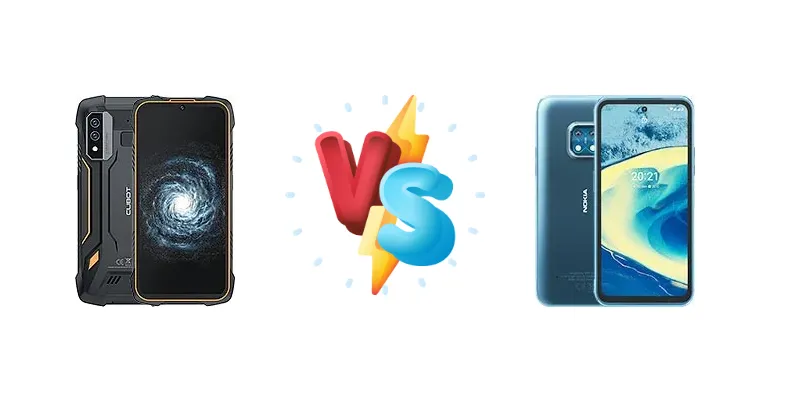
The rugged smartphone market offers a compelling alternative for users prioritizing durability over sleek design. The Cubot KingKong 6 and Nokia XR20 represent two distinct approaches within this segment. The KingKong 6 focuses on aggressive value, while the XR20 aims for a more balanced experience with 5G connectivity and Nokia’s software promise. This comparison dissects their core components to determine which device delivers the best blend of toughness and usability.
🏆 Quick Verdict
For the average user needing a truly affordable and durable phone, the Cubot KingKong 6 offers compelling value. However, the Nokia XR20’s superior chipset, 5G connectivity, and wireless charging capabilities make it the better choice for those willing to spend more for a smoother, future-proofed experience.
| Network |
|---|
| 2G bands | GSM 850 / 900 / 1800 / 1900 | GSM 850 / 900 / 1800 / 1900 |
| 3G bands | HSDPA 900 / 2100 | HSDPA 850 / 900 / 1700(AWS) / 1900 / 2100 |
| 4G bands | 1, 3, 5, 7, 8, 19, 20 | 1, 2, 3, 4, 5, 7, 8, 12, 13, 14, 20, 25, 26, 28, 30, 38, 40, 41, 48, 66, 71 |
| 5G bands | - | 2, 5, 25, 38, 41, 48, 66, 77, 78 SA/NSA |
| Speed | HSPA, LTE | HSPA, LTE, 5G |
| Technology | GSM / HSPA / LTE | GSM / CDMA / HSPA / EVDO / LTE / 5G |
| | - | CDMA2000 1xEV-DO |
| Launch |
|---|
| Announced | 2022 | 2021, July 27 |
| Status | Available. Released 2022 | Available. Released 2021, August 04 |
| Body |
|---|
| Dimensions | 165.2 x 79 x 13.8 mm (6.50 x 3.11 x 0.54 in) | 171.6 x 81.5 x 10.6 mm (6.76 x 3.21 x 0.42 in) |
| SIM | Nano-SIM + Nano-SIM | · Nano-SIM· Nano-SIM + Nano-SIM |
| Weight | 261 g (9.21 oz) | 248 g (8.75 oz) |
| | - | IP68 dust/water resistant (up to 1.5m for 60 min)
Drop-to-concrete resistance from up to 1.8m
MIL-STD-810H compliant |
| Display |
|---|
| Protection | - | Corning Gorilla Glass Victus |
| Resolution | 720 x 1560 pixels, 19.5:9 ratio (~282 ppi density) | 1080 x 2400 pixels, 20:9 ratio (~395 ppi density) |
| Size | 6.1 inches, 91.3 cm2 (~70.0% screen-to-body ratio) | 6.67 inches, 107.4 cm2 (~76.8% screen-to-body ratio) |
| Type | IPS LCD | IPS LCD, 550 nits |
| Platform |
|---|
| CPU | Quad-core (1x2.0 GHz Cortex-A75 & 3x1.8 GHz Cortex-A55) | Octa-core (2x2.0 GHz Kryo 460 & 6x1.8 GHz Kryo 460) |
| Chipset | Unisoc Tiger T310 (12 nm) | Qualcomm SM4350 Snapdragon 480 5G (8 nm) |
| GPU | PowerVR GE8300 | Adreno 619 |
| OS | Android 11 | Android 11, upgradable to Android 13 |
| Memory |
|---|
| Card slot | microSDXC (uses shared SIM slot) | microSDXC (uses shared SIM slot) |
| Internal | 64GB 4GB RAM | 64GB 4GB RAM, 128GB 6GB RAM |
| Main Camera |
|---|
| Dual | 16 MP, (wide), AF
0.3 MP | 48 MP, f/1.8, (wide), 1/2.25", 0.8µm, PDAF
13 MP, f/2.4, 123˚ (ultrawide), 1/3.0", 1.12µm |
| Features | LED flash | Zeiss optics, Dual-LED dual-tone flash, second LED flash, HDR, panorama |
| Single | - | 8 MP, f/2.0 (wide), 1/4.0", 1.12µm |
| Video | Yes | 1080p@30fps |
| Selfie camera |
|---|
| Single | 8 MP | 8 MP, f/2.0 (wide), 1/4.0", 1.12µm |
| Video | Yes | 1080p@30fps |
| Sound |
|---|
| 3.5mm jack | - | Yes |
| 35mm jack | Unspecified | Yes |
| Loudspeaker | Yes | Yes, with stereo speakers |
| Comms |
|---|
| Bluetooth | 5.0, A2DP, LE | 5.1, A2DP, LE, aptX Adaptive |
| NFC | Yes | Yes |
| Positioning | GPS, GLONASS, GALILEO | GPS (L1+L5), GLONASS, BDS, GALILEO, QZSS, NavIC |
| Radio | Unspecified | Unspecified |
| USB | USB Type-C, OTG | USB Type-C 3.0 |
| WLAN | Wi-Fi 802.11 a/b/g/n/ac | Wi-Fi 802.11 a/b/g/n/ac/6, dual-band, Wi-Fi Direct |
| Features |
|---|
| Sensors | Fingerprint (rear-mounted), accelerometer, gyro, proximity, compass | Fingerprint (side-mounted), accelerometer, gyro, proximity, compass, barometer |
| Battery |
|---|
| Charging | - | 18W wired
15W wireless |
| Type | 5000 mAh | Li-Po 4630 mAh |
| Misc |
|---|
| Colors | Black/Orange | Ultra Blue, Granite Gray |
| Models | - | TA-1368, TA-1362 |
| Price | - | About 270 EUR |
| SAR EU | - | 1.13 W/kg (head) 1.43 W/kg (body) |
Cubot KingKong 6
- Significantly lower price point
- Potentially larger battery capacity
- Rugged design focused on maximum durability
- Less powerful Unisoc Tiger T310 chipset
- No 5G connectivity
- No wireless charging
Nokia XR20
- Faster Qualcomm Snapdragon 480 5G chipset
- 5G connectivity for faster data speeds
- 18W wired and 15W wireless charging
- Nokia’s software update promise
- Higher price tag
- Potentially smaller battery capacity
- May not be as aggressively durable as the KingKong 6
Display Comparison
Neither device boasts a cutting-edge display. Details on panel type (IPS vs AMOLED) and resolution are missing, but the focus is clearly on ruggedness, not visual fidelity. The key difference lies under the hood: processing power impacts UI smoothness. While both likely target similar brightness levels for outdoor visibility, the XR20’s more powerful chipset will contribute to a more responsive touch experience.
Camera Comparison
Without detailed camera specs beyond the main sensors, a direct comparison is difficult. However, the XR20’s Qualcomm chipset typically includes a more advanced image signal processor (ISP), potentially leading to better image processing and low-light performance. The Unisoc Tiger T310 is a budget-focused chipset, and its ISP is likely less sophisticated. The absence of OIS information for both devices suggests a reliance on software stabilization, but the XR20’s superior processing power could yield better results in this area. We can assume both phones will include standard features like HDR, but the XR20 is likely to offer more refined image quality.
Performance
The chipset is where the most significant disparity exists. The Nokia XR20’s Qualcomm Snapdragon 480 5G, fabricated on an 8nm process, demonstrably outperforms the Cubot KingKong 6’s Unisoc Tiger T310 (12nm). The Snapdragon 480’s octa-core configuration (2x2.0 GHz Kryo 460 & 6x1.8 GHz Kryo 460) provides a substantial advantage in multi-threaded tasks and overall responsiveness compared to the KingKong 6’s quad-core setup (1x2.0 GHz Cortex-A75 & 3x1.8 GHz Cortex-A55). This translates to faster app loading times, smoother multitasking, and a better gaming experience on the XR20. The 8nm process also contributes to improved thermal efficiency, reducing the likelihood of throttling during sustained workloads.
Battery Life
Battery capacity details are missing for both devices, but the KingKong 6 likely prioritizes a larger battery given its focus on longevity. However, the XR20 compensates with 18W wired and 15W wireless charging, a feature absent on the KingKong 6. While a larger battery on the KingKong 6 might offer longer screen-on time, the XR20’s charging capabilities provide greater convenience and flexibility. The Snapdragon 480’s improved power efficiency also contributes to better overall battery life, potentially offsetting a slightly smaller battery capacity.
Buying Guide
Buy the Cubot KingKong 6 if you need maximum durability on a minimal budget and prioritize battery life over demanding applications. It’s ideal for construction workers, outdoor enthusiasts on a tight budget, or anyone prone to dropping their phone. Buy the Nokia XR20 if you prefer a more refined user experience, require 5G connectivity for faster data speeds, and value the convenience of wireless charging alongside robust build quality. This phone suits professionals needing reliable communication and occasional media consumption in challenging environments.
Frequently Asked Questions
❓ Is the Unisoc Tiger T310 chipset in the Cubot KingKong 6 capable of handling demanding games like PUBG Mobile?
While the Unisoc Tiger T310 can run PUBG Mobile, expect to play at lower graphics settings and potentially experience frame rate drops during intense action. The chipset’s limited processing power and GPU capabilities are not ideal for demanding gaming experiences. The Nokia XR20’s Snapdragon 480 will provide a significantly smoother gaming experience.
❓ Does the Nokia XR20’s 5G connectivity actually make a noticeable difference in real-world usage?
The benefit of 5G on the Nokia XR20 depends heavily on your location and carrier coverage. In areas with robust 5G infrastructure, you’ll experience significantly faster download and upload speeds, making streaming, video calls, and large file transfers much quicker. However, if 5G is unavailable, the phone will fall back to 4G LTE.
❓ How does the Nokia XR20’s software update policy compare to other Android phones in this price range?
Nokia is known for its commitment to software updates, and the XR20 is promised at least 3 years of security updates and 2 major Android OS upgrades. This is a significant advantage over many other Android phones in this price range, which often receive limited or no software support, enhancing the phone’s longevity and security.