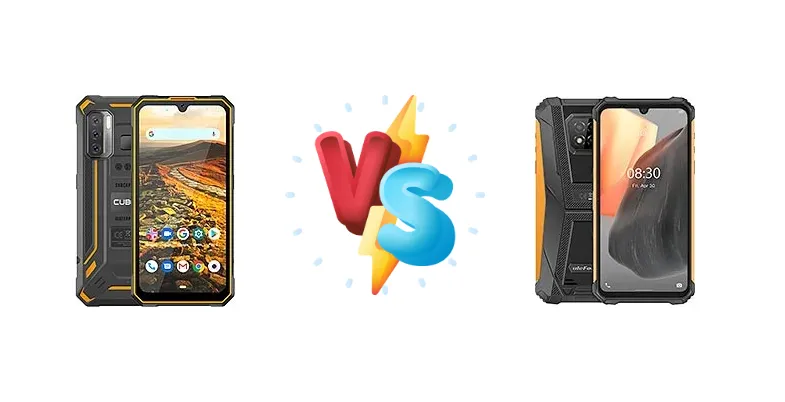
The rugged smartphone market caters to a specific user: those needing durability and reliability in challenging environments. Both the Cubot KingKong 5 and Ulefone Armor 8 Pro aim to deliver this, but they differ significantly in their internal hardware. This comparison dissects those differences, focusing on how they impact real-world performance and usability.
🏆 Quick Verdict
For the average user prioritizing smoother multitasking and a slightly faster overall experience, the Ulefone Armor 8 Pro is the better choice. Its Helio P60 chipset offers a noticeable performance uplift over the KingKong 5’s Helio P22, despite the KingKong 5 potentially offering better value depending on current pricing.
| Network |
|---|
| 2G bands | GSM 850 / 900 / 1800 / 1900 | GSM 850 / 900 / 1800 / 1900 |
| 3G bands | HSDPA 900 / 2100 | HSDPA 850 / 900 / 1700(AWS) / 1900 / 2100 |
| 4G bands | 1, 3, 5, 7, 8, 19, 20, 40 | 1, 2, 3, 4, 5, 7, 8, 12, 13, 17, 18, 19, 20, 25, 26, 28, 66 |
| Speed | HSPA, LTE | HSPA 42.2/11.5 Mbps, LTE Cat7 300/150 Mbps |
| Technology | GSM / HSPA / LTE | GSM / HSPA / LTE |
| Launch |
|---|
| Announced | 2022 | 2021, April 28 |
| Status | Available. Released 2022 | Available. Released 2021, April 28 |
| Body |
|---|
| Build | - | Front glass, aluminum back with rubber, aluminum frame |
| Dimensions | 160.3 x 78.6 x 15 mm (6.31 x 3.09 x 0.59 in) | 166 x 81.8 x 15 mm (6.54 x 3.22 x 0.59 in) |
| SIM | Nano-SIM + Nano-SIM | Nano-SIM + Nano-SIM |
| Weight | - | 282 g (9.95 oz) |
| | - | IP68 dust/water resistant (up to 1.5m for 30 min)
Drop-to-concrete resistance from up to 1.2m
MIL-STD-810G compliant |
| Display |
|---|
| Protection | - | Scratch-resistant glass, oleophobic coating |
| Resolution | 720 x 1560 pixels, 19.5:9 ratio (~286 ppi density) | 720 x 1560 pixels, 19.5:9 ratio (~282 ppi density) |
| Size | 6.01 inches, 88.7 cm2 (~70.4% screen-to-body ratio) | 6.1 inches, 91.3 cm2 (~67.3% screen-to-body ratio) |
| Type | IPS LCD | IPS LCD |
| Platform |
|---|
| CPU | Octa-core (4x2.0 GHz Cortex-A53 & 4x1.5 GHz Cortex-A53) | Octa-core (4x2.0 GHz Cortex-A73 & 4x2.0 GHz Cortex-A53) |
| Chipset | Mediatek MT6762 Helio P22 (12 nm) | Mediatek MT6771 Helio P60 (12 nm) |
| GPU | PowerVR GE8320 | Mali-G72 MP3 |
| OS | Android 11 | Android 11 |
| Memory |
|---|
| Card slot | microSDXC (uses shared SIM slot) | microSDXC (uses shared SIM slot) |
| Internal | 32GB 4GB RAM | 128GB 6GB RAM, 128GB 8GB RAM |
| Main Camera |
|---|
| Features | LED flash | LED flash, Panorama, HDR |
| Single | - | 8 MP, f/2.2 |
| Triple | 48 MP, (wide), AF
5 MP (macro), AF
Auxiliary lens | 16 MP, f/2.2, (wide), PDAF
5 MP (macro)
Auxiliary lens |
| Video | Yes | 1080p@30fps |
| Selfie camera |
|---|
| Single | 8 MP | 8 MP, f/2.2 |
| Video | Yes | 1080p@30fps |
| Sound |
|---|
| 3.5mm jack | - | Yes |
| 35mm jack | Unspecified | Yes |
| Loudspeaker | Yes | Yes |
| Comms |
|---|
| Bluetooth | 5.3, A2DP, LE | 4.2, A2DP, LE |
| NFC | Yes | Yes |
| Positioning | GPS, GLONASS, BDS | GPS, GLONASS, GALILEO, BDS |
| Radio | Unspecified | FM radio, RDS, recording |
| USB | USB Type-C, OTG | USB Type-C 2.0, OTG |
| WLAN | Wi-Fi 802.11 a/b/g/n/ac, dual-band | Wi-Fi 802.11 a/b/g/n/ac, Wi-Fi Direct |
| Features |
|---|
| Sensors | Fingerprint (rear-mounted), accelerometer, gyro, proximity, compass | Fingerprint (side-mounted), accelerometer, gyro, proximity, compass |
| Battery |
|---|
| Charging | - | 15W wired |
| Type | 5000 mAh | Li-Po 5580 mAh |
| Misc |
|---|
| Colors | Black | Black, Orange, Red |
| Price | - | About 190 EUR |
Cubot KingKong 5
- Likely more affordable price point.
- Robust build quality expected from Cubot's KingKong series.
- Potentially longer battery life due to less demanding chipset.
- Significantly slower performance compared to the Armor 8 Pro.
- Less responsive user experience.
- Limited gaming capabilities.
Ulefone Armor 8 Pro
- Faster and more responsive performance thanks to the Helio P60.
- Improved multitasking and app loading times.
- Better suited for casual gaming.
- Slower 15W charging.
- Potentially higher price.
- May not offer significantly better battery life than the KingKong 5.
Display Comparison
Neither device boasts a standout display. Both likely utilize IPS LCD panels, common in this price bracket. The focus here isn't on visual fidelity, but durability. We lack specific data on brightness nits or color accuracy, but expect both to prioritize visibility in direct sunlight over color accuracy. Bezels are likely substantial on both, reflecting the rugged design constraints.
Camera Comparison
Without detailed camera specs beyond the chipsets, a direct comparison is difficult. Both phones likely feature multiple rear cameras, but image quality will heavily depend on sensor size and image processing. The P60’s ISP (Image Signal Processor) is more advanced, potentially leading to better dynamic range and noise reduction in the Armor 8 Pro. It’s reasonable to assume the Armor 8 Pro will produce more detailed and vibrant photos, especially in challenging lighting conditions. We can expect both to include a basic macro camera, but these are often of limited utility.
Performance
The core difference lies in the chipsets. The Ulefone Armor 8 Pro’s Mediatek Helio P60 (MT6771) is a significant upgrade over the Cubot KingKong 5’s Helio P22 (MT6762). The P60 utilizes a more modern CPU architecture – 4x2.0 GHz Cortex-A73 cores alongside 4x2.0 GHz Cortex-A53 cores – compared to the P22’s 4x2.0 GHz Cortex-A53 and 4x1.5 GHz Cortex-A53 configuration. The A73 cores in the P60 offer substantially better single-core performance, translating to snappier app launches and smoother multitasking. While both are 12nm chips, the architectural improvements in the P60 provide a clear advantage. The Armor 8 Pro also benefits from potentially better GPU performance, making it more suitable for casual gaming.
Battery Life
Battery capacity isn’t specified, but rugged phones typically prioritize long battery life. The Ulefone Armor 8 Pro includes 15W wired charging, which is relatively slow by modern standards. The KingKong 5’s charging speed is unknown, but it’s unlikely to be significantly faster. Real-world battery life will depend on usage patterns, but the more efficient Helio P60 in the Armor 8 Pro may offer slightly better endurance despite potentially having a similar capacity battery. The slower charging speed on the Armor 8 Pro means topping up will take longer.
Buying Guide
Buy the Cubot KingKong 5 if you need a highly affordable, extremely durable phone for basic tasks like calls, texts, and light app usage. It’s ideal for those on a tight budget who prioritize resilience above all else. Buy the Ulefone Armor 8 Pro if you prefer a more responsive user experience, occasionally play mobile games, or require faster app loading times. The P60 chipset provides a tangible performance boost for everyday tasks and light gaming.
Frequently Asked Questions
❓ Will the Ulefone Armor 8 Pro struggle with demanding apps like Asphalt 9?
While the Helio P60 can handle some gaming, Asphalt 9 is a graphically intensive title. Expect to play at lower settings to maintain a playable frame rate. The KingKong 5’s Helio P22 would likely struggle significantly more, making it unsuitable for this game.
❓ How well does the Ulefone Armor 8 Pro handle prolonged use of GPS for navigation?
The Helio P60’s more efficient architecture should handle GPS navigation for extended periods without excessive overheating. However, rugged phones often prioritize thermal management over peak performance, so expect some throttling during prolonged, intensive tasks.
❓ Is the 15W charging on the Ulefone Armor 8 Pro a significant drawback?
Yes, 15W is relatively slow compared to the 30W or 65W charging found on many modern smartphones. Expect a full charge to take over 2 hours. This is a trade-off for the ruggedized design and potentially larger battery capacity.