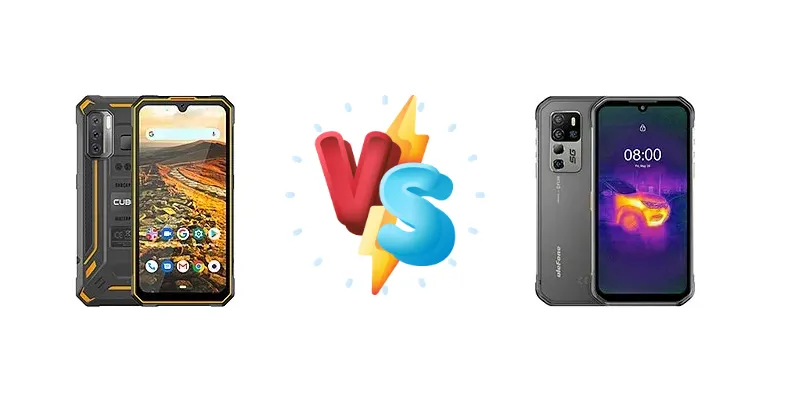
The rugged smartphone market caters to a specific need: durability. However, performance and features vary wildly even within this niche. We're pitting the budget-focused Cubot KingKong 5 against the more ambitious Ulefone Armor 11T 5G to determine which offers the best balance of toughness and usability, focusing on the core differences in their processing power and connectivity.
🏆 Quick Verdict
For the average user prioritizing future-proofing and responsiveness, the Ulefone Armor 11T 5G is the clear winner. Its Mediatek Dimensity 800 chipset delivers significantly better performance than the Cubot KingKong 5’s Helio P22. However, the KingKong 5 remains a viable option for those on a tight budget who primarily need a durable device for basic tasks.
| Network |
|---|
| 2G bands | GSM 850 / 900 / 1800 / 1900 | GSM 850 / 900 / 1800 / 1900 |
| 3G bands | HSDPA 900 / 2100 | HSDPA 850 / 900 / 1700(AWS) / 1900 / 2100 |
| 4G bands | 1, 3, 5, 7, 8, 19, 20, 40 | 1, 2, 3, 4, 5, 7, 8, 12, 13, 17, 18, 19, 20, 25, 26, 28, 34, 38, 39, 40, 41, 66 |
| 5G bands | - | 1, 3, 5, 8, 20, 28, 38, 41, 77, 78, 79 SA/NSA |
| Speed | HSPA, LTE | HSPA, LTE, 5G |
| Technology | GSM / HSPA / LTE | GSM / CDMA / HSPA / EVDO / LTE / 5G |
| | - | CDMA2000 1xEV-DO |
| Launch |
|---|
| Announced | 2022 | 2021, May 29 |
| Status | Available. Released 2022 | Available. Released 2021, June 07 |
| Body |
|---|
| Build | - | Front glass, aluminum back with rubber, aluminum frame |
| Dimensions | 160.3 x 78.6 x 15 mm (6.31 x 3.09 x 0.59 in) | 163.8 x 81.6 x 14.2 mm (6.45 x 3.21 x 0.56 in) |
| SIM | Nano-SIM + Nano-SIM | Nano-SIM + Nano-SIM |
| Weight | - | 293 g (10.34 oz) |
| | - | IP69K dust/water resistant (up to 1.5m for 30 min)
Drop-to-concrete resistance from up to 1.2m
MIL-STD-810G compliant |
| Display |
|---|
| Protection | - | Oleophobic coating |
| Resolution | 720 x 1560 pixels, 19.5:9 ratio (~286 ppi density) | 720 x 1560 pixels, 19.5:9 ratio (~282 ppi density) |
| Size | 6.01 inches, 88.7 cm2 (~70.4% screen-to-body ratio) | 6.1 inches, 91.3 cm2 (~68.3% screen-to-body ratio) |
| Type | IPS LCD | IPS LCD |
| Platform |
|---|
| CPU | Octa-core (4x2.0 GHz Cortex-A53 & 4x1.5 GHz Cortex-A53) | Octa-core (4x2.0 GHz Cortex-A76 & 4x2.0 GHz Cortex-A55) |
| Chipset | Mediatek MT6762 Helio P22 (12 nm) | Mediatek Dimensity 800 (7 nm) |
| GPU | PowerVR GE8320 | Mali-G57 MP4 |
| OS | Android 11 | Android 11 |
| Memory |
|---|
| Card slot | microSDXC (uses shared SIM slot) | No |
| Internal | 32GB 4GB RAM | 256GB 8GB RAM |
| | - | UFS 2.1 |
| Main Camera |
|---|
| Features | LED flash | Dual-LED dual-tone flash, HDR, panorama |
| Penta | - | 48 MP, f/1.8, 26mm (wide), 1/2.0", 0.8µm, PDAF
FLIR thermal camera (Lepton module)
5 MP
2 MP (macro)
Auxiliary lens |
| Single | - | 16 MP, f/2.0 |
| Triple | 48 MP, (wide), AF
5 MP (macro), AF
Auxiliary lens | - |
| Video | Yes | 4K@30fps, 1080p@30fps |
| Selfie camera |
|---|
| Features | - | HDR, panorama |
| Single | 8 MP | 16 MP, f/2.0 |
| Video | Yes | 1080p@30fps |
| Sound |
|---|
| 3.5mm jack | - | Yes |
| 35mm jack | Unspecified | Yes |
| Loudspeaker | Yes | Yes |
| Comms |
|---|
| Bluetooth | 5.3, A2DP, LE | 5.0, A2DP, LE |
| NFC | Yes | Yes |
| Positioning | GPS, GLONASS, BDS | GPS, GLONASS, GALILEO, BDS |
| Radio | Unspecified | FM radio, RDS, recording |
| USB | USB Type-C, OTG | USB Type-C 2.0, OTG |
| WLAN | Wi-Fi 802.11 a/b/g/n/ac, dual-band | Wi-Fi 802.11 a/b/g/n/ac, Wi-Fi Direct |
| Features |
|---|
| Sensors | Fingerprint (rear-mounted), accelerometer, gyro, proximity, compass | Fingerprint (side-mounted), accelerometer, gyro, proximity, compass, baroceptor |
| Battery |
|---|
| Charging | - | 18W wired
10W wireless |
| Type | 5000 mAh | Li-Po 5200 mAh |
| Misc |
|---|
| Colors | Black | Black |
| Price | - | About 590 EUR |
Cubot KingKong 5
- Extremely affordable price point
- Rugged design for durability
- Suitable for basic smartphone tasks
- Outdated Helio P22 chipset
- Limited performance for demanding apps
- Likely lacks 5G connectivity
Ulefone Armor 11T 5G
- Powerful Mediatek Dimensity 800 chipset
- 5G connectivity for faster data speeds
- Wireless charging for added convenience
- Higher price compared to the KingKong 5
- May experience thermal throttling under sustained load
- Rugged design may add bulk
Display Comparison
Neither device’s display specifications are provided, so a direct comparison is limited. However, given the price point of the KingKong 5, it likely utilizes a standard LCD panel. The Armor 11T 5G, being a more premium offering, may feature a higher-quality panel with improved color accuracy and viewing angles. The absence of details like resolution and refresh rate makes a definitive statement impossible, but the Armor 11T likely offers a more visually pleasing experience.
Camera Comparison
Without specific camera sensor details, a detailed comparison is challenging. However, rugged phones often prioritize durability over camera quality. It’s reasonable to assume both devices feature modest camera setups. The Armor 11T 5G’s more powerful processor could potentially enable better image processing, leading to improved photo and video quality, but this is speculative. The presence of a 5G modem suggests a more modern ISP (Image Signal Processor) which could contribute to better image quality.
Performance
The performance disparity is the most significant difference between these two phones. The Cubot KingKong 5’s Mediatek MT6762 Helio P22 (12nm) is an entry-level chipset designed for basic smartphone functions. Its octa-core CPU, while offering multi-core processing, relies on older Cortex-A53 cores. In contrast, the Ulefone Armor 11T 5G boasts the Mediatek Dimensity 800 (7nm). This chipset utilizes more modern and powerful Cortex-A76 cores, resulting in a substantial performance uplift in CPU-intensive tasks and gaming. The 7nm process node also contributes to better power efficiency and thermal management. Users who intend to run demanding applications or play graphically intensive games will find the Armor 11T 5G far more capable.
Battery Life
Battery capacity isn’t specified for the KingKong 5, but rugged phones typically prioritize large batteries. The Ulefone Armor 11T 5G offers 18W wired and 10W wireless charging, providing convenient charging options. The Armor 11T’s Dimensity 800, despite being more powerful, benefits from the 7nm process, potentially mitigating battery drain compared to the KingKong 5’s less efficient Helio P22. The wireless charging capability is a significant advantage for the Armor 11T 5G, offering added convenience.
Buying Guide
Buy the Cubot KingKong 5 if you need an extremely affordable, durable phone for essential communication and light tasks like calls, texts, and basic navigation. It’s ideal for users who prioritize longevity and don’t demand high performance. Buy the Ulefone Armor 11T 5G if you prefer a more modern smartphone experience with 5G connectivity, faster processing for multitasking and gaming, and the convenience of wireless charging, even if it comes at a higher price point.
Frequently Asked Questions
❓ Will the Ulefone Armor 11T 5G's Dimensity 800 chipset overheat during prolonged gaming sessions?
While the Dimensity 800 is a capable processor, it's not immune to thermal throttling. The rugged design of the Armor 11T 5G may limit passive cooling. Expect some performance reduction after extended gaming, but it will still outperform the KingKong 5 significantly.
❓ Is the Cubot KingKong 5 suitable for running multiple apps simultaneously?
The Helio P22 chipset and limited RAM (spec not provided, but likely 3-4GB) in the KingKong 5 will struggle with heavy multitasking. Switching between apps will be slow, and running demanding applications concurrently is not recommended.
❓ Does the Ulefone Armor 11T 5G support VoLTE and VoWiFi for improved call quality?
Given its 5G capabilities and market positioning, the Ulefone Armor 11T 5G likely supports VoLTE (Voice over LTE) and VoWiFi (Voice over Wi-Fi) for enhanced call quality and network coverage. However, compatibility depends on your carrier.
❓ How does the ruggedness of the KingKong 5 compare to the Armor 11T 5G in terms of drop and water resistance?
Both phones are built to withstand harsh conditions, but specific certifications (IP68, MIL-STD-810G) are needed for a precise comparison. Generally, Ulefone tends to emphasize robust build quality, suggesting the Armor 11T 5G may offer slightly better protection, but both are designed for durability.