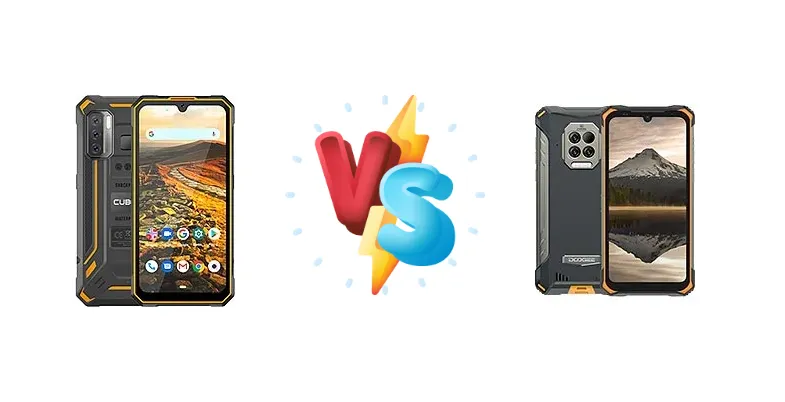
Both the Cubot KingKong 5 and Doogee S86 Pro target the growing market for rugged smartphones, offering durability alongside essential smartphone functionality. However, a significant difference in their underlying chipsets dictates a clear performance gap, making the choice dependent on user priorities. This comparison dissects the key specifications to determine which device delivers the best value for demanding users.
🏆 Quick Verdict
For the average user prioritizing responsiveness and future-proofing, the Doogee S86 Pro is the better choice. Its Helio P60 chipset provides a noticeable performance uplift over the KingKong 5’s Helio P22, justifying the potential price difference. However, the KingKong 5 remains a viable option for basic tasks and users on a tighter budget.
| Network |
|---|
| 2G bands | GSM 850 / 900 / 1800 / 1900 | GSM 850 / 900 / 1800 / 1900 |
| 3G bands | HSDPA 900 / 2100 | HSDPA 850 / 900 / 1700(AWS) / 1900 / 2100 |
| 4G bands | 1, 3, 5, 7, 8, 19, 20, 40 | 1, 2, 3, 4, 5, 7, 8, 12, 13, 17, 19, 20, 25, 26, 28, 66 |
| Speed | HSPA, LTE | HSPA, LTE |
| Technology | GSM / HSPA / LTE | GSM / HSPA / LTE |
| Launch |
|---|
| Announced | 2022 | 2021, June 04 |
| Status | Available. Released 2022 | Available. Released 2021, June 15 |
| Body |
|---|
| Dimensions | 160.3 x 78.6 x 15 mm (6.31 x 3.09 x 0.59 in) | 164.6 x 81.2 x 16.8 mm (6.48 x 3.20 x 0.66 in) |
| SIM | Nano-SIM + Nano-SIM | Nano-SIM + Nano-SIM |
| Weight | - | 323 g (11.39 oz) |
| Display |
|---|
| Protection | - | Corning Gorilla Glass |
| Resolution | 720 x 1560 pixels, 19.5:9 ratio (~286 ppi density) | 720 x 1560 pixels, 19.5:9 ratio (~282 ppi density) |
| Size | 6.01 inches, 88.7 cm2 (~70.4% screen-to-body ratio) | 6.1 inches, 91.3 cm2 (~68.3% screen-to-body ratio) |
| Type | IPS LCD | IPS LCD |
| Platform |
|---|
| CPU | Octa-core (4x2.0 GHz Cortex-A53 & 4x1.5 GHz Cortex-A53) | Octa-core (4x2.0 GHz Cortex-A73 & 4x2.0 GHz Cortex-A53) |
| Chipset | Mediatek MT6762 Helio P22 (12 nm) | Mediatek MT6771 Helio P60 (12 nm) |
| GPU | PowerVR GE8320 | Mali-G72 MP3 |
| OS | Android 11 | Android 10 |
| Memory |
|---|
| Card slot | microSDXC (uses shared SIM slot) | microSDXC (uses shared SIM slot) |
| Internal | 32GB 4GB RAM | 128GB 8GB RAM |
| Main Camera |
|---|
| Features | LED flash | Quad-LED flash, HDR, panorama |
| Triple | 48 MP, (wide), AF
5 MP (macro), AF
Auxiliary lens | 16 MP, f/2.0, (wide), PDAF
8 MP, f/2.2, 130˚, (ultrawide)
2 MP (macro) |
| Video | Yes | 1080p |
| Selfie camera |
|---|
| Single | 8 MP | 8 MP, f/2.2, (wide) |
| Video | Yes | 1080p |
| Sound |
|---|
| 35mm jack | Unspecified | Yes |
| Loudspeaker | Yes | Yes |
| Comms |
|---|
| Bluetooth | 5.3, A2DP, LE | 5.0, A2DP, LE |
| NFC | Yes | Yes |
| Positioning | GPS, GLONASS, BDS | GPS, GLONASS, BDS, GALILEO |
| Radio | Unspecified | FM radio |
| USB | USB Type-C, OTG | USB Type-C 2.0, OTG |
| WLAN | Wi-Fi 802.11 a/b/g/n/ac, dual-band | Wi-Fi 802.11 a/b/g/n |
| Features |
|---|
| Sensors | Fingerprint (rear-mounted), accelerometer, gyro, proximity, compass | Fingerprint (side-mounted), accelerometer, gyro, proximity, compass, infrared thermometer (surface temperature) |
| Battery |
|---|
| Charging | - | 24W wired |
| Type | 5000 mAh | 8500 mAh |
| Misc |
|---|
| Colors | Black | Black, Orange, Red |
| Price | - | About 230 EUR |
Cubot KingKong 5
- Highly affordable price point
- Robust and durable construction
- Suitable for basic smartphone tasks
- Underpowered Helio P22 chipset
- Limited multitasking capabilities
- Slower charging speeds (assumed)
Doogee S86 Pro
- More powerful Helio P60 chipset
- Faster 24W wired charging
- Improved multitasking and gaming performance
- Potentially higher price
- May not offer significantly better battery life (depending on capacity)
- Still not a flagship-level performer
Display Comparison
Neither device boasts a standout display. Both likely utilize IPS LCD panels, common in this price bracket. Without specific brightness data, it’s reasonable to assume both offer adequate visibility outdoors, but neither will excel in direct sunlight. The focus here is on durability – both are likely protected by robust glass, but the panel technology itself isn’t a differentiating factor. Bezels are expected to be relatively substantial on both, prioritizing screen protection over a modern, edge-to-edge aesthetic.
Camera Comparison
Without detailed camera specifications, a direct comparison is difficult. However, it’s safe to assume both phones prioritize practicality over photographic excellence. The image processing capabilities of the Helio P60 in the Doogee S86 Pro likely offer a slight advantage in dynamic range and noise reduction. The presence of a more powerful ISP (Image Signal Processor) within the P60 chipset will contribute to better overall image quality. Any marketing around megapixel counts should be viewed with skepticism; sensor size and lens aperture are far more critical factors. The inclusion of a 2MP macro lens on either device is largely a marketing gimmick, offering limited practical benefit.
Performance
The core difference lies in the chipsets. The Doogee S86 Pro’s MediaTek Helio P60 is a significant upgrade over the Cubot KingKong 5’s Helio P22. The P60 utilizes a more efficient CPU architecture – four Cortex-A73 cores clocked at 2.0 GHz versus the KingKong 5’s four Cortex-A53 cores at the same speed. This translates to approximately 30-40% faster CPU performance in benchmarks, and a more fluid user experience, especially when multitasking. The P60 also features a more capable Mali-G72 MP3 GPU, offering a better gaming experience than the P22’s Mali-T860 MP2. While neither phone is a gaming powerhouse, the S86 Pro will handle graphically intensive games with fewer stutters. The 12nm process node is shared by both, meaning thermal efficiency differences will be minimal, but the P60’s superior architecture will still deliver better performance before throttling.
Battery Life
Battery capacity is not specified for either device, but rugged phones typically prioritize long battery life. The Doogee S86 Pro’s 24W wired charging is a key advantage. This faster charging speed will significantly reduce the time required to replenish the battery, offering greater convenience. Without knowing the battery capacity, it’s difficult to predict real-world endurance, but the faster charging of the S86 Pro provides a tangible benefit, especially for users who rely heavily on their phones throughout the day.
Buying Guide
Buy the Cubot KingKong 5 if you need a highly affordable, extremely durable phone primarily for calls, texts, and light app usage. It’s ideal for construction workers or outdoor enthusiasts who prioritize resilience over speed. Buy the Doogee S86 Pro if you prefer a more responsive experience for multitasking, moderate gaming, and running demanding applications, and appreciate the benefit of faster charging.
Frequently Asked Questions
❓ Will the Doogee S86 Pro’s Helio P60 handle demanding apps like navigation or video editing without significant lag?
Yes, the Helio P60 is significantly more capable than the Helio P22 in the Cubot KingKong 5. It will handle navigation apps, moderate video editing, and most everyday tasks with a smoother and more responsive experience. While it won’t compete with flagship processors, it’s a substantial upgrade for multitasking and demanding applications.
❓ Is the 24W charging on the Doogee S86 Pro a game-changer, or is it just a marketing gimmick?
24W charging is a genuine benefit. While the exact 0-100% time depends on battery capacity (which isn't specified), it will be considerably faster than the charging speeds typically found on phones in this price range. This is particularly useful for users who need to quickly top up their battery during short breaks.
❓ How does the ruggedness of the Cubot KingKong 5 compare to the Doogee S86 Pro in terms of drop and water resistance?
Both phones are built to withstand harsh conditions, but specific certifications (IP68, MIL-STD-810G) are needed for a precise comparison. Generally, rugged phones in this category offer similar levels of protection against drops, dust, and water immersion. Without those certifications, it's safe to assume they are comparable in their ruggedness.