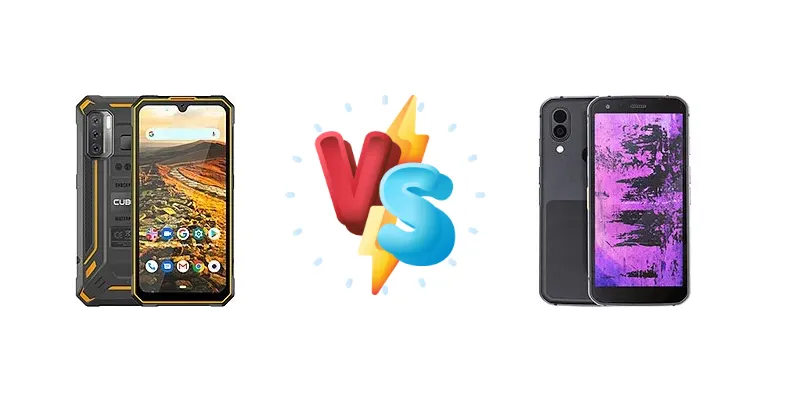
The rugged smartphone market caters to a specific user: those needing a device that can withstand drops, dust, and water. The Cubot KingKong 5 and Cat S62 Pro both aim to deliver this durability, but they differ significantly in their internal hardware. This comparison dissects those differences, focusing on how the chipset choices impact real-world performance and value.
🏆 Quick Verdict
For the average user prioritizing consistent performance and a more refined software experience, the Cat S62 Pro emerges as the better choice. While the Cubot KingKong 5 offers compelling value, the Snapdragon 660’s superior architecture and efficiency translate to smoother multitasking and a more responsive user interface.
| Network |
|---|
| 2G bands | GSM 850 / 900 / 1800 / 1900 | GSM 850 / 900 / 1800 / 1900 |
| 3G bands | HSDPA 900 / 2100 | HSDPA 850 / 900 / 1700(AWS) / 1900 / 2100 |
| 4G bands | 1, 3, 5, 7, 8, 19, 20, 40 | 1, 2, 3, 4, 5, 7, 8, 20, 28, 38, 40 |
| Speed | HSPA, LTE | HSPA 42.2/5.76 Mbps, LTE (2CA) Cat13 400/150 Mbps |
| Technology | GSM / HSPA / LTE | GSM / HSPA / LTE |
| Launch |
|---|
| Announced | 2022 | 2020, June 28. Released 2020, August 17 |
| Status | Available. Released 2022 | Discontinued |
| Body |
|---|
| Build | - | Glass front (Gorilla Glass 6), plastic back, aluminum frame |
| Dimensions | 160.3 x 78.6 x 15 mm (6.31 x 3.09 x 0.59 in) | 158.5 x 76.7 x 11.9 mm (6.24 x 3.02 x 0.47 in) |
| SIM | Nano-SIM + Nano-SIM | · Nano-SIM· Nano-SIM + Nano-SIM |
| Weight | - | 248 g (8.75 oz) |
| | - | IP68/IP69 dust/water resistant (up to 1.5m for 35 mins)
Drop-to-concrete resistance from up to 1.8m
MIL-STD-810H compliant |
| Display |
|---|
| Protection | - | Corning Gorilla Glass 6 |
| Resolution | 720 x 1560 pixels, 19.5:9 ratio (~286 ppi density) | 1080 x 2160 pixels, 18:9 ratio (~424 ppi density) |
| Size | 6.01 inches, 88.7 cm2 (~70.4% screen-to-body ratio) | 5.7 inches, 83.8 cm2 (~69.0% screen-to-body ratio) |
| Type | IPS LCD | IPS LCD |
| Platform |
|---|
| CPU | Octa-core (4x2.0 GHz Cortex-A53 & 4x1.5 GHz Cortex-A53) | Octa-core (4x2.2 GHz Kryo 260 Gold & 4x1.8 GHz Kryo 260 Silver) |
| Chipset | Mediatek MT6762 Helio P22 (12 nm) | Qualcomm SDM660 Snapdragon 660 (14 nm) |
| GPU | PowerVR GE8320 | Adreno 512 |
| OS | Android 11 | Android 10 |
| Memory |
|---|
| Card slot | microSDXC (uses shared SIM slot) | microSDXC (dedicated slot) |
| Internal | 32GB 4GB RAM | 128GB 6GB RAM |
| Main Camera |
|---|
| Dual | - | 12 MP, f/1.8, (wide), 1/2.55", 1.4µm, dual pixel PDAF
FLIR thermal camera (Lepton 3.5 module) |
| Features | LED flash | Thermal imaging, heat palettes, temp. spot meter, LED flash |
| Triple | 48 MP, (wide), AF
5 MP (macro), AF
Auxiliary lens | - |
| Video | Yes | 1080p@30fps, gyro-EIS |
| Selfie camera |
|---|
| Single | 8 MP | 8 MP |
| Video | Yes | 1080p@30fps |
| Sound |
|---|
| 3.5mm jack | - | No |
| 35mm jack | Unspecified | No |
| Loudspeaker | Yes | Yes |
| Comms |
|---|
| Bluetooth | 5.3, A2DP, LE | 5.0, A2DP, LE |
| NFC | Yes | Yes |
| Positioning | GPS, GLONASS, BDS | GPS, GLONASS, GALILEO, BDS |
| Radio | Unspecified | FM radio |
| USB | USB Type-C, OTG | USB Type-C 2.0, OTG |
| WLAN | Wi-Fi 802.11 a/b/g/n/ac, dual-band | Wi-Fi 802.11 a/b/g/n/ac, dual-band, Wi-Fi Direct |
| Features |
|---|
| Sensors | Fingerprint (rear-mounted), accelerometer, gyro, proximity, compass | Fingerprint (rear-mounted), accelerometer, gyro, proximity, compass |
| Battery |
|---|
| Type | 5000 mAh | Li-Ion 4000 mAh |
| Misc |
|---|
| Colors | Black | Black |
| Price | - | About 530 EUR |
Cubot KingKong 5
- Significantly lower price point
- Rugged design for demanding environments
- Potentially larger battery capacity (spec dependent)
- Inferior chipset performance
- Less responsive user interface
- Likely slower app loading times
Cat S62 Pro
- Superior chipset performance (Snapdragon 660)
- Smoother multitasking and app loading
- More efficient power management
- Higher price point
- May not offer significantly better battery life if capacity is low
- Rugged design may be bulkier
Display Comparison
Neither device boasts a cutting-edge display. Details on panel type (IPS vs AMOLED) and resolution are missing, but both likely target 720p+ resolutions given the price points. The key difference lies in the processing power driving the display. The Snapdragon 660’s more powerful GPU will likely result in smoother animations and transitions, even if the raw pixel count is similar. Bezels are expected to be substantial on both, prioritizing durability over a modern, edge-to-edge design.
Camera Comparison
Without detailed camera specs beyond the presence of cameras, a direct comparison is difficult. However, the Snapdragon 660’s image signal processor (ISP) is considerably more advanced than the one found in the Helio P22. This means the Cat S62 Pro will likely produce better image quality, particularly in challenging lighting conditions, with improved dynamic range and noise reduction. Expect the Cat S62 Pro to handle video recording with greater stability and detail. The presence of a dedicated ISP on the Snapdragon 660 also allows for more sophisticated image processing algorithms.
Performance
The core of the difference lies in the chipsets. The Cat S62 Pro’s Qualcomm Snapdragon 660 (14nm) is a significant step up from the Cubot KingKong 5’s MediaTek Helio P22 (12nm). While both are octa-core, the Snapdragon 660 utilizes Kryo 260 cores – a custom design offering superior performance per clock cycle compared to the Cortex-A53 cores in the Helio P22. The 660’s clock speeds (2.2 GHz Gold vs 2.0 GHz Cortex-A53) further emphasize this advantage. This translates to faster app loading times, smoother multitasking, and a more responsive overall experience on the Cat S62 Pro. The 14nm process node of the Snapdragon 660, while older, is generally more efficient than the 12nm node of the Helio P22, potentially leading to better sustained performance under load.
Battery Life
Battery capacity details are missing for both devices. However, the Snapdragon 660’s superior power efficiency will likely result in longer battery life for the Cat S62 Pro, even if the Cubot KingKong 5 has a slightly larger battery. The Snapdragon 660’s Quick Charge support (likely version 3.0) will also enable faster charging speeds compared to the Cubot KingKong 5, which may have slower charging capabilities. Real-world usage will dictate the actual battery life, but the chipset advantage favors the Cat S62 Pro.
Buying Guide
Buy the Cubot KingKong 5 if you need a highly affordable, extremely durable phone for basic tasks like communication, navigation, and occasional photography, and are willing to accept some performance limitations. Buy the Cat S62 Pro if you prioritize a smoother, more responsive user experience, better multitasking capabilities, and a more established brand reputation for ruggedized devices, even at a higher price point.
Frequently Asked Questions
❓ Will the Cubot KingKong 5 struggle with demanding apps like navigation or video editing?
Yes, the MediaTek Helio P22 is a budget-focused chipset. While it can handle basic tasks, demanding applications like real-time navigation with complex maps or video editing will likely experience lag and slowdowns. The Cat S62 Pro’s Snapdragon 660 is far better equipped for these workloads.
❓ Is the Snapdragon 660 in the Cat S62 Pro capable of playing modern mobile games?
The Snapdragon 660 can handle many modern mobile games at medium settings. However, graphically intensive titles may require reduced settings to maintain a smooth frame rate. The Helio P22 in the Cubot KingKong 5 will struggle with most modern games, requiring significant compromises in graphics quality and frame rate.
❓ How does the chipset affect the long-term software support for each device?
Qualcomm typically provides longer software support for its chipsets compared to MediaTek. This means the Cat S62 Pro is more likely to receive Android updates and security patches for a longer period, enhancing its longevity and security.