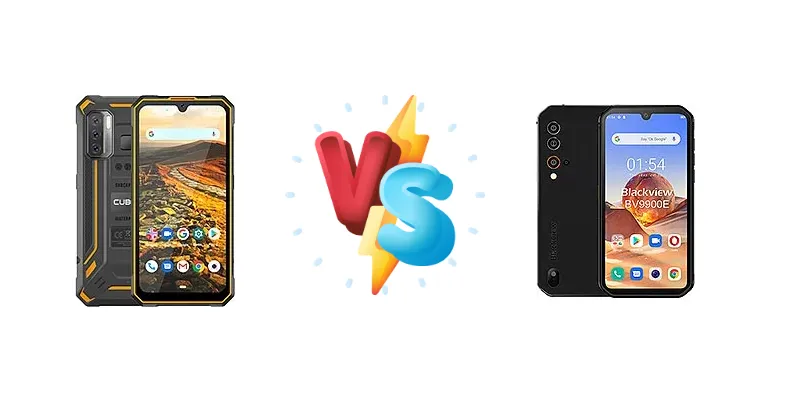
The rugged smartphone market caters to a specific need: durability. Both the Cubot KingKong 5 and Blackview BV9900E aim to deliver on that promise, but they diverge significantly in their internal hardware. This comparison dissects those differences, focusing on how the chipset choice impacts real-world performance and user experience.
🏆 Quick Verdict
For the average user prioritizing raw performance and future-proofing, the Blackview BV9900E is the clear winner. Its Helio P90 chipset provides a substantial leap in processing power over the KingKong 5’s Helio P22. However, the KingKong 5 remains a viable option for basic tasks and users on a tighter budget.
| Network |
|---|
| 2G bands | GSM 850 / 900 / 1800 / 1900 | GSM 850 / 900 / 1800 / 1900 |
| 3G bands | HSDPA 900 / 2100 | HSDPA 800 / 850 / 900 / 1700(AWS) / 1900 / 2100 |
| 4G bands | 1, 3, 5, 7, 8, 19, 20, 40 | 1, 2, 3, 4, 5, 7, 8, 12, 13, 17, 18, 19, 20, 25, 26, 28, 34, 38, 39, 40, 41, 66 |
| Speed | HSPA, LTE | HSPA, LTE |
| Technology | GSM / HSPA / LTE | GSM / CDMA / HSPA / CDMA2000 / LTE |
| Launch |
|---|
| Announced | 2022 | 2020, September 10. Released 2020, September |
| Status | Available. Released 2022 | Discontinued |
| Body |
|---|
| Dimensions | 160.3 x 78.6 x 15 mm (6.31 x 3.09 x 0.59 in) | 156.5 x 78.3 x 14.2 mm (6.16 x 3.08 x 0.56 in) |
| SIM | Nano-SIM + Nano-SIM | Nano-SIM + Nano-SIM |
| Weight | - | 273 g (9.63 oz) |
| Display |
|---|
| Protection | - | Corning Gorilla Glass 5 |
| Resolution | 720 x 1560 pixels, 19.5:9 ratio (~286 ppi density) | 1080 x 2280 pixels, 19:9 ratio (~432 ppi density) |
| Size | 6.01 inches, 88.7 cm2 (~70.4% screen-to-body ratio) | 5.84 inches, 85.1 cm2 (~69.5% screen-to-body ratio) |
| Type | IPS LCD | IPS LCD |
| Platform |
|---|
| CPU | Octa-core (4x2.0 GHz Cortex-A53 & 4x1.5 GHz Cortex-A53) | Octa-core (2x2.2 GHz Cortex-A75 & 6x2.0 GHz Cortex-A55) |
| Chipset | Mediatek MT6762 Helio P22 (12 nm) | Mediatek MT6779V/CE Helio P90 (12 nm) |
| GPU | PowerVR GE8320 | PowerVR GM9446 |
| OS | Android 11 | Android 10 |
| Memory |
|---|
| Card slot | microSDXC (uses shared SIM slot) | microSDXC |
| Internal | 32GB 4GB RAM | 128GB 6GB RAM |
| Main Camera |
|---|
| Features | LED flash | LED flash, HDR, panorama |
| Quad | - | 48 MP, f/1.8, (wide), PDAF
16 MP, 120˚ (ultrawide)
2 MP (macro)
Auxiliary lens |
| Triple | 48 MP, (wide), AF
5 MP (macro), AF
Auxiliary lens | - |
| Video | Yes | 4K@30fps, 1080p@60fps |
| Selfie camera |
|---|
| Single | 8 MP | 16 MP, f/2.0, (wide) |
| Video | Yes | 1080p@30fps |
| Sound |
|---|
| 35mm jack | Unspecified | No |
| Loudspeaker | Yes | Yes |
| Comms |
|---|
| Bluetooth | 5.3, A2DP, LE | 5.0, A2DP, LE |
| NFC | Yes | Yes |
| Positioning | GPS, GLONASS, BDS | GPS, GLONASS, GALILEO, BDS |
| Radio | Unspecified | FM radio |
| USB | USB Type-C, OTG | USB Type-C 2.0, OTG |
| WLAN | Wi-Fi 802.11 a/b/g/n/ac, dual-band | Wi-Fi 802.11 a/b/g/n/ac |
| Features |
|---|
| Sensors | Fingerprint (rear-mounted), accelerometer, gyro, proximity, compass | Fingerprint (side-mounted), accelerometer, gyro, proximity, compass, barometer |
| Battery |
|---|
| Charging | - | 15W wired
18W wireless |
| Type | 5000 mAh | 4380 mAh |
| Misc |
|---|
| Colors | Black | Black, Silver |
| Price | - | About 260 EUR |
Cubot KingKong 5
- Extremely affordable price point
- Rugged build quality for durability
- Suitable for basic communication tasks
- Weak processor performance
- Likely limited multitasking capabilities
- No wireless charging
Blackview BV9900E
- Significantly faster processor (Helio P90)
- Wireless charging support (18W)
- Improved image processing capabilities
- Higher price compared to the KingKong 5
- May have slightly shorter battery life depending on capacity
- Still a rugged phone, so aesthetics are secondary
Display Comparison
Neither device’s display specifications are provided, so a direct comparison is limited. However, given the price point of the KingKong 5, it likely features a lower-resolution panel and less accurate color reproduction than the BV9900E. The BV9900E, benefiting from a more powerful chipset, likely has a display controller capable of supporting higher refresh rates, though this isn’t confirmed. Bezels are expected to be substantial on both devices, typical of the rugged phone category, prioritizing protection over aesthetics.
Camera Comparison
Without detailed camera specifications, a precise comparison is difficult. However, the processing power of the Helio P90 in the BV9900E suggests superior image processing capabilities. The P90’s ISP (Image Signal Processor) can handle more complex algorithms for noise reduction, dynamic range optimization, and detail enhancement. While both phones likely feature multiple cameras, the BV9900E is more likely to deliver consistently better image quality, especially in challenging lighting conditions. The presence of a more powerful chipset also allows for faster image capture and processing speeds.
Performance
The core difference lies in the chipsets. The Cubot KingKong 5 utilizes the Mediatek MT6762 Helio P22, an entry-level SoC built on a 12nm process. Its octa-core CPU, comprised of four 2.0 GHz Cortex-A53 cores and four 1.5 GHz Cortex-A53 cores, is geared towards efficiency rather than speed. Conversely, the Blackview BV9900E boasts the Mediatek MT6779V/CE Helio P90, also on a 12nm process, but with a vastly superior CPU configuration: two 2.2 GHz Cortex-A75 cores and six 2.0 GHz Cortex-A55 cores. The Cortex-A75 cores represent a significant architectural improvement over the A53, delivering substantially higher single-core performance – crucial for responsiveness and app launch times. This translates to a smoother user experience and the ability to handle more demanding applications on the BV9900E.
Battery Life
Battery capacity isn’t specified for the KingKong 5, but rugged phones typically prioritize large batteries. The BV9900E offers both 15W wired and 18W wireless charging, a significant convenience feature absent on the KingKong 5. While a larger battery capacity on the KingKong 5 could offset the BV9900E’s faster charging, the P90’s efficiency could result in comparable real-world battery life despite potentially having a smaller battery. The wireless charging capability of the BV9900E adds a layer of usability for users who prefer cable-free charging.
Buying Guide
Buy the Cubot KingKong 5 if you need an extremely affordable, durable phone for essential communication – calls, texts, and light app usage. It’s ideal for construction workers or outdoor enthusiasts who prioritize a low-risk device. Buy the Blackview BV9900E if you prefer a rugged phone capable of handling demanding tasks like gaming, video editing, or running multiple apps simultaneously, and if wireless charging is a must-have feature.
Frequently Asked Questions
❓ Will the Blackview BV9900E handle demanding games like PUBG Mobile smoothly?
The Helio P90 chipset in the BV9900E is capable of running PUBG Mobile at medium to high settings. While it won't deliver flagship-level performance, the A75 cores provide a substantial boost over the KingKong 5’s P22, resulting in a more playable experience with fewer frame drops. However, sustained performance may be limited by thermal throttling.
❓ Is the difference in performance between the Helio P22 and Helio P90 noticeable for everyday tasks like browsing and social media?
Yes, the difference is quite noticeable. The Helio P90’s faster CPU cores and improved architecture result in snappier app launches, smoother scrolling, and a more responsive overall user experience. While the KingKong 5 can handle basic tasks, the BV9900E will feel significantly more fluid and efficient.
❓ Does the Blackview BV9900E's wireless charging significantly impact battery health over time?
Wireless charging generally generates more heat than wired charging, which *can* contribute to slightly faster battery degradation over the long term. However, the 18W wireless charging on the BV9900E is relatively moderate, and the impact is unlikely to be significant for most users. Using a quality wireless charger and avoiding overnight charging can further minimize any potential degradation.