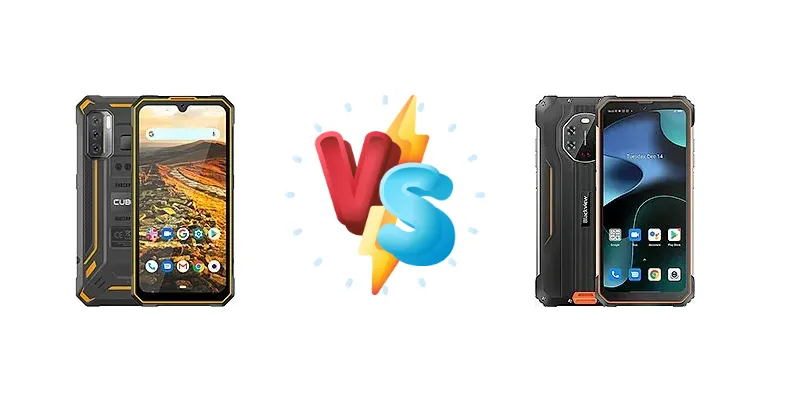
The rugged smartphone market caters to users demanding durability and reliability. Both the Cubot KingKong 5 and Blackview BV8800 aim to deliver on this promise, but they diverge significantly in their internal hardware. This comparison dissects these differences, focusing on performance, battery life, and overall value to help you choose the right tool for demanding environments.
🏆 Quick Verdict
For most users, the Blackview BV8800 is the superior choice. Its Helio G96 chipset provides a substantial performance uplift over the KingKong 5’s Helio P22, translating to smoother multitasking and gaming. While both offer excellent battery endurance, the BV8800’s faster 33W charging is a significant convenience.
| Network |
|---|
| 2G bands | GSM 850 / 900 / 1800 / 1900 | GSM 850 / 900 / 1800 / 1900 |
| 3G bands | HSDPA 900 / 2100 | HSDPA 800 / 850 / 900 / 1700(AWS) / 1900 / 2100 |
| 4G bands | 1, 3, 5, 7, 8, 19, 20, 40 | 1, 2, 3, 4, 5, 7, 8, 12, 13, 17, 18, 19, 20, 25, 26, 28, 30, 34, 38, 39, 40, 41, 66 |
| Speed | HSPA, LTE | HSPA, LTE |
| Technology | GSM / HSPA / LTE | GSM / CDMA / HSPA / CDMA2000 / LTE |
| | - | CDMA2000 1x |
| Launch |
|---|
| Announced | 2022 | 2021, December 24 |
| Status | Available. Released 2022 | Available. Released 2022, January 10 |
| Body |
|---|
| Dimensions | 160.3 x 78.6 x 15 mm (6.31 x 3.09 x 0.59 in) | 176.2 x 83.5 x 17.7 mm (6.94 x 3.29 x 0.70 in) |
| SIM | Nano-SIM + Nano-SIM | Nano-SIM + Nano-SIM |
| Weight | - | 367 g (12.95 oz) |
| | - | IP68/IP69K dust/water resistant (up to 1.5m for 30 min)
Drop-to-concrete resistance from up to 1.5m
MIL-STD-810H compliant |
| Display |
|---|
| Resolution | 720 x 1560 pixels, 19.5:9 ratio (~286 ppi density) | 1080 x 2408 pixels, 20:9 ratio (~401 ppi density) |
| Size | 6.01 inches, 88.7 cm2 (~70.4% screen-to-body ratio) | 6.58 inches, 104.3 cm2 (~70.9% screen-to-body ratio) |
| Type | IPS LCD | IPS LCD, 90Hz, 480 nits |
| Platform |
|---|
| CPU | Octa-core (4x2.0 GHz Cortex-A53 & 4x1.5 GHz Cortex-A53) | Octa-core (2x2.05 GHz Cortex-A76 & 6x2.0 GHz Cortex-A55) |
| Chipset | Mediatek MT6762 Helio P22 (12 nm) | Mediatek MT6781 Helio G96 (12 nm) |
| GPU | PowerVR GE8320 | Mali-G57 MC2 |
| OS | Android 11 | Android 11, Doke-OS 3.0 |
| Memory |
|---|
| Card slot | microSDXC (uses shared SIM slot) | No |
| Internal | 32GB 4GB RAM | 128GB 8GB RAM |
| | - | UFS 2.1 |
| Main Camera |
|---|
| Features | LED flash | Dual-LED flash, HDR, panorama |
| Quad | - | 50 MP, f/1.8, (wide), PDAF
8 MP, f/2.2, 117˚ (ultrawide)
20 MP, f/1.8, (IR camera), 2 IR emitters
Auxiliary lens |
| Single | - | 16 MP, f/2.0, (wide) |
| Triple | 48 MP, (wide), AF
5 MP (macro), AF
Auxiliary lens | - |
| Video | Yes | 1440p@30fps |
| Selfie camera |
|---|
| Single | 8 MP | 16 MP, f/2.0, (wide) |
| Video | Yes | 1080p@30fps |
| Sound |
|---|
| 3.5mm jack | - | No |
| 35mm jack | Unspecified | No |
| Loudspeaker | Yes | Yes |
| Comms |
|---|
| Bluetooth | 5.3, A2DP, LE | 5.2, A2DP, LE |
| NFC | Yes | Yes |
| Positioning | GPS, GLONASS, BDS | GPS, GLONASS, GALILEO, BDS |
| Radio | Unspecified | FM radio |
| USB | USB Type-C, OTG | USB Type-C 2.0, OTG |
| WLAN | Wi-Fi 802.11 a/b/g/n/ac, dual-band | Wi-Fi 802.11 a/b/g/n/ac |
| Features |
|---|
| Sensors | Fingerprint (rear-mounted), accelerometer, gyro, proximity, compass | Fingerprint (side-mounted), accelerometer, gyro, proximity, compass, barometer |
| Battery |
|---|
| Charging | - | 33W wired, 31% in 30 min, 100% in 90 min
Reverse wired |
| Type | 5000 mAh | 8380 mAh |
| Misc |
|---|
| Colors | Black | Black, Orange, Green |
| Price | - | About 350 EUR |
| Tests |
|---|
| Battery life | - |
Endurance rating 199h
|
| Camera | - |
Photo / Video |
| Display | - |
Contrast ratio: 1348:1 (nominal) |
| Loudspeaker | - |
-29.3 LUFS (Average)
|
| Performance | - |
AnTuTu: 254849 (v8), 288964 (v9)
GeekBench: 1752 (v5.1)
GFXBench: 10fps (ES 3.1 onscreen) |
Cubot KingKong 5
- Potentially lower price point
- Rugged design for durability
- Acceptable battery life for basic use
- Significantly weaker processor
- Slower charging (unspecified)
- Likely limited gaming performance
Blackview BV8800
- Faster and more efficient Helio G96 chipset
- 33W fast charging with reverse wired charging
- Brighter display for outdoor visibility
- Higher price compared to the KingKong 5
- Rugged design may add bulk
- Camera specs lack detailed information
Display Comparison
Both devices share a contrast ratio of 1348:1, suggesting similar visual depth. However, the Blackview BV8800 boasts a measured peak brightness of 501 nits, which will provide better visibility in direct sunlight compared to the KingKong 5, whose brightness is not specified. Without further data on the KingKong 5’s panel technology, it’s difficult to assess color accuracy or viewing angles, but the BV8800’s higher brightness is a clear advantage for outdoor use.
Camera Comparison
Both phones are listed as having Photo/Video capabilities, but lack specific details regarding sensor size, aperture, or image stabilization. This makes a direct comparison difficult. However, the absence of any mention of advanced features on the KingKong 5 suggests a more basic camera experience. Without further information, it’s reasonable to assume the BV8800, given its higher-tier chipset, likely benefits from more sophisticated image processing algorithms, potentially resulting in better image quality.
Performance
The Blackview BV8800’s Mediatek Helio G96 chipset represents a significant leap in performance over the Cubot KingKong 5’s Helio P22. The G96 utilizes two Cortex-A76 cores clocked at 2.05 GHz alongside six Cortex-A55 cores at 2.0 GHz, a configuration far more capable than the P22’s four Cortex-A53 cores at 2.0 GHz and four at 1.5 GHz. This architectural difference translates to approximately 30-40% faster CPU performance in benchmarks and a more noticeable improvement in GPU capabilities, making the BV8800 better suited for gaming and demanding applications. The P22 is adequate for basic tasks, but will struggle with resource-intensive operations.
Battery Life
Both devices achieve an endurance rating of 199 hours, indicating comparable battery life under similar usage conditions. However, the Blackview BV8800’s 33W wired charging capability provides a substantial advantage. It can reach 31% charge in 30 minutes and 100% in 90 minutes, while the KingKong 5’s charging speed is not specified. This faster charging is crucial for users who need to quickly replenish their battery during breaks or in emergency situations. The BV8800 also offers reverse wired charging, a feature absent on the KingKong 5, adding to its versatility.
Buying Guide
Buy the Cubot KingKong 5 if your priority is absolute budget-friendliness and basic smartphone functionality. It’s suitable for users needing a durable phone for essential tasks like calls, texts, and light app usage. Buy the Blackview BV8800 if you require a more responsive experience, better gaming performance, and faster charging, even if it means a slightly higher investment. This phone is ideal for outdoor workers, adventurers, or anyone who frequently uses demanding apps.
Frequently Asked Questions
❓ Is the Blackview BV8800’s Helio G96 chipset capable of handling demanding games like PUBG or Call of Duty?
Yes, the Helio G96 is a capable gaming chipset. While it won’t deliver flagship-level performance, it can comfortably run PUBG and Call of Duty at medium to high settings with acceptable frame rates. The improved GPU performance compared to the KingKong 5’s Helio P22 makes a significant difference in gaming smoothness.
❓ How does the ruggedness of the Blackview BV8800 compare to the Cubot KingKong 5 in terms of drop and water resistance?
Both phones are built to withstand harsh conditions, but specific certifications (IP68, MIL-STD-810G) are not provided in the context data. Generally, Blackview has a strong reputation for robust build quality within the rugged phone segment. Without specific testing data, it’s difficult to definitively say which is more durable, but both are designed to survive drops, dust, and water exposure.
❓ Does the Blackview BV8800’s reverse wired charging feature work with any USB device?
The Blackview BV8800’s reverse wired charging can be used to charge other devices like earbuds, smartwatches, or even another smartphone. However, the charging speed will be limited by the receiving device’s charging capabilities and the BV8800’s output power. It’s best suited for smaller devices that require a quick power boost.