
Cubot KingKong 11 vs. Ulefone Armor 9E: A Deep Dive into Rugged Smartphone Performance
| Phones Images | |||||
|---|---|---|---|---|---|
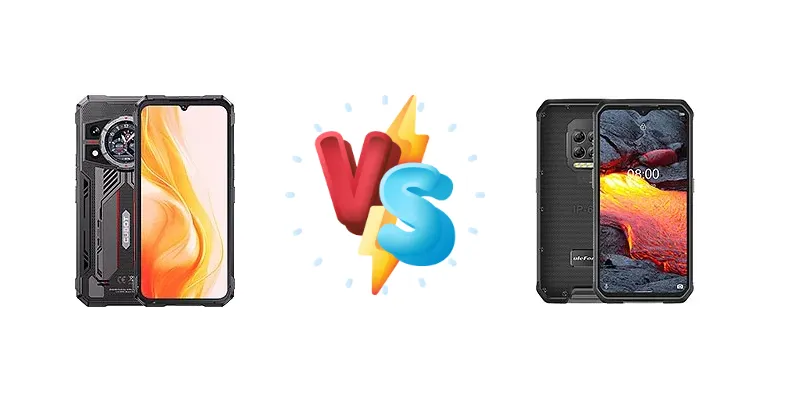
|
🏆 Quick Verdict
For most users, the Cubot KingKong 11 emerges as the superior choice. Its Mediatek Dimensity 7025 chipset, built on a 6nm process, provides a significant performance and efficiency advantage over the Ulefone Armor 9E’s 12nm Helio P90. The KingKong 11’s superior battery endurance and faster charging further solidify its position as the better all-around rugged device.
| PHONES | ||
|---|---|---|
| Phone Names | Cubot KingKong 11 | Ulefone Armor 9E |
| Network | ||
|---|---|---|
| 2G bands | GSM 850 / 900 / 1800 / 1900 | GSM 850 / 900 / 1800 / 1900 |
| 3G bands | HSDPA 800 / 850 / 900 / 1700(AWS) / 1900 / 2100 | HSDPA 850 / 900 / 1700(AWS) / 1900 / 2100 |
| 4G bands | 1, 2, 3, 4, 5, 7, 8, 12, 13, 17, 18, 19, 20, 25, 26, 28, 34, 38, 39, 40, 41, 66, 71 | 1, 2, 3, 4, 5, 7, 8, 12, 13, 17, 18, 19, 20, 25, 26, 28, 34, 38, 39, 40, 41, 66 |
| 5G bands | 1, 2, 3, 5, 7, 8, 20, 25, 28, 38, 40, 41, 66, 77, 78 SA/NSA | - |
| Speed | HSPA, LTE, 5G | HSPA 42.2/11.5 Mbps, LTE Cat12 600/150 Mbps |
| Technology | GSM / HSPA / LTE / 5G | GSM / CDMA / HSPA / EVDO / LTE |
| - | CDMA2000 1xEV-DO | |
| Launch | ||
|---|---|---|
| Announced | 2025, August | 2020, September 08. Released 2020, September 08 |
| Status | Available. Released 2025, August | Discontinued |
| Body | ||
|---|---|---|
| Build | - | Front glass, aluminum back with rubber, aluminum frame |
| Dimensions | 176 x 84.1 x 18.7 mm (6.93 x 3.31 x 0.74 in) | 168.2 x 82 x 15 mm (6.62 x 3.23 x 0.59 in) |
| SIM | Nano-SIM + Nano-SIM | Nano-SIM + Nano-SIM |
| Weight | - | 324 g (11.43 oz) |
| - | IP68/IP69K dust/water resistant (up to 1.5m for 30 min) Drop-to-concrete resistance from up to 1.2m MIL-STD-810G compliant | |
| Display | ||
|---|---|---|
| Protection | Mohs level 6 | Scratch-resistant glass, oleophobic coating |
| Resolution | 1080 x 2400 pixels, 20:9 ratio (~392 ppi density) | 1080 x 2340 pixels, 19.5:9 ratio (~409 ppi density) |
| Size | 6.72 inches, 109.0 cm2 (~73.7% screen-to-body ratio) | 6.3 inches, 97.4 cm2 (~70.6% screen-to-body ratio) |
| Type | IPS LCD, 120Hz | IPS LCD |
| Platform | ||
|---|---|---|
| CPU | Octa-core (2x2.5 GHz Cortex-A78 & 6x2.0 GHz Cortex-A55) | Octa-core (2x2.2 GHz Cortex-A75 & 6x2.0 GHz Cortex-A55) |
| Chipset | Mediatek Dimensity 7025 (6 nm) | Mediatek MT6779 Helio P90 (12 nm) |
| GPU | IMG BXM-8-256 | PowerVR GM9446 |
| OS | Android 15 | Android 10 |
| Memory | ||
|---|---|---|
| Card slot | microSDXC (uses shared SIM slot) | microSDXC (uses shared SIM slot) |
| Internal | 256GB 16GB RAM | 128GB 8GB RAM |
| - | UFS 2.1 | |
| Main Camera | ||
|---|---|---|
| Dual | 108 MP, (wide), PDAF 8 MP, (ultrawide), AF | - |
| Features | LED flash, dual infrared LED | Quad-LED flash, HDR, panorama |
| Quad | - | 64 MP, f/1.9, 26mm (wide), 1/1.72", 0.8µm, PDAF 8 MP, f/2.4, 100˚ (ultrawide), 1/4.0", 1.12µm 2 MP (macro) Auxiliary lens |
| Video | Yes | 4K@30fps, 1080p@30fps |
| Selfie camera | ||
|---|---|---|
| Features | - | HDR, panorama |
| Single | 32 MP | 8 MP, f/2.2 |
| Video | Yes | 1080p@30fps |
| Sound | ||
|---|---|---|
| 3.5mm jack | - | Yes |
| 35mm jack | No | Yes |
| Loudspeaker | Yes | Yes |
| Comms | ||
|---|---|---|
| Bluetooth | 5.1, A2DP, LE | 5.0, A2DP, LE |
| NFC | Yes | Yes |
| Positioning | GPS, GALILEO, GLONASS, BDS | GPS, GLONASS, GALILEO, BDS |
| Radio | Unspecified | FM radio, RDS, recording |
| USB | USB Type-C, OTG | USB Type-C 2.0, OTG, accessory connector |
| WLAN | Wi-Fi 802.11 a/b/g/n/ac, dual-band | Wi-Fi 802.11 a/b/g/n/ac, Wi-Fi Direct |
| Features | ||
|---|---|---|
| Sensors | Fingerprint (side-mounted), accelerometer, gyro, proximity, compass | Fingerprint (side-mounted), accelerometer, gyro, proximity, compass, coulombmeter |
| - | Endoscope mount (camera sold separately) | |
| Battery | ||
|---|---|---|
| Charging | 33W wired | 18W wired |
| Type | 10200 mAh | Li-Po 6600 mAh |
| Misc | ||
|---|---|---|
| Colors | Black | Black |
| Price | € 254.95 / $ 196.64 / £ 265.99 | About 290 EUR |
| EU LABEL | ||
|---|---|---|
| Battery | 40:46h endurance, 1400 cycles | - |
| Energy | Class G | - |
| Free fall | Class C (90 falls) | - |
| Repairability | Class C | - |
Cubot KingKong 11
- Superior performance with the Dimensity 7025 chipset
- Excellent battery endurance (40:46h)
- Faster 33W wired charging
- Potentially higher price point
- Rugged design may add bulk
Ulefone Armor 9E
- More affordable price
- Rugged design for durability
- Established Helio P90 platform
- Slower performance compared to the Dimensity 7025
- Slower 18W charging
Display Comparison
While display specifications aren't provided, both phones likely feature ruggedized LCD panels. However, the chipset difference suggests the KingKong 11 could potentially drive a higher resolution or refresh rate display without significant performance impact. The 6nm Dimensity 7025 is more efficient, leaving headroom for a more visually demanding screen. The Armor 9E’s older Helio P90 might struggle to maintain smooth performance with a high-resolution display.
Camera Comparison
Without specific camera details, it’s difficult to make a definitive comparison. However, the chipset advantage of the KingKong 11 suggests superior image signal processing (ISP) capabilities. A more powerful ISP can result in better noise reduction, dynamic range, and overall image quality. It’s reasonable to assume the KingKong 11 can handle more complex computational photography tasks. The Armor 9E’s Helio P90 ISP is older and less capable, potentially leading to less refined image processing.
Performance
The core difference lies in the chipsets. The Cubot KingKong 11’s Mediatek Dimensity 7025 (6nm) is a substantial upgrade over the Ulefone Armor 9E’s Helio P90 (12nm). The 6nm process node translates to significantly improved power efficiency and thermal management. The Dimensity 7025’s Cortex-A78 cores, clocked at 2.5 GHz, offer a performance boost over the Armor 9E’s 2.2 GHz Cortex-A75 cores. This means faster app loading, smoother multitasking, and a better gaming experience on the KingKong 11. The Armor 9E, while capable, will exhibit more noticeable slowdowns under heavy load.
Battery Life
The Cubot KingKong 11 boasts an impressive 40:46h endurance, coupled with 33W wired charging. This indicates a well-optimized power management system and faster replenishment. The Ulefone Armor 9E’s 18W charging is significantly slower, meaning longer downtime between uses. While the Armor 9E’s battery capacity isn’t specified, the KingKong 11’s endurance suggests a combination of efficient chipset and optimized software, allowing it to extract more usage from its battery.
Buying Guide
Buy the Cubot KingKong 11 if you prioritize sustained performance for demanding tasks like gaming or video editing, and value longer battery life with quicker charging. This phone is ideal for professionals working in the field or anyone who frequently uses their phone for resource-intensive applications. Buy the Ulefone Armor 9E if you are on a tighter budget and primarily need a durable phone for basic communication and light usage. It’s a viable option for those who prioritize ruggedness over raw power and aren’t concerned with the latest chipset technology.