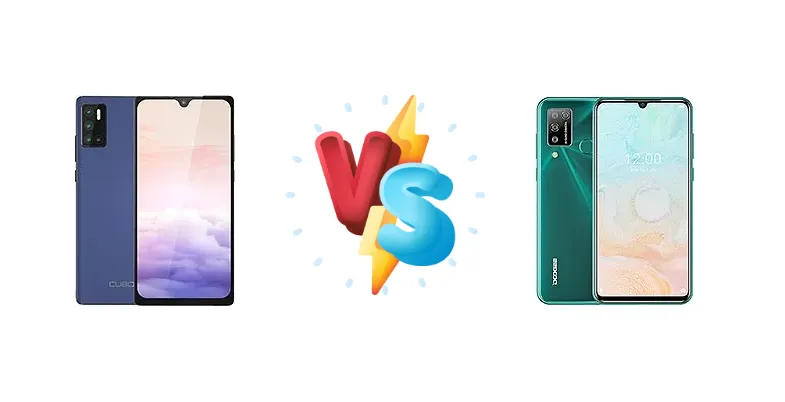
The Cubot J9 and Doogee N20 Pro represent two distinct approaches to the ultra-budget smartphone market. The J9 aims for rock-bottom pricing, while the N20 Pro attempts to offer a more modern experience with a more powerful chipset. This comparison dissects their key differences to determine which device delivers the best value for your money.
🏆 Quick Verdict
For most users, the Doogee N20 Pro is the superior choice. Its Helio P60 chipset provides a significantly smoother and more responsive experience than the Cubot J9’s aging MT6580. While the J9 is cheaper, the performance gap justifies the price difference for anyone beyond the most basic smartphone tasks.
| Network |
|---|
| 2G bands | GSM 850 / 900 / 1800 / 1900 | GSM 850 / 900 / 1800 / 1900 |
| 3G bands | HSDPA 900 / 2100 | HSDPA 850 / 900 / 2100 |
| 4G bands | - | 1, 3, 5, 7, 8, 19, 20 |
| Speed | HSPA | HSPA, LTE |
| Technology | GSM / HSPA | GSM / HSPA / LTE |
| Launch |
|---|
| Announced | 2020. Released 2020 | 2020, August 04. Released 2020, August |
| Status | Discontinued | Discontinued |
| Body |
|---|
| Dimensions | 156.2 x 74.6 x 9.4 mm (6.15 x 2.94 x 0.37 in) | 159 x 77.1 x 8.8 mm (6.26 x 3.04 x 0.35 in) |
| SIM | Nano-SIM + Nano-SIM | Nano-SIM + Nano-SIM |
| Weight | 185 g (6.53 oz) | 175 g (6.17 oz) |
| Display |
|---|
| Resolution | 720 x 1520 pixels, 19:9 ratio (~271 ppi density) | 1080 x 2280 pixels, 19:9 ratio (~400 ppi density) |
| Size | 6.2 inches, 95.9 cm2 (~82.3% screen-to-body ratio) | 6.3 inches, 99.1 cm2 (~80.8% screen-to-body ratio) |
| Type | IPS LCD | IPS LCD |
| Platform |
|---|
| CPU | Quad-core 1.3 GHz | Octa-core (4x2.0 GHz Cortex-A73 & 4x2.0 GHz Cortex-A53) |
| Chipset | Mediatek MT6580 (28 nm) | Mediatek MT6771V/CA Helio P60 (12 nm) |
| GPU | - | Mali-G72 MP3 |
| OS | Android 10 | Android 10 |
| Memory |
|---|
| Card slot | No | microSDXC (uses shared SIM slot) |
| Internal | 16GB 2GB RAM | 128GB 6GB RAM |
| Main Camera |
|---|
| Features | LED flash | LED flash |
| Quad | - | 16 MP, f/2.0, (wide), PDAF
8 MP, f/2.4, 130˚ (ultrawide)
2 MP (macro)
Auxiliary lens |
| Triple | 13 MP, (wide), AF
2 MP
0.3 MP | - |
| Video | Yes | 1080p |
| Selfie camera |
|---|
| Single | 8 MP | 16 MP, f/2.0, (wide) |
| Video | Yes | 1080p |
| Sound |
|---|
| 35mm jack | Yes | Yes |
| Loudspeaker | Yes | Yes |
| Comms |
|---|
| Bluetooth | 4.0, A2DP | 5.0, A2DP, LE |
| NFC | No | No |
| Positioning | GPS | GPS, GLONASS, BDS, GALILEO |
| Radio | Unspecified | FM radio |
| USB | USB Type-C | microUSB 2.0 |
| WLAN | Wi-Fi 802.11 b/g/n | Wi-Fi 802.11 a/b/g/n/ac, dual-band |
| Features |
|---|
| Sensors | Accelerometer, proximity | Fingerprint (rear-mounted), accelerometer, proximity |
| Battery |
|---|
| Charging | - | 10W wired |
| Type | 4200 mAh, removable | 4400 mAh |
| Misc |
|---|
| Colors | Blue, Black, Green | Gray, Purple, Forest |
| Price | - | About 170 EUR |
Cubot J9
- Lowest possible price point
- Potentially longer battery life due to less powerful chipset
- Simple and functional operating system
- Extremely limited performance
- Poor multitasking capabilities
- Outdated chipset architecture
Doogee N20 Pro
- Significantly faster performance with Helio P60
- More responsive user experience
- 10W wired charging for quicker top-ups
- Higher price than Cubot J9
- Potentially shorter battery life under heavy load
- May still struggle with demanding games
Display Comparison
Neither device boasts a standout display. Given the price points, details like panel type and resolution are not provided. However, the focus should be on usability. The N20 Pro’s more powerful GPU will likely translate to smoother scrolling and animations, even if the resolution is similar. Expect both to have basic LCD panels with adequate, but not exceptional, viewing angles.
Camera Comparison
Without detailed camera specifications, a direct comparison is difficult. However, it’s reasonable to assume both phones feature basic camera setups geared towards casual photography. The N20 Pro’s more powerful ISP (Image Signal Processor), integrated within the Helio P60, will likely result in better image processing, particularly in low-light conditions. Expect both to struggle with dynamic range and detail, but the N20 Pro should offer a slight edge in overall image quality. The presence of a 2MP macro lens on either device is largely a marketing gimmick and should not be a deciding factor.
Performance
The performance disparity is the most significant difference. The Cubot J9’s Mediatek MT6580, a quad-core processor built on a 28nm process, is demonstrably slower than the Doogee N20 Pro’s Helio P60. The P60’s octa-core configuration (4x2.0 GHz Cortex-A73 & 4x2.0 GHz Cortex-A53) and 12nm fabrication process deliver substantially improved multi-tasking and application launch speeds. The Cortex-A73 cores in the P60 provide a significant architectural advantage, offering better single-core performance crucial for responsive UI interactions. Users attempting even moderate gaming will find the J9 severely limited, while the N20 Pro can handle less demanding titles.
Battery Life
Battery capacity isn’t specified for either device, making a direct mAh comparison impossible. However, the Doogee N20 Pro’s 10W wired charging is a notable feature, suggesting a more modern charging implementation. The MT6580 in the Cubot J9 is less power-hungry, potentially leading to similar battery life despite a potentially smaller capacity. However, the P60’s more efficient architecture could offset this, especially during moderate usage. Real-world battery life will depend heavily on usage patterns, but the N20 Pro’s faster charging will be appreciated by users who need to quickly top up their device.
Buying Guide
Buy the Cubot J9 if you absolutely need the lowest possible price and only intend to use your phone for calls, texts, and very light browsing. It's a functional device for minimalists. Buy the Doogee N20 Pro if you want a phone capable of handling social media, streaming video, and occasional gaming without frustrating lag. The N20 Pro offers a far more versatile and enjoyable user experience.
Frequently Asked Questions
❓ Will the Doogee N20 Pro be able to run popular social media apps like TikTok and Instagram smoothly?
Yes, the Helio P60 chipset in the Doogee N20 Pro is more than capable of handling social media apps like TikTok and Instagram without significant lag. The octa-core processor and improved GPU will provide a much smoother experience compared to the Cubot J9’s MT6580.
❓ Is the Cubot J9 suitable for someone who primarily uses their phone for making calls and sending texts?
Absolutely. The Cubot J9 excels as a basic communication device. Its less powerful processor consumes less battery, potentially extending standby time. If your needs are limited to calls, texts, and very light browsing, the J9 is a functional and affordable option.
❓ Can the Doogee N20 Pro handle any mobile games?
The Doogee N20 Pro can handle less demanding mobile games, but don't expect high frame rates or graphics settings on titles like PUBG or Genshin Impact. It's suitable for casual gaming and older titles, but it's not a gaming powerhouse.
❓ What type of charging port does the Doogee N20 Pro use?
While the exact port type isn't specified, most phones in this price range utilize a Micro-USB port. The 10W wired charging capability indicates a standard charging implementation.