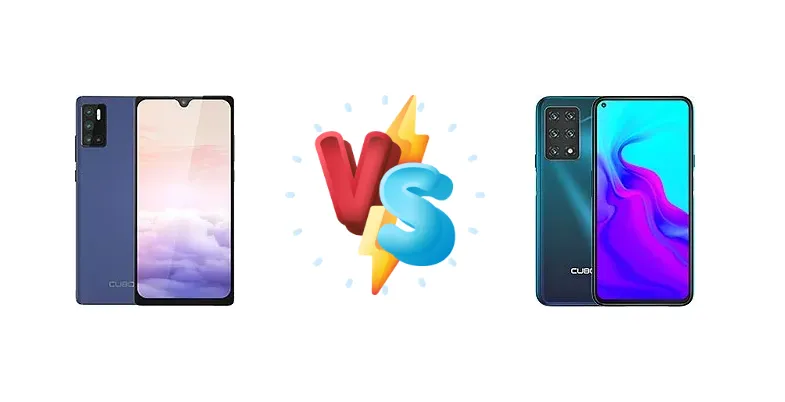
Cubot offers two compelling options in the ultra-budget smartphone space: the J9 and the X30. While both aim to deliver affordability, they differ significantly in their internal hardware. This comparison dissects those differences, focusing on how the X30’s more modern chipset impacts real-world performance and user experience compared to the J9’s older platform.
🏆 Quick Verdict
For most users, the Cubot X30 is the clear winner. Its Helio P60 chipset provides a substantial performance boost over the J9’s MT6580, enabling smoother multitasking and a more responsive user interface. While the J9 remains a viable option for basic tasks, the X30 offers a significantly improved experience for a relatively small price increase.
| Network |
|---|
| 2G bands | GSM 850 / 900 / 1800 / 1900 | GSM 850 / 900 / 1800 / 1900 |
| 3G bands | HSDPA 900 / 2100 | HSDPA 850 / 900 / 1700(AWS) / 1900 / 2100 |
| 4G bands | - | 1, 2, 3, 4, 5, 7, 8, 12, 13, 17, 18, 19, 20, 25, 26, 28, 38, 40, 41, 66 |
| Speed | HSPA | HSPA, LTE |
| Technology | GSM / HSPA | GSM / HSPA / LTE |
| Launch |
|---|
| Announced | 2020. Released 2020 | 2020. Released 2020 |
| Status | Discontinued | Discontinued |
| Body |
|---|
| Dimensions | 156.2 x 74.6 x 9.4 mm (6.15 x 2.94 x 0.37 in) | 157.1 x 76.4 x 8.5 mm (6.19 x 3.01 x 0.33 in) |
| SIM | Nano-SIM + Nano-SIM | Nano-SIM + Nano-SIM |
| Weight | 185 g (6.53 oz) | 193 g (6.81 oz) |
| Display |
|---|
| Resolution | 720 x 1520 pixels, 19:9 ratio (~271 ppi density) | 1080 x 2310 pixels (~398 ppi density) |
| Size | 6.2 inches, 95.9 cm2 (~82.3% screen-to-body ratio) | 6.4 inches, 101.4 cm2 (~84.5% screen-to-body ratio) |
| Type | IPS LCD | IPS LCD |
| Platform |
|---|
| CPU | Quad-core 1.3 GHz | Octa-core (4x2.0 GHz Cortex-A73 & 4x2.0 GHz Cortex-A53) |
| Chipset | Mediatek MT6580 (28 nm) | Mediatek MT6771 Helio P60 (12 nm) |
| GPU | - | Mali-G72 MP3 |
| OS | Android 10 | Android 10 |
| Memory |
|---|
| Card slot | No | microSDXC (uses shared SIM slot) |
| Internal | 16GB 2GB RAM | 128GB 8GB RAM, 256GB 8GB RAM |
| Main Camera |
|---|
| Features | LED flash | LED flash |
| Penta | - | 48 MP, (wide), 1/2.0", AF
16 MP, (ultrawide)
5 MP (macro)
Auxiliary lenses |
| Triple | 13 MP, (wide), AF
2 MP
0.3 MP | - |
| Video | Yes | Yes |
| Selfie camera |
|---|
| Single | 8 MP | 32 MP |
| Video | Yes | Yes |
| Sound |
|---|
| 35mm jack | Yes | Unspecified |
| Loudspeaker | Yes | Yes |
| Comms |
|---|
| Bluetooth | 4.0, A2DP | 4.2, A2DP |
| NFC | No | Yes |
| Positioning | GPS | GPS |
| Radio | Unspecified | Unspecified |
| USB | USB Type-C | USB Type-C, OTG |
| WLAN | Wi-Fi 802.11 b/g/n | Wi-Fi 802.11 a/b/g/n |
| Features |
|---|
| Sensors | Accelerometer, proximity | Fingerprint (side-mounted), accelerometer, gyro, proximity, compass |
| Battery |
|---|
| Type | 4200 mAh, removable | 4200 mAh |
| Misc |
|---|
| Colors | Blue, Black, Green | Blue, Black, Gradient Green |
Cubot J9
- Lowest possible price point
- Simple and easy to use
- Acceptable for basic communication
- Slow performance
- Limited multitasking capabilities
- Outdated chipset
Cubot X30
- Significantly faster performance
- More efficient processor for better battery life
- Improved multitasking capabilities
- Slightly higher price
- May still struggle with very demanding games
- Camera quality likely still limited by sensor
Display Comparison
Neither Cubot provides detailed display specifications. However, given their price points, both likely utilize IPS LCD panels. The X30 benefits indirectly from its more powerful chipset, potentially allowing for smoother animations and faster response times when interacting with the display. The J9, constrained by its processor, may exhibit noticeable lag during scrolling or transitions. Without knowing the resolution or brightness levels, it's difficult to assess image quality, but the X30’s processing power suggests a better overall visual experience.
Camera Comparison
Detailed camera specifications are unavailable. However, it’s reasonable to assume both phones feature basic camera setups geared towards casual photography. The X30’s Helio P60 includes an image signal processor (ISP) that is far more advanced than the one found in the MT6580. This ISP enables better noise reduction, dynamic range, and overall image quality, even with similar sensor hardware. While neither phone is likely to compete with flagship camera performance, the X30 will almost certainly produce more pleasing results, particularly in challenging lighting conditions. The presence of a dedicated ISP in the X30 allows for more sophisticated image processing algorithms.
Performance
The core difference lies in the chipsets. The Cubot J9’s Mediatek MT6580, built on a 28nm process, features a quad-core CPU clocked at 1.3 GHz. This is a relatively old architecture, designed for basic tasks. In contrast, the Cubot X30 boasts the Mediatek MT6771 Helio P60, fabricated on a more efficient 12nm process. Its octa-core configuration (4x2.0 GHz Cortex-A73 & 4x2.0 GHz Cortex-A53) delivers significantly higher processing power. The Cortex-A73 cores in the X30 provide a substantial uplift in single-core performance, crucial for app launch speeds and general responsiveness, while the A53 cores handle background tasks efficiently. This translates to a much smoother multitasking experience and the ability to run more demanding applications on the X30.
Battery Life
Battery capacity details are missing for both devices. However, the X30’s 12nm Helio P60 chipset is significantly more power-efficient than the J9’s 28nm MT6580. This means the X30 will likely achieve longer battery life on a single charge, even with a similar battery capacity. The more efficient processor reduces power draw during both active use and standby. While charging wattage is unknown, the X30’s chipset may also support faster charging technologies, further enhancing its usability.
Buying Guide
Buy the Cubot J9 if you need a phone for extremely basic communication – calls, texts, and light web browsing – and prioritize absolute minimum cost. It’s suitable for first-time smartphone users or as a temporary device. Buy the Cubot X30 if you prefer a more fluid and responsive experience, enjoy occasional gaming, or anticipate using multiple apps simultaneously. The X30’s octa-core processor and more efficient manufacturing process deliver a noticeable upgrade in usability.
Frequently Asked Questions
❓ Will the Cubot X30 handle popular games like PUBG Mobile?
While the Helio P60 isn't a gaming powerhouse, it's capable of running PUBG Mobile at medium settings with acceptable frame rates. Expect some occasional stuttering, especially in intense firefights. The J9’s MT6580 would struggle significantly with this title.
❓ Is the difference in performance between the J9 and X30 noticeable for everyday tasks like browsing and social media?
Yes, the difference is very noticeable. The X30’s octa-core processor and more efficient architecture result in significantly faster app launch times, smoother scrolling, and a more responsive overall experience when browsing the web or using social media apps. The J9 will feel sluggish in comparison.
❓ Does the Cubot X30 support 4G LTE connectivity?
Yes, the Helio P60 chipset includes an integrated 4G LTE modem, allowing the Cubot X30 to connect to 4G networks. The MT6580 in the J9 also supports 4G, but the X30’s more modern modem may offer slightly faster and more reliable connections.