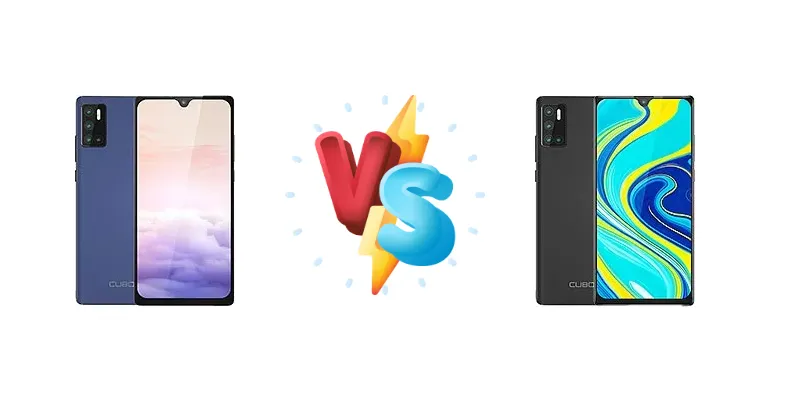
Cubot offers two compelling options in the ultra-budget smartphone space: the J9 and the P40. While both aim to deliver essential smartphone functionality at a low price, they differ significantly in their underlying hardware. This comparison dives deep into those differences, focusing on the impact of their respective chipsets on performance, efficiency, and overall user experience.
🏆 Quick Verdict
For most users, the Cubot P40 is the better choice. Its newer Mediatek Helio A22 chipset, built on a more efficient 12nm process, provides a noticeable performance boost over the J9’s older MT6580. While neither phone excels in any single area, the P40 offers a more modern and responsive experience.
| Network |
|---|
| 2G bands | GSM 850 / 900 / 1800 / 1900 | GSM 850 / 900 / 1800 / 1900 |
| 3G bands | HSDPA 900 / 2100 | HSDPA 900 / 2100 |
| 4G bands | - | 1, 3, 7, 8, 19, 20 |
| Speed | HSPA | HSPA, LTE |
| Technology | GSM / HSPA | GSM / HSPA / LTE |
| Launch |
|---|
| Announced | 2020. Released 2020 | 2020. Released 2020 |
| Status | Discontinued | Discontinued |
| Body |
|---|
| Dimensions | 156.2 x 74.6 x 9.4 mm (6.15 x 2.94 x 0.37 in) | 155 x 73 x 10 mm (6.10 x 2.87 x 0.39 in) |
| SIM | Nano-SIM + Nano-SIM | Nano-SIM + Nano-SIM |
| Weight | 185 g (6.53 oz) | 184 g (6.49 oz) |
| Display |
|---|
| Resolution | 720 x 1520 pixels, 19:9 ratio (~271 ppi density) | 720 x 1520 pixels, 19:9 ratio (~271 ppi density) |
| Size | 6.2 inches, 95.9 cm2 (~82.3% screen-to-body ratio) | 6.2 inches, 95.9 cm2 (~84.8% screen-to-body ratio) |
| Type | IPS LCD | IPS LCD |
| Platform |
|---|
| CPU | Quad-core 1.3 GHz | Quad-core 1.8 GHz Cortex-A53 |
| Chipset | Mediatek MT6580 (28 nm) | Mediatek MT6761 Helio A22 (12 nm) |
| GPU | - | PowerVR GE8320 |
| OS | Android 10 | Android 10 |
| Memory |
|---|
| Card slot | No | microSDXC |
| Internal | 16GB 2GB RAM | 128GB 4GB RAM |
| Main Camera |
|---|
| Features | LED flash | LED flash |
| Triple | 13 MP, (wide), AF
2 MP
0.3 MP | 12 MP, (wide), 1/2.9", PDAF
5 MP (macro)
Auxiliary lenses |
| Video | Yes | Yes |
| Selfie camera |
|---|
| Single | 8 MP | 20 MP |
| Video | Yes | Yes |
| Sound |
|---|
| 35mm jack | Yes | Unspecified |
| Loudspeaker | Yes | Yes |
| Comms |
|---|
| Bluetooth | 4.0, A2DP | 4.2, A2DP |
| NFC | No | Yes |
| Positioning | GPS | GPS |
| Radio | Unspecified | Unspecified |
| USB | USB Type-C | USB Type-C, OTG |
| WLAN | Wi-Fi 802.11 b/g/n | Wi-Fi 802.11 a/b/g/n |
| Features |
|---|
| Sensors | Accelerometer, proximity | Accelerometer, gyro, proximity, compass |
| Battery |
|---|
| Charging | - | 10W wired |
| Type | 4200 mAh, removable | 4200 mAh, removable |
| Misc |
|---|
| Colors | Blue, Black, Green | Blue, Black, Green |
Cubot J9
- Potentially lower price point
- Simple and straightforward operation
- May have slightly larger battery capacity (unconfirmed)
- Outdated and slow MT6580 chipset
- Less efficient 28nm process
- Poor multitasking performance
- Likely slower charging
Cubot P40
- More powerful and efficient Helio A22 chipset
- 12nm process for better battery life
- Smoother user experience
- 10W wired charging
- Slightly higher price
- Still a budget-level chipset
- Camera performance likely limited by sensor quality
Display Comparison
Neither Cubot provides detailed display specifications. However, given their price points, both likely utilize IPS LCD panels. The P40’s advantage isn’t in panel technology, but in the chipset’s ability to drive the display more efficiently. The J9’s older chipset may exhibit slight lag when scrolling or transitioning between apps, impacting perceived smoothness. Expect both to have similar color accuracy and viewing angles typical of budget displays.
Camera Comparison
Without detailed camera specs, a direct comparison is difficult. Both phones likely feature basic camera setups. Given the market segment, expect a primary sensor on both, potentially paired with a low-resolution depth or macro sensor. The P40’s more powerful chipset *could* enable slightly better image processing, resulting in marginally improved image quality, but the sensor itself will be the limiting factor. The usefulness of any 2MP macro lens on either device is questionable.
Performance
The core difference lies in the chipsets. The Cubot J9’s Mediatek MT6580, fabricated on a 28nm process, is a significantly older design. Its quad-core 1.3 GHz CPU is demonstrably slower than the Cubot P40’s Mediatek MT6761 Helio A22. The Helio A22, built on a 12nm process, offers improved power efficiency and a higher clock speed of 1.8 GHz with Cortex-A53 cores. This translates to faster app loading times, smoother multitasking, and a more responsive user interface on the P40. The 12nm process also generates less heat, potentially reducing thermal throttling during sustained use.
Battery Life
Battery capacity isn’t specified for either device. However, the P40’s more efficient Helio A22 chipset will undoubtedly result in longer battery life. While the J9 might have a slightly larger battery, the power-hungry MT6580 will drain it faster. The P40 also supports 10W wired charging, which, while slow by modern standards, is likely faster than any charging solution offered on the J9, contributing to quicker top-ups.
Buying Guide
Buy the Cubot J9 if you prioritize absolute lowest cost and only need a phone for very basic tasks like calls, texts, and light web browsing. Its older chipset will struggle with demanding apps. Buy the Cubot P40 if you want a more fluid user experience, even for moderate multitasking, and appreciate the benefits of a more power-efficient processor, even if it means spending a little more.
Frequently Asked Questions
❓ Will the Cubot P40 be able to handle popular social media apps like Facebook and Instagram without significant lag?
Yes, the Helio A22 chipset in the P40 is capable of running most popular social media apps smoothly. While it won’t offer a flagship-level experience, it provides a noticeable improvement over the J9’s MT6580, which may struggle with these apps, especially when multitasking.
❓ Is the 10W charging on the Cubot P40 slow compared to other smartphones?
Yes, 10W charging is relatively slow by today’s standards. Expect a full charge to take around 2-3 hours. However, it’s likely faster than the charging speed on the Cubot J9, and the P40’s more efficient chipset means you won’t need to charge it as frequently.
❓ Can the Cubot J9 run modern mobile games like PUBG Mobile or Call of Duty Mobile?
The Cubot J9’s MT6580 chipset is not powerful enough to run PUBG Mobile or Call of Duty Mobile at playable frame rates. Even at the lowest settings, you’ll likely experience significant lag and stuttering. The P40 might be able to run these games at very low settings, but performance will still be limited.