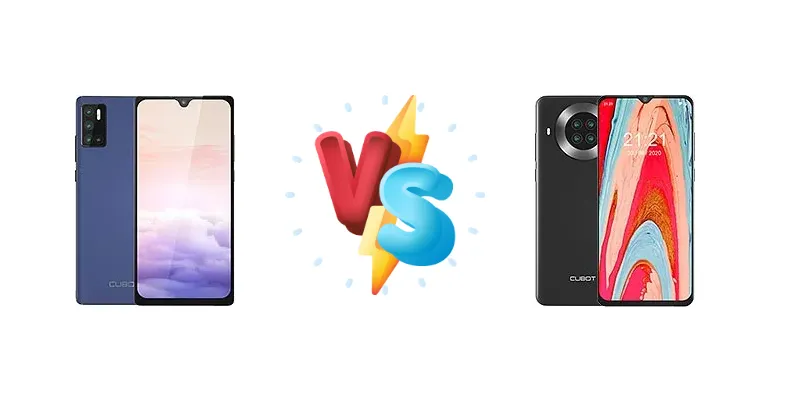
Cubot offers two compelling options in the ultra-budget smartphone space: the J9 and the Note 20 Pro. While both aim to deliver affordability, they differ significantly in their internal hardware. This comparison dissects those differences, focusing on how the chipset impacts real-world performance and user experience, helping you determine which device best suits your needs.
🏆 Quick Verdict
For most users, the Cubot Note 20 Pro is the superior choice. Its Helio P60 chipset provides a substantial performance uplift over the J9’s MT6580, enabling smoother multitasking and a more responsive user interface. While the J9 offers basic functionality, the Note 20 Pro delivers a noticeably improved experience for a relatively small price increase.
| Network |
|---|
| 2G bands | GSM 850 / 900 / 1800 / 1900 | GSM 850 / 900 / 1800 / 1900 |
| 3G bands | HSDPA 900 / 2100 | HSDPA 900 / 2100 |
| 4G bands | - | 1, 3, 7, 8, 19, 20 |
| Speed | HSPA | HSPA, LTE |
| Technology | GSM / HSPA | GSM / HSPA / LTE |
| Launch |
|---|
| Announced | 2020. Released 2020 | 2020. Released 2020 |
| Status | Discontinued | Discontinued |
| Body |
|---|
| Dimensions | 156.2 x 74.6 x 9.4 mm (6.15 x 2.94 x 0.37 in) | 162.8 x 75.4 x 9.1 mm (6.41 x 2.97 x 0.36 in) |
| SIM | Nano-SIM + Nano-SIM | Nano-SIM + Nano-SIM |
| Weight | 185 g (6.53 oz) | 200 g (7.05 oz) |
| Display |
|---|
| Resolution | 720 x 1520 pixels, 19:9 ratio (~271 ppi density) | 720 x 1600 pixels, 20:9 ratio (~270 ppi density) |
| Size | 6.2 inches, 95.9 cm2 (~82.3% screen-to-body ratio) | 6.5 inches, 102.0 cm2 (~83.1% screen-to-body ratio) |
| Type | IPS LCD | IPS LCD |
| Platform |
|---|
| CPU | Quad-core 1.3 GHz | Octa-core (4x2.0 GHz Cortex-A73 & 4x2.0 GHz Cortex-A53) |
| Chipset | Mediatek MT6580 (28 nm) | Mediatek MT6771 Helio P60 (12 nm) |
| GPU | - | Mali-G72 MP3 |
| OS | Android 10 | Android 10 |
| Memory |
|---|
| Card slot | No | microSDXC (dedicated slot) |
| Internal | 16GB 2GB RAM | 128GB 8GB RAM |
| Main Camera |
|---|
| Features | LED flash | LED flash |
| Quad | - | 12 MP, (wide), 1/2.9", AF
20 MP, (depth), 1/2.78"
Auxiliary lenses |
| Triple | 13 MP, (wide), AF
2 MP
0.3 MP | - |
| Video | Yes | Yes |
| Selfie camera |
|---|
| Single | 8 MP | 8 MP |
| Video | Yes | Yes |
| Sound |
|---|
| 35mm jack | Yes | Yes |
| Loudspeaker | Yes | Yes |
| Comms |
|---|
| Bluetooth | 4.0, A2DP | 4.2, A2DP |
| NFC | No | Yes |
| Positioning | GPS | GPS |
| Radio | Unspecified | Unspecified |
| USB | USB Type-C | microUSB, OTG |
| WLAN | Wi-Fi 802.11 b/g/n | Wi-Fi 802.11 a/b/g/n |
| Features |
|---|
| Sensors | Accelerometer, proximity | Accelerometer, gyro, proximity, compass |
| Battery |
|---|
| Type | 4200 mAh, removable | 4200 mAh, removable |
| Misc |
|---|
| Colors | Blue, Black, Green | Black, Blue, Green |
Cubot J9
- Lowest possible price point
- Potentially longer battery life during basic use (due to less powerful processor)
- Simple and easy to use for basic tasks
- Extremely limited performance
- Struggles with multitasking and modern apps
- Poor gaming performance
Cubot Note 20 Pro
- Significantly faster performance
- Smoother multitasking and app responsiveness
- Better gaming capabilities
- More power-efficient chipset
- Slightly higher price
- Potentially shorter battery life under heavy load (though offset by efficiency)
- May require more frequent software updates
Display Comparison
Details regarding the displays of both devices are unavailable. However, given the price points, it's reasonable to assume both utilize IPS LCD panels. The Note 20 Pro's more powerful chipset *could* support a higher resolution or refresh rate, but this is speculative. The J9 likely prioritizes power efficiency, potentially resulting in a slightly longer battery life during video playback, while the Note 20 Pro may offer a sharper image if it has a higher resolution panel.
Camera Comparison
Camera specifications beyond the presence of cameras are unavailable. However, given the market segment, it’s likely both devices feature basic camera setups. The Note 20 Pro’s more powerful image signal processor (ISP) within the Helio P60 chipset *could* offer improved image processing, resulting in better dynamic range and noise reduction compared to the J9. The P60’s ability to handle more complex algorithms could also enable features like HDR mode, which are unlikely to be present on the J9. Any claims of high megapixel counts should be viewed with skepticism, as sensor size and image processing quality are far more important.
Performance
The core difference lies in the chipsets. The Cubot J9’s Mediatek MT6580, built on a 28nm process, features a quad-core CPU clocked at 1.3 GHz. This is a very basic processor designed for minimal tasks. Conversely, the Cubot Note 20 Pro boasts the Mediatek Helio P60 (MT6771), fabricated on a more efficient 12nm process. Its octa-core configuration (4x2.0 GHz Cortex-A73 & 4x2.0 GHz Cortex-A53) delivers significantly higher performance. The Cortex-A73 cores in the P60 provide a substantial boost in single-core performance, crucial for app responsiveness, while the additional cores improve multitasking capabilities. This translates to faster app loading times, smoother scrolling, and the ability to run more demanding applications on the Note 20 Pro.
Battery Life
Battery capacity details are missing for both devices. However, the Helio P60’s 12nm process is more power-efficient than the MT6580’s 28nm process. This means the Note 20 Pro is likely to achieve comparable or better battery life despite potentially having a similar or even smaller battery capacity. The P60 also supports faster charging technologies, which, if implemented in the Note 20 Pro, would significantly reduce charging times compared to the J9.
Buying Guide
Buy the Cubot J9 if you need a truly basic smartphone for essential tasks like calls, texts, and light web browsing, and prioritize absolute minimum cost. It's suitable for users who rarely use apps or demand minimal performance. Buy the Cubot Note 20 Pro if you want a more versatile device capable of handling social media, streaming video, and light gaming without significant lag. It’s the better option for anyone who wants a more modern smartphone experience.
Frequently Asked Questions
❓ Will the Cubot Note 20 Pro handle popular social media apps like TikTok and Instagram smoothly?
Yes, the Helio P60 chipset in the Note 20 Pro is capable of running TikTok and Instagram without significant lag or stuttering. The octa-core processor and improved GPU provide sufficient power for these applications, offering a much smoother experience than the J9’s MT6580.
❓ Is the Cubot J9 suitable for playing mobile games like PUBG Mobile or Call of Duty Mobile?
No, the Cubot J9’s MT6580 chipset is not powerful enough to run PUBG Mobile or Call of Duty Mobile at playable frame rates. Even on the lowest settings, you’ll likely experience significant lag and stuttering. The Note 20 Pro, while not a gaming powerhouse, will offer a far more tolerable experience.
❓ Does the Cubot Note 20 Pro support fast charging?
While the exact charging wattage isn't specified, the Helio P60 chipset supports fast charging technologies. Whether Cubot implemented this feature in the Note 20 Pro is unknown, but it's a possibility that would give it a significant advantage over the J9 in terms of charging speed.
❓ How much storage does each phone have, and can it be expanded?
Storage details are unavailable. However, given the price point, both devices likely offer limited internal storage (e.g., 16GB or 32GB). It's highly probable that both support microSD card expansion, allowing you to increase storage capacity.