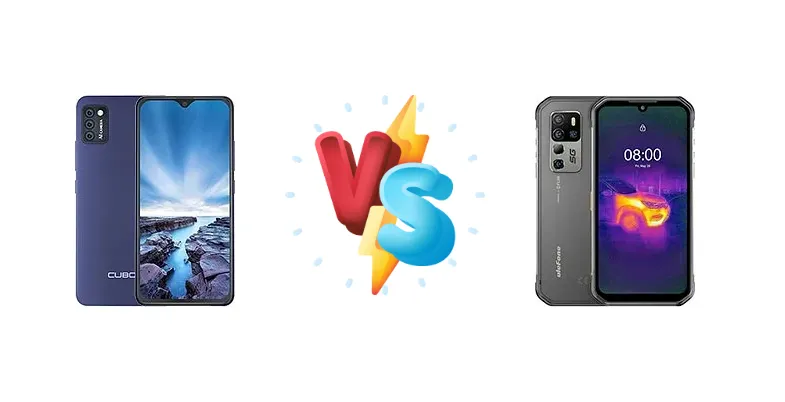
The smartphone market caters to diverse needs, from those prioritizing affordability to those demanding cutting-edge performance. The Cubot J8 represents the ultra-budget segment, while the Ulefone Armor 11T 5G aims to deliver 5G connectivity and improved processing power without breaking the bank. This comparison dissects the core differences between these two devices, helping you determine which best suits your requirements.
🏆 Quick Verdict
For the average user prioritizing responsiveness and future-proofing, the Ulefone Armor 11T 5G is the clear winner. Its Dimensity 800 chipset provides a substantial performance advantage over the Cubot J8’s aging MT6580. However, the Cubot J8 remains a viable option for those on an extremely tight budget with basic smartphone needs.
| Network |
|---|
| 2G bands | GSM 850 / 900 / 1800 / 1900 | GSM 850 / 900 / 1800 / 1900 |
| 3G bands | HSDPA 900 / 2100 | HSDPA 850 / 900 / 1700(AWS) / 1900 / 2100 |
| 4G bands | - | 1, 2, 3, 4, 5, 7, 8, 12, 13, 17, 18, 19, 20, 25, 26, 28, 34, 38, 39, 40, 41, 66 |
| 5G bands | - | 1, 3, 5, 8, 20, 28, 38, 41, 77, 78, 79 SA/NSA |
| Speed | HSPA | HSPA, LTE, 5G |
| Technology | GSM / HSPA | GSM / CDMA / HSPA / EVDO / LTE / 5G |
| | - | CDMA2000 1xEV-DO |
| Launch |
|---|
| Announced | 2020. Released 2020 | 2021, May 29 |
| Status | Discontinued | Available. Released 2021, June 07 |
| Body |
|---|
| Build | - | Front glass, aluminum back with rubber, aluminum frame |
| Dimensions | 135 x 63 x 11 mm (5.31 x 2.48 x 0.43 in) | 163.8 x 81.6 x 14.2 mm (6.45 x 3.21 x 0.56 in) |
| SIM | Nano-SIM + Nano-SIM | Nano-SIM + Nano-SIM |
| Weight | 144 g (5.08 oz) | 293 g (10.34 oz) |
| | - | IP69K dust/water resistant (up to 1.5m for 30 min)
Drop-to-concrete resistance from up to 1.2m
MIL-STD-810G compliant |
| Display |
|---|
| Protection | - | Oleophobic coating |
| Resolution | 442 x 960 pixels, 19.5:9 ratio (~192 ppi density) | 720 x 1560 pixels, 19.5:9 ratio (~282 ppi density) |
| Size | 5.5 inches, 74.1 cm2 (~87.2% screen-to-body ratio) | 6.1 inches, 91.3 cm2 (~68.3% screen-to-body ratio) |
| Type | IPS LCD | IPS LCD |
| Platform |
|---|
| CPU | Quad-core 1.3 GHz | Octa-core (4x2.0 GHz Cortex-A76 & 4x2.0 GHz Cortex-A55) |
| Chipset | Mediatek MT6580 (28 nm) | Mediatek Dimensity 800 (7 nm) |
| GPU | - | Mali-G57 MP4 |
| OS | Android 10 | Android 11 |
| Memory |
|---|
| Card slot | No | No |
| Internal | 16GB 2GB RAM | 256GB 8GB RAM |
| | - | UFS 2.1 |
| Main Camera |
|---|
| Features | LED flash | Dual-LED dual-tone flash, HDR, panorama |
| Penta | - | 48 MP, f/1.8, 26mm (wide), 1/2.0", 0.8µm, PDAF
FLIR thermal camera (Lepton module)
5 MP
2 MP (macro)
Auxiliary lens |
| Single | - | 16 MP, f/2.0 |
| Triple | 13 MP, (wide), AF
0.3 MP
third unspecified camera | - |
| Video | Yes | 4K@30fps, 1080p@30fps |
| Selfie camera |
|---|
| Features | - | HDR, panorama |
| Single | 8 MP | 16 MP, f/2.0 |
| Video | Yes | 1080p@30fps |
| Sound |
|---|
| 3.5mm jack | - | Yes |
| 35mm jack | Yes | Yes |
| Loudspeaker | Yes | Yes |
| Comms |
|---|
| Bluetooth | 4.2, A2DP | 5.0, A2DP, LE |
| NFC | No | Yes |
| Positioning | GPS | GPS, GLONASS, GALILEO, BDS |
| Radio | Unspecified | FM radio, RDS, recording |
| USB | Yes | USB Type-C 2.0, OTG |
| WLAN | Wi-Fi 802.11 a/b/g/n | Wi-Fi 802.11 a/b/g/n/ac, Wi-Fi Direct |
| Features |
|---|
| Sensors | Accelerometer, proximity | Fingerprint (side-mounted), accelerometer, gyro, proximity, compass, baroceptor |
| Battery |
|---|
| Charging | - | 18W wired
10W wireless |
| Type | 3100 mAh, removable | Li-Po 5200 mAh |
| Misc |
|---|
| Colors | Black, Red, Blue, Green | Black |
| Price | - | About 590 EUR |
Cubot J8
- Extremely affordable price point
- Simple and easy-to-use interface
- Potentially longer battery life due to less demanding hardware
- Significantly slower performance
- Outdated chipset and architecture
- Limited camera capabilities
- No 5G connectivity
Ulefone Armor 11T 5G
- Fast 5G connectivity
- Powerful Dimensity 800 processor
- Wireless charging support
- Improved camera performance
- Ruggedized design for enhanced durability
- Higher price compared to the Cubot J8
- Potentially shorter battery life under heavy load
- Rugged design may add bulk
Display Comparison
Neither device boasts a standout display. Given the context data, we can assume the Cubot J8 utilizes a basic LCD panel, likely with a 720p resolution, typical for its price point. The Ulefone Armor 11T 5G, while likely also LCD, benefits from a more robust processor capable of handling higher resolutions and refresh rates, though specifics aren't provided. The Armor 11T’s ruggedized design may also necessitate a thicker glass cover, potentially impacting clarity. Color accuracy and viewing angles will likely be superior on the Armor 11T due to the more modern chipset’s image processing capabilities.
Camera Comparison
Without detailed camera specifications, a direct comparison is challenging. However, given the price difference, the Ulefone Armor 11T 5G likely features a more capable camera system. While both may include multiple lenses, the Armor 11T’s image signal processor (ISP), integrated within the Dimensity 800, will offer superior image processing, resulting in better dynamic range, noise reduction, and overall image quality. Expect the Cubot J8 to rely heavily on software processing, which may introduce artifacts and limitations. The presence of a 5G modem on the Ulefone also suggests better video recording capabilities.
Performance
The performance gap is the most significant differentiator. The Cubot J8’s Mediatek MT6580, built on a 28nm process, is a quad-core processor designed for basic functionality. It will struggle with demanding applications and multitasking. Conversely, the Ulefone Armor 11T 5G’s Dimensity 800, fabricated on a 7nm process, is an octa-core powerhouse. The Cortex-A76 cores provide a substantial uplift in CPU performance, while the integrated Mali-G52 MC4 GPU delivers a far superior gaming experience. The 7nm process also translates to improved power efficiency and reduced thermal throttling compared to the older 28nm MT6580.
Battery Life
Battery life is a complex equation. While the Cubot J8 may have a larger mAh capacity (speculation based on market segment), the Ulefone Armor 11T 5G’s more efficient 7nm Dimensity 800 chipset will likely offset any capacity difference. Furthermore, the Armor 11T 5G offers both 18W wired and 10W wireless charging, providing greater convenience and flexibility. The Cubot J8 likely relies solely on slower wired charging, extending the time required to reach a full charge.
Buying Guide
Buy the Cubot J8 if you need a functional smartphone for essential tasks like calls, texts, and light social media, and your budget is under $100. Buy the Ulefone Armor 11T 5G if you prioritize faster performance for gaming, streaming, and multitasking, and require 5G connectivity for improved data speeds, even if it means spending more.
Frequently Asked Questions
❓ Will the Ulefone Armor 11T 5G overheat during prolonged gaming sessions?
The Dimensity 800's 7nm process and the Ulefone Armor 11T 5G's likely thermal design should mitigate overheating. While some warmth is expected during intensive tasks, the chipset is designed for sustained performance and should avoid significant throttling compared to the Cubot J8's older processor.
❓ Is the 5G connectivity on the Ulefone Armor 11T 5G worth the extra cost if I don't have 5G coverage in my area?
Even without immediate 5G access, the Ulefone Armor 11T 5G's 5G modem offers future-proofing. The modem also supports 4G LTE, and the more advanced modem technology can sometimes improve 4G performance as well. However, if 5G is unavailable and unlikely to become available soon, the Cubot J8's affordability might be a more sensible choice.
❓ Can the Cubot J8 handle popular social media apps like Facebook and Instagram without significant lag?
The Cubot J8 can run basic social media apps, but expect a less fluid experience compared to the Ulefone Armor 11T 5G. Loading times will be longer, and multitasking between apps will likely result in noticeable lag. The MT6580 is simply not designed for demanding applications.