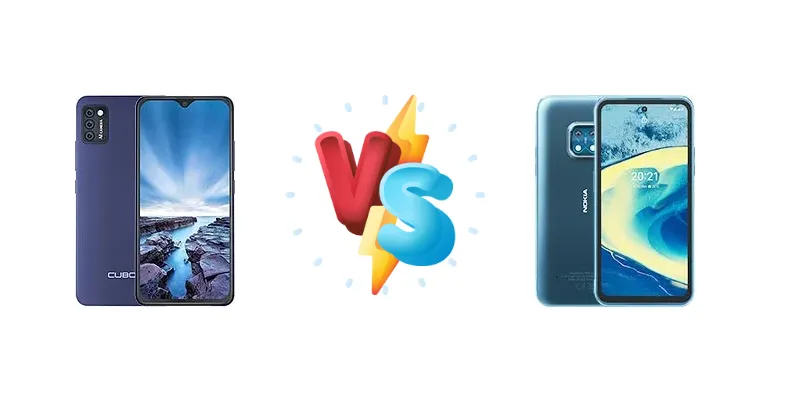
The smartphone market is flooded with options, but finding the right balance between price and performance can be challenging. We pit the Cubot J8, a budget-focused device, against the Nokia XR20, a rugged and 5G-enabled contender, to determine which offers the best value for your money. This comparison focuses on the core hardware differences and their real-world implications.
🏆 Quick Verdict
For the average user, the Nokia XR20 is the clear winner. Its Qualcomm Snapdragon 480 5G chipset delivers significantly faster performance and 5G connectivity, justifying the price difference over the Cubot J8’s aging Mediatek MT6580. While the J8 is cheaper, the XR20 provides a smoother, more future-proof experience.
| Network |
|---|
| 2G bands | GSM 850 / 900 / 1800 / 1900 | GSM 850 / 900 / 1800 / 1900 |
| 3G bands | HSDPA 900 / 2100 | HSDPA 850 / 900 / 1700(AWS) / 1900 / 2100 |
| 4G bands | - | 1, 2, 3, 4, 5, 7, 8, 12, 13, 14, 20, 25, 26, 28, 30, 38, 40, 41, 48, 66, 71 |
| 5G bands | - | 2, 5, 25, 38, 41, 48, 66, 77, 78 SA/NSA |
| Speed | HSPA | HSPA, LTE, 5G |
| Technology | GSM / HSPA | GSM / CDMA / HSPA / EVDO / LTE / 5G |
| | - | CDMA2000 1xEV-DO |
| Launch |
|---|
| Announced | 2020. Released 2020 | 2021, July 27 |
| Status | Discontinued | Available. Released 2021, August 04 |
| Body |
|---|
| Dimensions | 135 x 63 x 11 mm (5.31 x 2.48 x 0.43 in) | 171.6 x 81.5 x 10.6 mm (6.76 x 3.21 x 0.42 in) |
| SIM | Nano-SIM + Nano-SIM | · Nano-SIM· Nano-SIM + Nano-SIM |
| Weight | 144 g (5.08 oz) | 248 g (8.75 oz) |
| | - | IP68 dust/water resistant (up to 1.5m for 60 min)
Drop-to-concrete resistance from up to 1.8m
MIL-STD-810H compliant |
| Display |
|---|
| Protection | - | Corning Gorilla Glass Victus |
| Resolution | 442 x 960 pixels, 19.5:9 ratio (~192 ppi density) | 1080 x 2400 pixels, 20:9 ratio (~395 ppi density) |
| Size | 5.5 inches, 74.1 cm2 (~87.2% screen-to-body ratio) | 6.67 inches, 107.4 cm2 (~76.8% screen-to-body ratio) |
| Type | IPS LCD | IPS LCD, 550 nits |
| Platform |
|---|
| CPU | Quad-core 1.3 GHz | Octa-core (2x2.0 GHz Kryo 460 & 6x1.8 GHz Kryo 460) |
| Chipset | Mediatek MT6580 (28 nm) | Qualcomm SM4350 Snapdragon 480 5G (8 nm) |
| GPU | - | Adreno 619 |
| OS | Android 10 | Android 11, upgradable to Android 13 |
| Memory |
|---|
| Card slot | No | microSDXC (uses shared SIM slot) |
| Internal | 16GB 2GB RAM | 64GB 4GB RAM, 128GB 6GB RAM |
| Main Camera |
|---|
| Dual | - | 48 MP, f/1.8, (wide), 1/2.25", 0.8µm, PDAF
13 MP, f/2.4, 123˚ (ultrawide), 1/3.0", 1.12µm |
| Features | LED flash | Zeiss optics, Dual-LED dual-tone flash, second LED flash, HDR, panorama |
| Single | - | 8 MP, f/2.0 (wide), 1/4.0", 1.12µm |
| Triple | 13 MP, (wide), AF
0.3 MP
third unspecified camera | - |
| Video | Yes | 1080p@30fps |
| Selfie camera |
|---|
| Single | 8 MP | 8 MP, f/2.0 (wide), 1/4.0", 1.12µm |
| Video | Yes | 1080p@30fps |
| Sound |
|---|
| 3.5mm jack | - | Yes |
| 35mm jack | Yes | Yes |
| Loudspeaker | Yes | Yes, with stereo speakers |
| Comms |
|---|
| Bluetooth | 4.2, A2DP | 5.1, A2DP, LE, aptX Adaptive |
| NFC | No | Yes |
| Positioning | GPS | GPS (L1+L5), GLONASS, BDS, GALILEO, QZSS, NavIC |
| Radio | Unspecified | Unspecified |
| USB | Yes | USB Type-C 3.0 |
| WLAN | Wi-Fi 802.11 a/b/g/n | Wi-Fi 802.11 a/b/g/n/ac/6, dual-band, Wi-Fi Direct |
| Features |
|---|
| Sensors | Accelerometer, proximity | Fingerprint (side-mounted), accelerometer, gyro, proximity, compass, barometer |
| Battery |
|---|
| Charging | - | 18W wired
15W wireless |
| Type | 3100 mAh, removable | Li-Po 4630 mAh |
| Misc |
|---|
| Colors | Black, Red, Blue, Green | Ultra Blue, Granite Gray |
| Models | - | TA-1368, TA-1362 |
| Price | - | About 270 EUR |
| SAR EU | - | 1.13 W/kg (head) 1.43 W/kg (body) |
Cubot J8
- Lowest possible price point
- Sufficient for basic tasks
- Lightweight and compact (likely)
- Outdated processor
- Poor performance for demanding apps
- Limited 5G support
- Likely slower charging
Nokia XR20
- 5G connectivity
- Faster and more efficient processor
- Wireless charging support
- More durable build quality (Nokia reputation)
- Better software support
- Higher price
- May be bulkier due to rugged design
- Potentially less battery life than a larger capacity budget phone
Display Comparison
Neither device's display specifications are provided, so a direct comparison is limited. However, given the XR20's higher price point, it likely features a higher-quality panel with better color accuracy and brightness. The Cubot J8, targeting the ultra-budget segment, likely utilizes a lower-cost display. The XR20's potential for higher peak brightness would be beneficial for outdoor visibility.
Camera Comparison
Without detailed camera specifications, a precise comparison is difficult. However, the XR20’s higher price suggests a more capable camera system. The MT6580’s ISP (Image Signal Processor) is less advanced than the one found in the Snapdragon 480, resulting in lower image quality, especially in low-light conditions. The XR20 likely benefits from more sophisticated image processing algorithms and potentially larger sensor sizes, leading to better dynamic range and detail. We can assume the XR20 will offer a more versatile and higher-quality photography experience.
Performance
The performance gap between these two devices is substantial. The Cubot J8’s Mediatek MT6580, built on a 28nm process, features a quad-core CPU clocked at 1.3 GHz. This is a significantly older architecture. In contrast, the Nokia XR20 boasts the Qualcomm SM4350 Snapdragon 480 5G, fabricated on a more efficient 8nm process, and equipped with an octa-core CPU (2x2.0 GHz Kryo 460 & 6x1.8 GHz Kryo 460). The 8nm process translates to better thermal efficiency, reducing throttling during sustained tasks. The XR20’s octa-core configuration provides a considerable advantage in multitasking and demanding applications. Users will experience noticeably faster app loading times and smoother performance on the XR20.
Battery Life
Battery capacity isn't specified for either device. However, the Nokia XR20’s 18W wired and 15W wireless charging capabilities provide a significant convenience advantage. The Cubot J8 likely supports slower charging speeds. While a larger battery capacity on the J8 could offset the slower charging, the XR20’s charging options allow for quicker top-ups, crucial for users on the go. The 8nm Snapdragon 480 is also more power-efficient, potentially contributing to longer battery life despite a potentially similar capacity.
Buying Guide
Buy the Cubot J8 if you absolutely need the lowest possible price and only require basic smartphone functionality like calls, texts, and light social media use. Its Mediatek MT6580 is sufficient for these tasks. Buy the Nokia XR20 if you prioritize 5G connectivity, smoother multitasking, better gaming performance, and a more durable build quality. The XR20 is ideal for users who need a reliable phone that can withstand daily wear and tear and offers a longer software support lifespan.
Frequently Asked Questions
❓ Is the Snapdragon 480 in the Nokia XR20 powerful enough for modern mobile games?
The Snapdragon 480 is capable of running many popular mobile games, but it's not a flagship-level gaming chip. Expect to play most titles at medium settings. The Cubot J8’s MT6580 will struggle with even less demanding games, experiencing significant lag and frame drops.
❓ How does the Nokia XR20's ruggedness compare to standard smartphones?
The Nokia XR20 is built to withstand drops, dust, and water (IP68 rated). It features a reinforced chassis and Gorilla Glass Victus. The Cubot J8, being a budget device, likely lacks these protective features and is more susceptible to damage from everyday use.
❓ Will the Nokia XR20 receive long-term software updates?
Nokia is known for providing excellent software support. The XR20 is guaranteed at least three years of security updates and two major Android OS upgrades, ensuring your phone remains secure and up-to-date. The Cubot J8 is unlikely to receive the same level of long-term support.
❓ Is the Mediatek MT6580 in the Cubot J8 sufficient for basic social media and communication?
Yes, the MT6580 can handle basic tasks like browsing social media, making calls, and sending texts without significant issues. However, expect slower loading times and occasional lag when switching between apps. It's not ideal for multitasking or demanding applications.