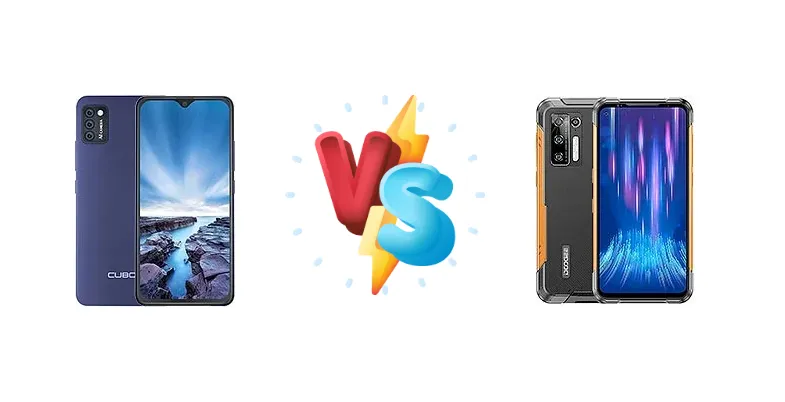
The Cubot J8 and Doogee S97 Pro represent vastly different approaches to the budget smartphone market. The J8 aims for affordability with a basic feature set, while the S97 Pro attempts to deliver a more robust experience, particularly in performance, with a focus on gaming and faster charging. This comparison dissects the core differences to help you determine which device aligns with your needs.
🏆 Quick Verdict
For the average user prioritizing smooth multitasking and gaming, the Doogee S97 Pro is the clear winner. Its Helio G95 chipset offers a substantial performance leap over the Cubot J8’s aging MT6580. While the J8 is cheaper, the S97 Pro’s added features and power justify the price difference for anyone beyond the most basic usage.
| Network |
|---|
| 2G bands | GSM 850 / 900 / 1800 / 1900 | GSM 850 / 900 / 1800 / 1900 |
| 3G bands | HSDPA 900 / 2100 | HSDPA 800 / 850 / 900 / 1700(AWS) / 1900 / 2100 |
| 4G bands | - | 1, 2, 3, 4, 5, 7, 8, 12, 13, 17, 18, 19, 20, 25, 26, 28, 38, 40, 66 |
| Speed | HSPA | HSPA, LTE |
| Technology | GSM / HSPA | GSM / HSPA / LTE |
| Launch |
|---|
| Announced | 2020. Released 2020 | 2021, April |
| Status | Discontinued | Available. Released 2021, April |
| Body |
|---|
| Dimensions | 135 x 63 x 11 mm (5.31 x 2.48 x 0.43 in) | 170.2 x 83.6 x 16.2 mm (6.70 x 3.29 x 0.64 in) |
| SIM | Nano-SIM + Nano-SIM | Nano-SIM + Nano-SIM |
| Weight | 144 g (5.08 oz) | - |
| Display |
|---|
| Protection | - | Corning Gorilla Glass |
| Resolution | 442 x 960 pixels, 19.5:9 ratio (~192 ppi density) | 720 x 1560 pixels, 19.5:9 ratio (~269 ppi density) |
| Size | 5.5 inches, 74.1 cm2 (~87.2% screen-to-body ratio) | 6.39 inches, 100.2 cm2 (~70.4% screen-to-body ratio) |
| Type | IPS LCD | IPS LCD |
| Platform |
|---|
| CPU | Quad-core 1.3 GHz | Octa-core (2x2.0 GHz Cortex-A76 & 6x2.0 GHz Cortex-A55) |
| Chipset | Mediatek MT6580 (28 nm) | Mediatek MT6785V/CD Helio G95 (12 nm) |
| GPU | - | Mali-G76 MC4 |
| OS | Android 10 | Android 11 |
| Memory |
|---|
| Card slot | No | microSDXC (uses shared SIM slot) |
| Internal | 16GB 2GB RAM | 128GB 8GB RAM |
| Main Camera |
|---|
| Features | LED flash | Quad-LED flash, HDR, panorama |
| Triple | 13 MP, (wide), AF
0.3 MP
third unspecified camera | 48 MP, f/1.8, (wide), PDAF
8 MP, f/2.2, 130˚, (ultrawide)
2 MP (macro)
Auxiliary lens |
| Video | Yes | 1080p |
| Selfie camera |
|---|
| Single | 8 MP | 16 MP, f/2.0, (wide) |
| Video | Yes | 1080p |
| Sound |
|---|
| 35mm jack | Yes | Unspecified |
| Loudspeaker | Yes | Yes |
| Comms |
|---|
| Bluetooth | 4.2, A2DP | 5.0, A2DP, LE |
| NFC | No | Yes |
| Positioning | GPS | GPS, GLONASS, BDS, GALILEO |
| Radio | Unspecified | FM radio |
| USB | Yes | USB Type-C 2.0, OTG |
| WLAN | Wi-Fi 802.11 a/b/g/n | Wi-Fi 802.11 a/b/g/n/ac, dual-band |
| Features |
|---|
| Sensors | Accelerometer, proximity | Fingerprint (side-mounted), accelerometer, gyro, proximity, compass, laser rangefinder |
| Battery |
|---|
| Charging | - | 33W wired
10W wireless |
| Type | 3100 mAh, removable | 8500 mAh |
| Misc |
|---|
| Colors | Black, Red, Blue, Green | Black, Orange, Red |
| Price | - | About 300 EUR |
Cubot J8
- Extremely affordable price point
- Potentially longer battery life due to less powerful processor
- Simple and easy-to-use interface
- Very slow performance with modern apps
- Outdated chipset and architecture
- Likely poor camera quality
Doogee S97 Pro
- Significantly faster performance with the Helio G95
- 33W fast charging and 10W wireless charging
- More capable camera system
- Higher price compared to the Cubot J8
- Potentially shorter battery life due to more powerful processor
- May require more frequent software updates
Display Comparison
Neither device's display specifications are provided, so a direct comparison is limited. However, given the J8's target market, it likely features a lower-resolution panel with standard LCD technology. The S97 Pro, positioned higher, may include a higher resolution and potentially improved color accuracy. The absence of details like refresh rate or peak brightness suggests both are focused on cost-effectiveness rather than display excellence.
Camera Comparison
Without detailed camera specifications, a precise comparison is difficult. However, it’s reasonable to assume the Doogee S97 Pro, being the more premium device, will feature a superior camera system. The S97 Pro likely benefits from a larger sensor and more advanced image processing capabilities, resulting in better low-light performance and overall image quality. The J8 likely relies on a basic camera setup suitable for casual snapshots. The presence of a 2MP macro lens on either device is unlikely to significantly impact image quality, serving primarily as a marketing feature.
Performance
The performance disparity is the most significant difference. The Cubot J8’s Mediatek MT6580, a 28nm quad-core processor, is several generations old and struggles with demanding tasks. In contrast, the Doogee S97 Pro boasts the MediaTek Helio G95 (12nm), an octa-core CPU featuring a combination of Cortex-A76 and Cortex-A55 cores. This architecture, coupled with the newer 12nm process, delivers significantly improved CPU and GPU performance. The G95’s higher clock speeds (2.0 GHz) and core count translate to smoother app launches, faster multitasking, and a more enjoyable gaming experience. The J8 will likely exhibit noticeable lag and slowdowns with even moderately intensive apps.
Battery Life
Battery capacity isn't specified for either device. However, the Doogee S97 Pro’s 33W wired and 10W wireless charging capabilities are a major advantage. This allows for significantly faster charging times compared to the J8, which likely supports only standard 5W or 10W charging. Even if the J8 has a slightly larger battery capacity, the S97 Pro’s faster charging will minimize downtime. The convenience of wireless charging is also exclusive to the S97 Pro.
Buying Guide
Buy the Cubot J8 if you need a very inexpensive phone for calls, texts, and light social media use, and battery life is paramount. You're willing to accept significant performance limitations. Buy the Doogee S97 Pro if you prefer a phone capable of handling modern apps, moderate gaming, and benefit from faster charging, even if it means spending a bit more. You value responsiveness and future-proofing.
Frequently Asked Questions
❓ Will the Doogee S97 Pro handle demanding games like PUBG or Call of Duty Mobile?
The Helio G95 in the Doogee S97 Pro is capable of running PUBG and Call of Duty Mobile at medium settings with reasonable frame rates. While it won't deliver a flagship gaming experience, it provides a significantly smoother and more enjoyable gaming experience compared to the Cubot J8's MT6580, which would struggle with these titles.
❓ Is the Cubot J8 suitable for someone who primarily uses their phone for calls, texts, and WhatsApp?
Yes, the Cubot J8 is perfectly adequate for basic communication tasks like calls, texts, and WhatsApp. Its limitations become apparent with more demanding applications, but for essential functions, it will perform reliably. The J8's strength lies in its affordability and simplicity.
❓ How long does it take to fully charge the Doogee S97 Pro with the 33W charger?
With the included 33W charger, the Doogee S97 Pro should charge from 0% to 100% in approximately 1 hour and 30 minutes to 2 hours, depending on usage during charging. This is a substantial improvement over the slower charging speeds expected on the Cubot J8.