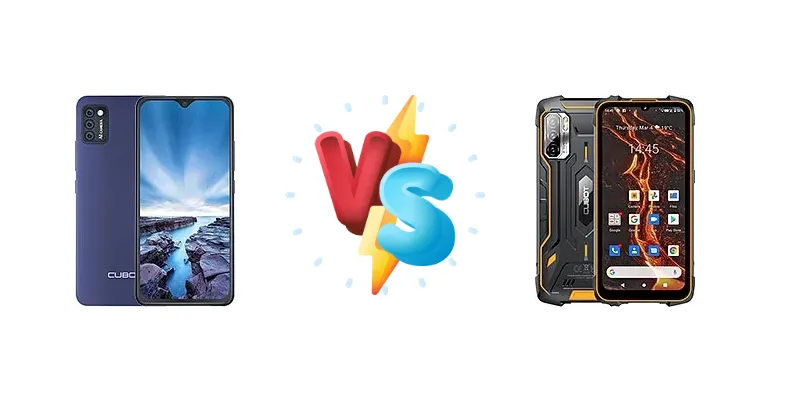
Cubot offers two distinct approaches to the budget smartphone market: the streamlined J8 and the ruggedized KingKong 5 Pro. While both aim for affordability, they diverge significantly in their internal hardware. This comparison dissects the core differences – specifically the chipset – to determine which device best suits your needs, from basic daily tasks to light gaming.
🏆 Quick Verdict
For most users, the Cubot KingKong 5 Pro is the superior choice. Its Helio P22 chipset delivers a substantially faster and more responsive experience than the J8’s aging MT6580, making it better suited for multitasking and modern app usage. The rugged build is a bonus for those prone to drops.
| Network |
|---|
| 2G bands | GSM 850 / 900 / 1800 / 1900 | GSM 850 / 900 / 1800 / 1900 |
| 3G bands | HSDPA 900 / 2100 | HSDPA 850 / 900 / 1700(AWS) / 1900 / 2100 |
| 4G bands | - | 1, 2, 3, 4, 5, 7, 8, 12, 13, 17, 18, 19, 20, 25, 26, 28, 38, 40, 41, 66 |
| Speed | HSPA | HSPA, LTE |
| Technology | GSM / HSPA | GSM / HSPA / LTE |
| Launch |
|---|
| Announced | 2020. Released 2020 | 2021 |
| Status | Discontinued | Available. Released 2021 |
| Body |
|---|
| Dimensions | 135 x 63 x 11 mm (5.31 x 2.48 x 0.43 in) | 165.8 x 81.4 x 18.8 mm (6.53 x 3.20 x 0.74 in) |
| SIM | Nano-SIM + Nano-SIM | Nano-SIM + Nano-SIM |
| Weight | 144 g (5.08 oz) | 319 g (11.25 oz) |
| Display |
|---|
| Resolution | 442 x 960 pixels, 19.5:9 ratio (~192 ppi density) | 720 x 1560 pixels, 19.5:9 ratio (~286 ppi density) |
| Size | 5.5 inches, 74.1 cm2 (~87.2% screen-to-body ratio) | 6.01 inches, 88.7 cm2 (~65.7% screen-to-body ratio) |
| Type | IPS LCD | IPS LCD |
| Platform |
|---|
| CPU | Quad-core 1.3 GHz | Octa-core (4x2.0 GHz Cortex-A53 & 4x1.5 GHz Cortex-A53) |
| Chipset | Mediatek MT6580 (28 nm) | Mediatek MT6762D Helio P22 (12 nm) |
| GPU | - | PowerVR GE8320 |
| OS | Android 10 | Android 11 |
| Memory |
|---|
| Card slot | No | microSDXC (uses shared SIM slot) |
| Internal | 16GB 2GB RAM | 64GB 4GB RAM |
| Main Camera |
|---|
| Features | LED flash | LED flash |
| Triple | 13 MP, (wide), AF
0.3 MP
third unspecified camera | 48 MP, (wide), AF
5 MP (macro), AF
Auxiliary lens |
| Video | Yes | Yes |
| Selfie camera |
|---|
| Single | 8 MP | 25 MP |
| Video | Yes | Yes |
| Sound |
|---|
| 35mm jack | Yes | Unspecified |
| Loudspeaker | Yes | Yes, with stereo speakers |
| Comms |
|---|
| Bluetooth | 4.2, A2DP | 5.0, A2DP, LE |
| NFC | No | Yes |
| Positioning | GPS | GPS, GLONASS, BDS |
| Radio | Unspecified | Unspecified |
| USB | Yes | USB Type-C, OTG |
| WLAN | Wi-Fi 802.11 a/b/g/n | Wi-Fi 802.11 a/b/g/n/ac, dual-band |
| Features |
|---|
| Sensors | Accelerometer, proximity | Fingerprint (rear-mounted), accelerometer, gyro, proximity, compass |
| Battery |
|---|
| Type | 3100 mAh, removable | 8000 mAh |
| Misc |
|---|
| Colors | Black, Red, Blue, Green | Black |
Cubot J8
- Extremely affordable
- Simple and functional
- Lightweight
- Outdated chipset
- Slow performance
- Limited multitasking capabilities
Cubot KingKong 5 Pro
- Significantly faster performance
- More efficient chipset
- Ruggedized design for durability
- Higher price point
- Potentially bulkier due to ruggedization
- May not have the latest software features
Display Comparison
Neither device boasts a standout display. Given the price point, details like peak brightness and color accuracy are likely to be average. However, the KingKong 5 Pro’s chipset allows for potentially smoother animations and faster app loading, indirectly improving the perceived display experience. We expect both to utilize IPS LCD panels, but the KingKong 5 Pro’s GPU will handle UI rendering more efficiently.
Camera Comparison
Without detailed camera specs, it’s difficult to make a definitive judgment. However, the KingKong 5 Pro’s more powerful chipset allows for more sophisticated image processing. This could result in better dynamic range, noise reduction, and overall image quality, even with similar sensor sizes. The J8’s limited processing power will likely constrain its camera’s capabilities. We anticipate both phones will include a standard macro lens, but its utility will be limited by the overall camera system.
Performance
The core difference lies in the chipsets. The Cubot J8’s Mediatek MT6580, built on a 28nm process, features a quad-core CPU clocked at 1.3 GHz. This is a significantly older architecture. In contrast, the KingKong 5 Pro utilizes the Mediatek MT6762D Helio P22, fabricated on a more efficient 12nm process, and boasts an octa-core CPU (4x2.0 GHz Cortex-A53 & 4x1.5 GHz Cortex-A53). This translates to a substantial performance advantage for the KingKong 5 Pro, particularly in multitasking and demanding applications. The P22’s more modern architecture and higher clock speeds will result in faster app launch times and smoother overall operation. The 12nm process also contributes to better thermal management, reducing the likelihood of throttling under sustained load.
Battery Life
Battery life will depend heavily on usage patterns. While the mAh capacity isn’t specified, the KingKong 5 Pro’s 12nm chipset is more power-efficient than the J8’s 28nm chip. This means the KingKong 5 Pro will likely deliver comparable or better battery life despite potentially having a similar battery capacity. The P22’s efficiency will be particularly noticeable during moderate to heavy use.
Buying Guide
Buy the Cubot J8 if you prioritize extreme affordability and only need a phone for basic communication – calls, texts, and very light web browsing. It’s a functional device for those on the tightest of budgets. Buy the Cubot KingKong 5 Pro if you value performance, responsiveness, and durability. The extra investment unlocks a smoother user experience and peace of mind against accidental damage, making it ideal for outdoor workers or active individuals.
Frequently Asked Questions
❓ Will the Cubot KingKong 5 Pro handle popular games like PUBG Mobile?
The Helio P22 is capable of running PUBG Mobile, but likely at lower graphics settings and frame rates to maintain a playable experience. Expect medium or low settings for smoother gameplay. The MT6580 in the J8 would struggle significantly with this title.
❓ Is the rugged design of the KingKong 5 Pro worth the extra cost if I'm careful with my phone?
The ruggedness provides peace of mind, even for careful users. Accidental drops happen, and the KingKong 5 Pro’s reinforced build offers significantly better protection against damage than the J8. It's a worthwhile investment if you value durability and want to avoid costly repairs.
❓ How much of a performance difference will I actually notice between the two chipsets in everyday use?
The difference will be very noticeable. The KingKong 5 Pro will feel significantly snappier when opening apps, browsing the web, and multitasking. The J8 will exhibit noticeable lag and slowdowns, especially with multiple apps open.