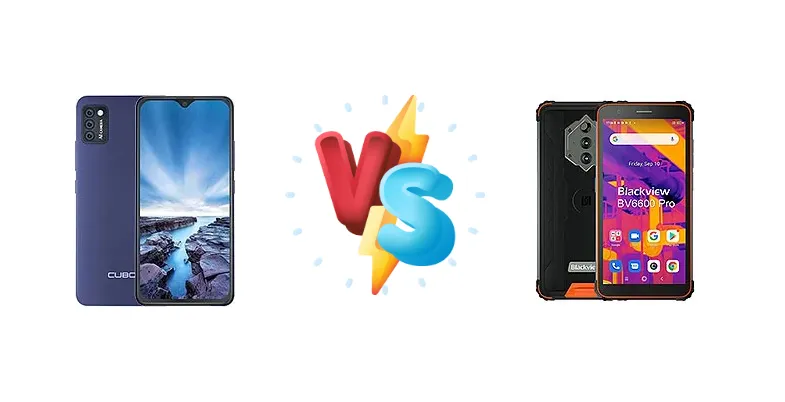
The sub-$200 smartphone market is fiercely competitive. We pit the Cubot J8, a basic but functional device, against the Blackview BV6600 Pro, a ruggedized phone offering a significant step up in processing power and charging capabilities. This comparison aims to determine which device delivers the best experience for the price.
🏆 Quick Verdict
For most users, the Blackview BV6600 Pro is the clear winner. Its Helio P35 chipset provides a substantially smoother experience than the Cubot J8’s aging MT6580, and the inclusion of 18W charging is a welcome addition. While the J8 is cheaper, the BV6600 Pro’s performance justifies the price difference.
| Network |
|---|
| 2G bands | GSM 850 / 900 / 1800 / 1900 | GSM 850 / 900 / 1800 / 1900 |
| 3G bands | HSDPA 900 / 2100 | HSDPA 850 / 900 / 1700(AWS) / 1900 / 2100 |
| 4G bands | - | 1, 2, 3, 4, 5, 7, 8, 12, 13, 17, 19, 18, 20, 28, 25, 26, 38, 40, 41, 66 |
| Speed | HSPA | HSPA, LTE |
| Technology | GSM / HSPA | GSM / CDMA / HSPA / CDMA2000 / LTE |
| | - | CDMA2000 1x |
| Launch |
|---|
| Announced | 2020. Released 2020 | 2021, September 28 |
| Status | Discontinued | Available. Released 2021, October |
| Body |
|---|
| Dimensions | 135 x 63 x 11 mm (5.31 x 2.48 x 0.43 in) | 159 x 79.4 x 18 mm (6.26 x 3.13 x 0.71 in) |
| SIM | Nano-SIM + Nano-SIM | Nano-SIM + Nano-SIM |
| Weight | 144 g (5.08 oz) | 325 g (11.46 oz) |
| | - | IP68/IP69K dust/water resistant (up to 1.5m for 30 min)
Drop-to-concrete resistance from up to 1.5m
MIL-STD-810G compliant |
| Display |
|---|
| Protection | - | Dragontrail Glass |
| Resolution | 442 x 960 pixels, 19.5:9 ratio (~192 ppi density) | 720 x 1440 pixels, 18:9 ratio (~282 ppi density) |
| Size | 5.5 inches, 74.1 cm2 (~87.2% screen-to-body ratio) | 5.7 inches, 83.8 cm2 (~66.4% screen-to-body ratio) |
| Type | IPS LCD | IPS LCD |
| Platform |
|---|
| CPU | Quad-core 1.3 GHz | Octa-core (4x2.35 GHz Cortex-A53 & 4x1.8 GHz Cortex-A53) |
| Chipset | Mediatek MT6580 (28 nm) | Mediatek MT6765V/CA Helio P35 (12 nm) |
| GPU | - | PowerVR GE8320 |
| OS | Android 10 | Android 11 |
| Memory |
|---|
| Card slot | No | microSDXC |
| Internal | 16GB 2GB RAM | 64GB 4GB RAM |
| | - | eMMC |
| Main Camera |
|---|
| Features | LED flash | Thermal imaging, LED flash |
| Single | - | 8 MP, f/2.0, (wide) |
| Triple | 13 MP, (wide), AF
0.3 MP
third unspecified camera | 16 MP, f/2.0, (wide), PDAF
5 MP, thermal assisted camera
FLIR thermal camera (Lepton module) |
| Video | Yes | 1080p@30fps |
| Selfie camera |
|---|
| Single | 8 MP | 8 MP, f/2.0, (wide) |
| Video | Yes | 1080p@30fps |
| Sound |
|---|
| 3.5mm jack | - | No |
| 35mm jack | Yes | No |
| Loudspeaker | Yes | Yes |
| Comms |
|---|
| Bluetooth | 4.2, A2DP | 5.0, A2DP, LE |
| NFC | No | Yes |
| Positioning | GPS | GPS, GLONASS, GALILEO, BDS |
| Radio | Unspecified | FM radio |
| USB | Yes | USB Type-C 2.0, OTG |
| WLAN | Wi-Fi 802.11 a/b/g/n | Wi-Fi 802.11 a/b/g/n/ac |
| Features |
|---|
| Sensors | Accelerometer, proximity | Fingerprint (side-mounted), accelerometer, gyro, proximity, compass |
| Battery |
|---|
| Charging | - | 18W wired |
| Type | 3100 mAh, removable | 8580 mAh |
| Misc |
|---|
| Colors | Black, Red, Blue, Green | Black, Orange, Green |
| Price | - | About 260 EUR |
Cubot J8
- Lowest possible price point
- Potentially longer battery life due to efficient processor
- Simple and easy to use
- Significantly slower performance
- Outdated chipset
- Likely limited software updates
Blackview BV6600 Pro
- Much faster performance with octa-core processor
- 18W fast charging
- Ruggedized design for increased durability
- Slightly higher price
- Potentially shorter battery life compared to J8 (offset by fast charging)
- May be bulkier due to ruggedized design
Display Comparison
Neither device boasts a standout display. Given the context data, we can assume both utilize LCD panels, common in this price bracket. The key difference lies beneath the surface: processing power to drive the display. The BV6600 Pro’s more capable GPU will likely result in smoother animations and faster app loading times, even if the resolution and pixel density are similar. Bezels are likely substantial on both, reflecting their budget nature.
Camera Comparison
Without detailed camera specs, a direct comparison is difficult. However, it’s safe to assume both phones feature basic camera setups. The BV6600 Pro, being a slightly more premium device, likely has a more refined image processing pipeline. The presence of a more powerful chipset allows for faster image processing and potentially better low-light performance. We can expect both to include a standard macro lens, but its utility will be limited by the sensor size and processing capabilities.
Performance
The performance gap is the most significant differentiator. The Cubot J8’s Mediatek MT6580, a quad-core processor built on a 28nm process, is demonstrably slower than the Blackview BV6600 Pro’s Helio P35. The P35’s octa-core configuration (4x2.35 GHz Cortex-A53 & 4x1.8 GHz Cortex-A53) and 12nm fabrication process offer a substantial performance boost in multi-tasking and app responsiveness. This translates to a smoother user experience, especially when running multiple apps or playing less demanding games. The P35 also benefits from CA (Carrier Aggregation) support, potentially improving data speeds.
Battery Life
While the battery capacity isn’t specified for the Cubot J8, the Blackview BV6600 Pro’s 18W wired charging is a major advantage. The MT6580’s lower power consumption in the J8 might result in comparable battery life despite a potentially smaller capacity, but the BV6600 Pro will significantly reduce charging times. A full charge on the BV6600 Pro will be considerably faster, offering more convenience for users who rely heavily on their phones throughout the day.
Buying Guide
Buy the Cubot J8 if you absolutely need the lowest possible price and only require a phone for basic tasks like calls, texts, and light web browsing. It’s a suitable option for first-time smartphone users or as a temporary device. Buy the Blackview BV6600 Pro if you prioritize performance, faster charging, and a more durable build quality. It’s ideal for users who want a phone that can withstand daily wear and tear and handle moderately demanding apps.
Frequently Asked Questions
❓ Will the Helio P35 in the Blackview BV6600 Pro overheat during extended gaming sessions?
The Helio P35 is a relatively efficient chipset. While it may get warm during prolonged gaming, it’s unlikely to overheat to the point of performance throttling, especially given the ruggedized design likely incorporates some thermal management features. The 12nm process node contributes to better thermal efficiency compared to the Cubot J8’s 28nm chip.
❓ Is the performance difference between the MT6580 and Helio P35 noticeable in everyday tasks like browsing and social media?
Yes, the difference is quite noticeable. The Helio P35’s octa-core architecture and higher clock speeds result in significantly faster app loading times, smoother scrolling, and a more responsive user interface. The MT6580 will feel sluggish in comparison, especially when multitasking.
❓ Does the Blackview BV6600 Pro support VoLTE and Wi-Fi calling?
While not explicitly stated in the provided specs, Blackview phones generally support VoLTE and Wi-Fi calling. However, compatibility depends on your carrier and region. It’s best to check with your mobile provider to confirm support before purchasing.
❓ How durable is the Blackview BV6600 Pro's ruggedized design?
Blackview is known for its rugged phones. The BV6600 Pro likely features reinforced corners, a durable chassis, and potentially IP68 or IP69K water and dust resistance. This makes it significantly more resistant to drops, shocks, and harsh environmental conditions compared to the Cubot J8.