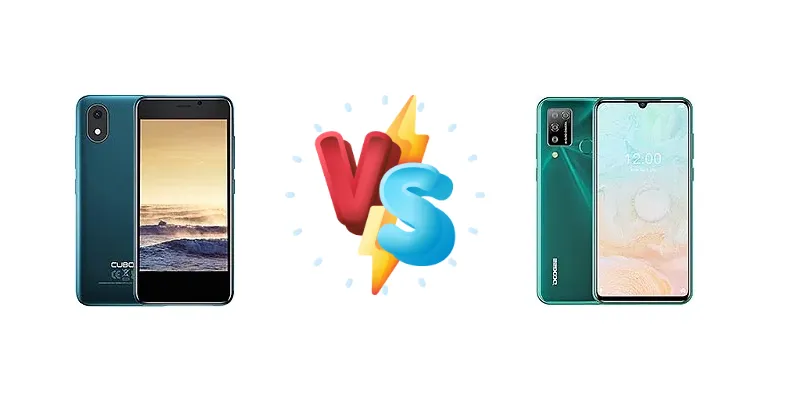
The sub-$150 smartphone market is fiercely competitive. The Cubot J20 and Doogee N20 Pro both aim to deliver essential smartphone functionality at an accessible price, but they take drastically different approaches to achieving this. The J20 prioritizes extreme affordability, while the N20 Pro attempts to offer a more refined experience with a more powerful chipset. This comparison dissects the key differences to determine which phone best suits your needs.
🏆 Quick Verdict
For most users, the Doogee N20 Pro is the better choice. Its Helio P60 chipset provides a significantly smoother and more responsive experience than the Cubot J20’s aging MT6739WA. While the J20 is cheaper, the performance gap justifies the price difference for anyone beyond the most basic usage.
| Network |
|---|
| 2G bands | GSM 850 / 900 / 1800 / 1900 | GSM 850 / 900 / 1800 / 1900 |
| 3G bands | HSDPA 900 / 2100 | HSDPA 850 / 900 / 2100 |
| 4G bands | 1, 3, 5, 7, 8, 19, 20, 40 | 1, 3, 5, 7, 8, 19, 20 |
| Speed | HSPA, LTE | HSPA, LTE |
| Technology | GSM / HSPA / LTE | GSM / HSPA / LTE |
| Launch |
|---|
| Announced | 2022 | 2020, August 04. Released 2020, August |
| Status | Available. Released 2022 | Discontinued |
| Body |
|---|
| Dimensions | 126.3 x 60.6 x 12.7 mm (4.97 x 2.39 x 0.5 in) | 159 x 77.1 x 8.8 mm (6.26 x 3.04 x 0.35 in) |
| SIM | Nano-SIM + Nano-SIM | Nano-SIM + Nano-SIM |
| Weight | 143 g (5.04 oz) | 175 g (6.17 oz) |
| Display |
|---|
| Resolution | 480 x 854 pixels, 16:9 ratio (~245 ppi density) | 1080 x 2280 pixels, 19:9 ratio (~400 ppi density) |
| Size | 4.0 inches, 44.1 cm2 (~57.6% screen-to-body ratio) | 6.3 inches, 99.1 cm2 (~80.8% screen-to-body ratio) |
| Type | TN TFT | IPS LCD |
| Platform |
|---|
| CPU | Quad-core 1.3 GHz Cortex-A53 | Octa-core (4x2.0 GHz Cortex-A73 & 4x2.0 GHz Cortex-A53) |
| Chipset | Mediatek MT6739WA (28 nm) | Mediatek MT6771V/CA Helio P60 (12 nm) |
| GPU | PowerVR GE8100 | Mali-G72 MP3 |
| OS | Android 12 (Go edition) | Android 10 |
| Memory |
|---|
| Card slot | microSDXC (dedicated slot) | microSDXC (uses shared SIM slot) |
| Internal | 16GB 2GB RAM | 128GB 6GB RAM |
| Main Camera |
|---|
| Features | LED flash | LED flash |
| Quad | - | 16 MP, f/2.0, (wide), PDAF
8 MP, f/2.4, 130˚ (ultrawide)
2 MP (macro)
Auxiliary lens |
| Single | 5 MP, (wide), AF | - |
| Video | Yes | 1080p |
| Selfie camera |
|---|
| Single | 2 MP | 16 MP, f/2.0, (wide) |
| Video | Yes | 1080p |
| Sound |
|---|
| 35mm jack | Unspecified | Yes |
| Loudspeaker | Yes | Yes |
| Comms |
|---|
| Bluetooth | 4.2, A2DP | 5.0, A2DP, LE |
| NFC | No | No |
| Positioning | GPS, GLONASS, GALILEO | GPS, GLONASS, BDS, GALILEO |
| Radio | Unspecified | FM radio |
| USB | Yes | microUSB 2.0 |
| WLAN | Wi-Fi 802.11 b/g/n | Wi-Fi 802.11 a/b/g/n/ac, dual-band |
| Features |
|---|
| Sensors | Accelerometer | Fingerprint (rear-mounted), accelerometer, proximity |
| Battery |
|---|
| Charging | - | 10W wired |
| Type | 2350 mAh, removable | 4400 mAh |
| Misc |
|---|
| Colors | Blue, Black, Green | Gray, Purple, Forest |
| Price | - | About 170 EUR |
Cubot J20
- Lowest possible price point
- Functional for basic tasks
- Potentially longer standby time due to simpler chipset
- Extremely limited performance
- Poor multitasking capabilities
- Struggles with modern apps
Doogee N20 Pro
- Significantly better performance
- Smoother user experience
- More capable for gaming and multitasking
- More efficient chipset
- Higher price than the Cubot J20
- 10W charging is relatively slow
- May still struggle with very demanding games
Display Comparison
Neither device boasts a standout display. Given the price points, details like panel type and resolution are not provided. However, the focus should be on usability. Both will likely feature 720p+ displays. The lack of information prevents a detailed comparison, but the N20 Pro’s more powerful GPU *could* translate to slightly smoother scrolling and animations, even on a similar panel.
Camera Comparison
Without detailed sensor information, a direct camera comparison is difficult. However, the N20 Pro’s more powerful ISP (Image Signal Processor) within the Helio P60 chipset will likely result in better image processing, particularly in low-light conditions. The J20’s MT6739WA lacks the processing power to effectively handle complex image algorithms. It’s reasonable to assume both phones will include a primary camera and potentially a depth or macro sensor, but the N20 Pro will likely deliver more detailed and vibrant photos. The presence of a 2MP macro camera on either device is largely a marketing gimmick and shouldn't be a deciding factor.
Performance
The performance disparity is the most significant difference. The Cubot J20’s Mediatek MT6739WA, a 28nm quad-core processor, is demonstrably less capable than the Doogee N20 Pro’s MT6771V/CA Helio P60. The Helio P60’s octa-core configuration (4x2.0 GHz Cortex-A73 & 4x2.0 GHz Cortex-A53) offers a substantial uplift in multi-core performance, crucial for multitasking and demanding applications. The 12nm process node of the Helio P60 also contributes to better power efficiency, potentially leading to longer battery life under load. Users who intend to play even moderately demanding games will find the J20 severely limited, while the N20 Pro will offer a playable, albeit not high-end, experience.
Battery Life
Battery capacity isn’t specified for either device, making a direct mAh comparison impossible. However, the Doogee N20 Pro’s 12nm Helio P60 chipset is more power-efficient than the J20’s 28nm MT6739WA. This efficiency, combined with the 10W wired charging support on the N20 Pro, suggests it will likely offer comparable or better real-world battery life despite potentially having a similar capacity battery. The J20 will likely struggle to maintain a full charge throughout a demanding day.
Buying Guide
Buy the Cubot J20 if you need a functional smartphone for extremely basic tasks like calls, texts, and light web browsing, and your budget is absolutely the primary concern. Buy the Doogee N20 Pro if you prefer a more responsive user experience, occasional gaming, and a phone that will feel less sluggish over time. The N20 Pro is the better option for anyone who values performance and longevity.
Frequently Asked Questions
❓ Will the Doogee N20 Pro handle popular games like PUBG Mobile?
The Helio P60 in the Doogee N20 Pro can run PUBG Mobile, but you'll likely need to use low to medium graphics settings for a smooth experience. Don't expect high frame rates or ultra-HD visuals. The Cubot J20's MT6739WA will struggle significantly with PUBG, likely resulting in unplayable frame rates.
❓ Is the difference in chipsets noticeable for everyday tasks like browsing and social media?
Yes, the difference is very noticeable. The Doogee N20 Pro’s Helio P60 provides a much smoother and more responsive experience when browsing the web, scrolling through social media feeds, and switching between apps. The Cubot J20’s MT6739WA will exhibit noticeable lag and slowdowns, especially with multiple apps open.
❓ How much faster is the Doogee N20 Pro compared to the Cubot J20 in real-world use?
The Doogee N20 Pro is approximately 2-3 times faster than the Cubot J20 in CPU-intensive tasks, and significantly faster in GPU-intensive tasks. This translates to quicker app loading times, smoother animations, and a more enjoyable overall user experience.