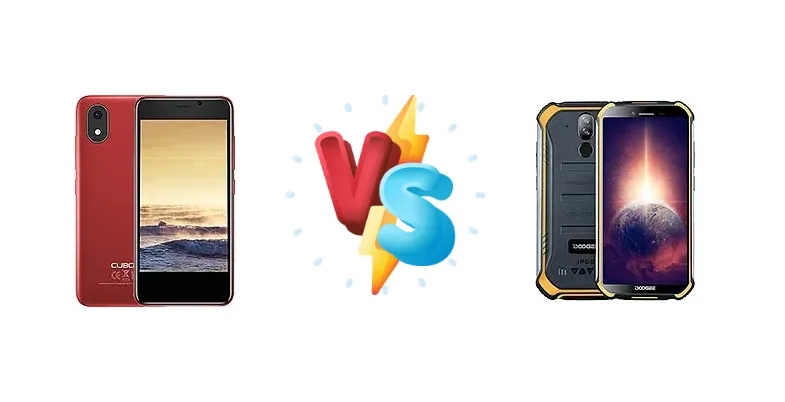
The Cubot J10 and Doogee S40 Pro represent the extreme end of the budget smartphone market, targeting users who prioritize affordability above all else. However, even within this segment, significant differences exist. The J10 relies on an older Unisoc chipset, while the S40 Pro opts for MediaTek’s Helio A25. This comparison dissects these key components and their impact on daily usage.
🏆 Quick Verdict
For the average user, the Doogee S40 Pro is the better choice. Its Helio A25 chipset, featuring an octa-core CPU, provides a noticeably smoother experience than the Cubot J10’s quad-core Unisoc SC7731e. While neither phone excels, the S40 Pro offers a more responsive user interface and better multitasking capabilities.
| Network |
|---|
| 2G bands | GSM 850 / 900 / 1800 / 1900 | GSM 850 / 900 / 1800 / 1900 |
| 3G bands | HSDPA 900 / 2100 | HSDPA 900 / 2100 |
| 4G bands | - | 1, 3, 7, 8, 20 |
| Speed | HSPA | HSPA, LTE |
| Technology | GSM / HSPA | GSM / HSPA / LTE |
| Launch |
|---|
| Announced | 2021 | 2020, July 17. Released 2020, July |
| Status | Available. Released 2021 | Discontinued |
| Body |
|---|
| Dimensions | 126.3 x 60.6 x 12.7 mm (4.97 x 2.39 x 0.5 in) | 158.2 x 79.4 x 14.1 mm (6.23 x 3.13 x 0.56 in) |
| SIM | Nano-SIM + Nano-SIM | Nano-SIM + Nano-SIM |
| Weight | 143 g (5.04 oz) | 238 g (8.40 oz) |
| Display |
|---|
| Protection | - | Corning Gorilla Glass |
| Resolution | 480 x 854 pixels, 16:9 ratio (~245 ppi density) | 720 x 1440 pixels, 18:9 ratio (~295 ppi density) |
| Size | 4.0 inches, 44.1 cm2 (~57.6% screen-to-body ratio) | 5.45 inches, 76.7 cm2 (~61.0% screen-to-body ratio) |
| Type | IPS LCD | IPS LCD |
| Platform |
|---|
| CPU | Quad-core 1.3 GHz Cortex-A7 | Octa-core (4x1.8 GHz Cortex-A53 & 4x1.5 GHz Cortex-A53) |
| Chipset | Unisoc SC7731e | Mediatek MT6762 Helio A25 (12 nm) |
| GPU | Mali-400 MP2 | PowerVR GE8320 |
| OS | Android 11 | Android 10 |
| Memory |
|---|
| Card slot | microSDXC (dedicated slot) | microSDXC (uses shared SIM slot) |
| Internal | 32GB 1GB RAM | 64GB 4GB RAM |
| Main Camera |
|---|
| Dual | - | 13 MP, f/2.8, (wide)
Auxiliary lens |
| Features | LED flash | LED flash |
| Single | 5 MP, (wide), AF | - |
| Video | Yes | 1080p |
| Selfie camera |
|---|
| Single | 2 MP | 5 MP, f/2.8, (wide) |
| Video | Yes | Yes |
| Sound |
|---|
| 35mm jack | Unspecified | Yes |
| Loudspeaker | Yes | Yes |
| Comms |
|---|
| Bluetooth | 4.2, A2DP | 5.0, A2DP, LE |
| NFC | No | Yes |
| Positioning | GPS | GPS, GLONASS, GALILEO, BDS |
| Radio | Unspecified | FM radio |
| USB | microUSB | microUSB 2.0, OTG |
| WLAN | Wi-Fi 802.11 b/g/n | Wi-Fi 802.11 a/b/g/n |
| Features |
|---|
| Sensors | Accelerometer | Fingerprint (rear-mounted), accelerometer, proximity, compass |
| Battery |
|---|
| Charging | - | 10W wired |
| Type | 2350 mAh, removable | 4650 mAh |
| Misc |
|---|
| Colors | Blue, Black, Green | Black, Orange, Green |
| Price | - | About 150 EUR |
Cubot J10
- Potentially lower price point
- Functional for basic tasks
- May include Android Go edition for optimized performance
- Significantly slower processor
- Limited multitasking capabilities
- Poor gaming performance
Doogee S40 Pro
- Octa-core processor for smoother performance
- More responsive user interface
- Better multitasking capabilities
- Slow 10W charging
- Basic camera system
- Still limited by budget components
Display Comparison
Neither device boasts a standout display. Specifications are unavailable for the Cubot J10’s panel, suggesting a basic LCD. The Doogee S40 Pro also utilizes an LCD, but its focus is on durability rather than visual fidelity. Both likely feature similar resolutions (around 720p+) given the price point. Bezels are expected to be substantial on both, and color accuracy will be limited. The absence of high refresh rates or advanced features like LTPO is standard for this segment.
Camera Comparison
Camera performance is likely to be similar on both devices, leaning towards basic functionality. Both will likely feature a primary camera and potentially a secondary depth sensor. The Doogee S40 Pro may have a slight edge due to potentially better image processing capabilities inherent in the Helio A25 chipset. However, don't expect exceptional image quality; both cameras will struggle in low-light conditions. The prevalence of 2MP macro cameras in this price range is likely, but their utility is minimal due to low resolution and poor image quality.
Performance
The core difference lies in the chipsets. The Cubot J10’s Unisoc SC7731e is a quad-core processor clocked at 1.3 GHz, built on an older architecture. This translates to slower app loading times and noticeable lag when switching between applications. The Doogee S40 Pro’s MediaTek Helio A25, fabricated on a more efficient 12nm process, features an octa-core configuration (4x1.8 GHz Cortex-A53 & 4x1.5 GHz Cortex-A53). This provides a significant performance boost, particularly in multitasking and handling more demanding apps. While neither chipset is a gaming powerhouse, the Helio A25 will offer a more playable experience in less intensive titles. The lack of RAM specifications for both devices further complicates the comparison, but the chipset difference remains the dominant factor.
Battery Life
Battery capacity is not specified for either device, but both likely house batteries in the 3000-4000 mAh range. The Doogee S40 Pro supports 10W wired charging, which is slow by modern standards, but adequate for overnight charging. The Cubot J10’s charging speed is unknown, but likely similar. Real-world battery life will depend heavily on usage patterns, but the more efficient Helio A25 in the S40 Pro may offer slightly better endurance despite potentially similar battery capacities.
Buying Guide
Buy the Cubot J10 if you absolutely need the lowest possible price and your usage is limited to basic tasks like calls, texts, and light web browsing. It’s a functional device for minimal smartphone needs. Buy the Doogee S40 Pro if you value a more responsive experience, even for basic tasks, and anticipate occasional multitasking or light gaming. The S40 Pro’s more powerful chipset provides a tangible improvement in usability.
Frequently Asked Questions
❓ Will the Doogee S40 Pro struggle with popular social media apps like Facebook and Instagram?
While the Helio A25 isn't a powerhouse, it should handle Facebook and Instagram reasonably well. Expect some loading times and occasional lag, but it's unlikely to be a crippling experience. The Cubot J10's Unisoc SC7731e will likely struggle more noticeably with these apps.
❓ Is the Doogee S40 Pro suitable for playing mobile games like PUBG Mobile or Call of Duty Mobile?
The Doogee S40 Pro can *run* these games, but performance will be limited to the lowest graphics settings and frame rates. Expect significant lag and stuttering. It's not a gaming phone, and a more powerful device is recommended for a smooth gaming experience. The Cubot J10 is unlikely to run these games acceptably.
❓ Does the Cubot J10 support software updates?
Software update support for the Cubot J10 is uncertain. Budget devices often receive limited or no updates. The Doogee S40 Pro may receive occasional security patches, but major Android version updates are unlikely for both devices.
❓ What type of SIM cards do these phones support?
Both the Cubot J10 and Doogee S40 Pro likely support dual SIM cards (Nano-SIM). However, specific network band compatibility should be verified based on your carrier's requirements.