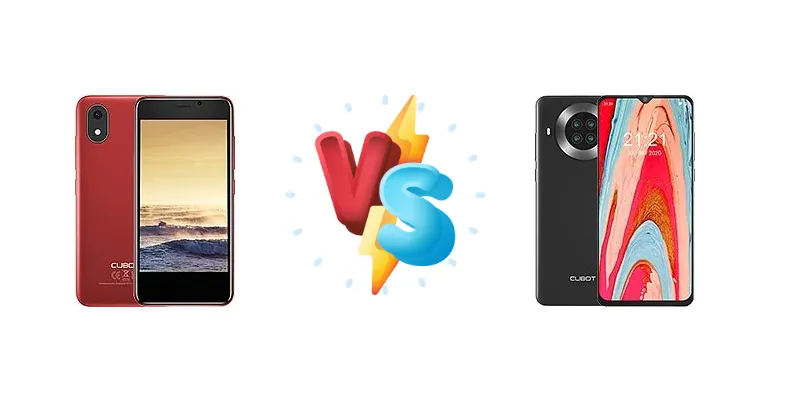
Cubot offers two compelling options in the ultra-budget smartphone space: the J10 and the Note 20 Pro. While both aim to deliver affordability, they diverge significantly in their internal hardware. This comparison dissects those differences, focusing on how the chipset choices impact real-world performance and usability, helping you determine which device best suits your needs.
🏆 Quick Verdict
For most users, the Cubot Note 20 Pro is the superior choice. Its Helio P60 chipset provides a substantial performance uplift over the J10’s Unisoc SC7731e, enabling smoother multitasking and a more responsive user experience. While the J10 offers basic functionality, the Note 20 Pro delivers a noticeably improved level of performance for a relatively small price increase.
| Network |
|---|
| 2G bands | GSM 850 / 900 / 1800 / 1900 | GSM 850 / 900 / 1800 / 1900 |
| 3G bands | HSDPA 900 / 2100 | HSDPA 900 / 2100 |
| 4G bands | - | 1, 3, 7, 8, 19, 20 |
| Speed | HSPA | HSPA, LTE |
| Technology | GSM / HSPA | GSM / HSPA / LTE |
| Launch |
|---|
| Announced | 2021 | 2020. Released 2020 |
| Status | Available. Released 2021 | Discontinued |
| Body |
|---|
| Dimensions | 126.3 x 60.6 x 12.7 mm (4.97 x 2.39 x 0.5 in) | 162.8 x 75.4 x 9.1 mm (6.41 x 2.97 x 0.36 in) |
| SIM | Nano-SIM + Nano-SIM | Nano-SIM + Nano-SIM |
| Weight | 143 g (5.04 oz) | 200 g (7.05 oz) |
| Display |
|---|
| Resolution | 480 x 854 pixels, 16:9 ratio (~245 ppi density) | 720 x 1600 pixels, 20:9 ratio (~270 ppi density) |
| Size | 4.0 inches, 44.1 cm2 (~57.6% screen-to-body ratio) | 6.5 inches, 102.0 cm2 (~83.1% screen-to-body ratio) |
| Type | IPS LCD | IPS LCD |
| Platform |
|---|
| CPU | Quad-core 1.3 GHz Cortex-A7 | Octa-core (4x2.0 GHz Cortex-A73 & 4x2.0 GHz Cortex-A53) |
| Chipset | Unisoc SC7731e | Mediatek MT6771 Helio P60 (12 nm) |
| GPU | Mali-400 MP2 | Mali-G72 MP3 |
| OS | Android 11 | Android 10 |
| Memory |
|---|
| Card slot | microSDXC (dedicated slot) | microSDXC (dedicated slot) |
| Internal | 32GB 1GB RAM | 128GB 8GB RAM |
| Main Camera |
|---|
| Features | LED flash | LED flash |
| Quad | - | 12 MP, (wide), 1/2.9", AF
20 MP, (depth), 1/2.78"
Auxiliary lenses |
| Single | 5 MP, (wide), AF | - |
| Video | Yes | Yes |
| Selfie camera |
|---|
| Single | 2 MP | 8 MP |
| Video | Yes | Yes |
| Sound |
|---|
| 35mm jack | Unspecified | Yes |
| Loudspeaker | Yes | Yes |
| Comms |
|---|
| Bluetooth | 4.2, A2DP | 4.2, A2DP |
| NFC | No | Yes |
| Positioning | GPS | GPS |
| Radio | Unspecified | Unspecified |
| USB | microUSB | microUSB, OTG |
| WLAN | Wi-Fi 802.11 b/g/n | Wi-Fi 802.11 a/b/g/n |
| Features |
|---|
| Sensors | Accelerometer | Accelerometer, gyro, proximity, compass |
| Battery |
|---|
| Type | 2350 mAh, removable | 4200 mAh, removable |
| Misc |
|---|
| Colors | Blue, Black, Green | Black, Blue, Green |
Cubot J10
- Lowest possible price point
- Simple and easy to use
- Acceptable for basic communication
- Very limited performance
- Struggles with multitasking
- Poor gaming capabilities
Cubot Note 20 Pro
- Significantly better performance
- Smoother user experience
- More capable for everyday tasks
- Slightly higher price
- May still struggle with very demanding games
- Likely similar display quality to J10
Display Comparison
Neither Cubot provides detailed display specifications. However, given their price points, both likely utilize IPS LCD panels. The key difference lies in the processing power available to drive the display. The Note 20 Pro’s Helio P60 will handle more complex graphics and animations with greater fluidity. While both will likely offer similar resolutions (around 720p+), the Note 20 Pro’s GPU will provide a smoother visual experience, particularly when scrolling through content or playing games. Bezels are expected to be substantial on both devices, typical of this price bracket.
Camera Comparison
Detailed camera specifications are lacking for both devices. However, it’s safe to assume both will feature multiple rear cameras, likely including a primary sensor and depth/macro lenses. The Note 20 Pro’s Helio P60 chipset includes a more powerful image signal processor (ISP) than the J10’s SC7731e. This means the Note 20 Pro will be able to process images more quickly and efficiently, resulting in better image quality, particularly in low-light conditions. While the megapixel count may be similar, the ISP’s capabilities will be the deciding factor in overall camera performance. Expect any 2MP macro lenses on both devices to offer limited utility.
Performance
The performance gap between these two devices is substantial. The Cubot J10’s Unisoc SC7731e, with its quad-core Cortex-A7 CPU clocked at 1.3 GHz, is designed for extremely basic tasks. It will struggle with multitasking and demanding applications. In contrast, the Cubot Note 20 Pro’s MediaTek Helio P60 features an octa-core configuration (4x2.0 GHz Cortex-A73 & 4x2.0 GHz Cortex-A53) built on a more efficient 12nm process. The Cortex-A73 cores provide a significant performance boost for CPU-intensive tasks, while the Mali-G72 MP3 GPU offers a far superior graphics experience. This translates to faster app loading times, smoother animations, and the ability to play more demanding games on the Note 20 Pro.
Battery Life
Again, specific battery capacities are not provided. However, given the more efficient chipset in the Note 20 Pro, it’s likely to offer comparable or even better battery life despite potentially having a similar capacity to the J10. The 12nm process of the Helio P60 consumes less power than the SC7731e. Furthermore, the Note 20 Pro may support faster charging speeds, reducing the time required to replenish the battery. The J10 will likely offer a more basic charging experience.
Buying Guide
Buy the Cubot J10 if you need a truly minimal smartphone for basic communication – calls, texts, and light web browsing – and prioritize absolute affordability above all else. It’s a suitable option for first-time smartphone users or as a simple backup device. Buy the Cubot Note 20 Pro if you want a more capable device for everyday tasks like social media, streaming video, and casual gaming. The Helio P60 chipset provides a significantly better user experience and offers more longevity as app requirements increase.
Frequently Asked Questions
❓ Will the Cubot Note 20 Pro handle popular games like PUBG Mobile?
The Helio P60 in the Note 20 Pro can run PUBG Mobile, but likely at lower graphics settings (Medium or Low) to maintain a playable frame rate. Don't expect a flagship-level gaming experience, but it's significantly more capable than the J10, which would struggle to run the game smoothly.
❓ Is the Unisoc SC7731e in the Cubot J10 sufficient for running WhatsApp and Facebook?
Yes, the Unisoc SC7731e is adequate for basic social media apps like WhatsApp and Facebook. However, expect slower loading times and occasional lag when switching between apps. It's best to avoid running multiple apps simultaneously.
❓ Does the Cubot Note 20 Pro support fast charging?
While specific charging speeds aren't confirmed, the Note 20 Pro is more likely to support a faster charging protocol than the J10, due to the more advanced chipset and potentially included charging circuitry. Expect a quicker 0-100% charge time compared to the J10.