
Cubot Hafury V1 vs. Oukitel WP210: A Deep Dive into Performance and Endurance
| Phones Images | |||||
|---|---|---|---|---|---|
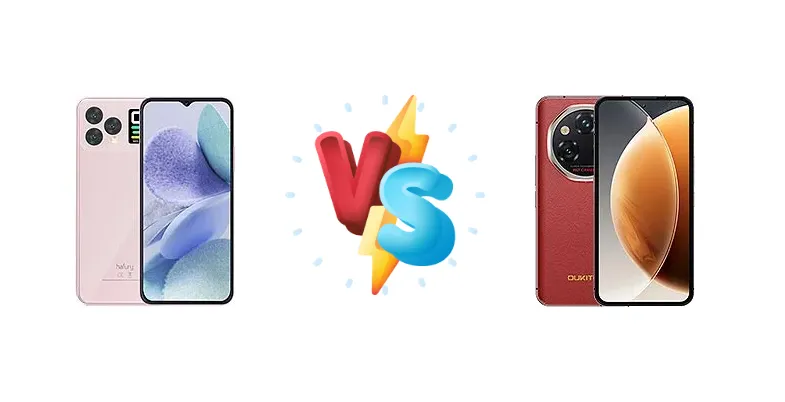
|
🏆 Quick Verdict
For users prioritizing sustained performance and fast charging, the Oukitel WP210 is the clear winner. Its Dimensity 8200 chipset offers a significant leap in processing power over the Hafury V1’s MT8788V. However, the Hafury V1 remains a viable option for those on a tighter budget who don't demand the absolute highest performance.
| PHONES | ||
|---|---|---|
| Phone Names | Cubot Hafury V1 | Oukitel WP210 |
| Network | ||
|---|---|---|
| 2G bands | GSM 850 / 900 / 1800 / 1900 | GSM 850 / 900 / 1800 / 1900 |
| 3G bands | HSDPA 800 / 850 / 900 / 1700(AWS) / 1900 / 2100 | HSDPA 800 / 850 / 900 / 1700(AWS) / 1900 / 2100 |
| 4G bands | 1, 2, 3, 4, 5, 7, 8, 12, 13, 17, 18, 19, 20, 26, 28, 34, 38, 39, 40, 41, 66 | 1, 2, 3, 4, 5, 7, 8, 12, 13, 17, 18, 19, 20, 25, 26, 28, 34, 38, 39, 40, 41, 66, 71 |
| 5G bands | - | 1, 2, 3, 5, 7, 8, 12, 20, 25, 28, 34, 38, 39, 40, 41, 48, 66, 71, 77, 78 SA/NSA |
| Speed | HSPA, LTE | HSPA, LTE, 5G |
| Technology | GSM / HSPA / LTE | GSM / HSPA / LTE / 5G |
| Launch | ||
|---|---|---|
| Announced | 2024, April 02 | 2025, July |
| Status | Available. Released 2024, April | Available. Released 2025, July 15 |
| Body | ||
|---|---|---|
| Dimensions | 165.8 x 75.8 x 9 mm (6.53 x 2.98 x 0.35 in) | 163.6 x 77.9 x 13.7 mm (6.44 x 3.07 x 0.54 in) |
| SIM | Nano-SIM + Nano-SIM | Nano-SIM + Nano-SIM |
| Weight | 200 g (7.05 oz) | 311 g (10.97 oz) |
| Display | ||
|---|---|---|
| Protection | - | Corning Gorilla Glass 5, Mohs level 5 |
| Resolution | 1080 x 2408 pixels, 20:9 ratio (~401 ppi density) | 1080 x 2408 pixels, 20:9 ratio (~394 ppi density) |
| Size | 6.58 inches, 104.3 cm2 (~83.0% screen-to-body ratio) | 6.7 inches, 108.1 cm2 (~84.9% screen-to-body ratio) |
| Type | IPS LCD | IPS LCD, 120Hz, 500 nits |
| Platform | ||
|---|---|---|
| CPU | Octa-core (4x2.0 GHz Cortex-A73 & 4x2.0 GHz Cortex-A53) | Octa-core (1x3.1 GHz Cortex-A78 & 3x3.0 GHz Cortex-A78 & 4x2.0 GHz Cortex-A55) |
| Chipset | Mediatek MT8788V/WA (12 nm) | Mediatek Dimensity 8200 (4 nm) |
| GPU | Mali-G72 MP3 | Mali-G610 MC6 |
| OS | Android 13 | Android 15 |
| Memory | ||
|---|---|---|
| Card slot | microSDXC (uses shared SIM slot) | microSDXC (uses shared SIM slot) |
| Internal | 256GB 8GB RAM | 512GB 12GB RAM |
| Main Camera | ||
|---|---|---|
| Features | LED flash | LED flash, HDR, panorama |
| Triple | 64 MP, (wide), PDAF 2 MP (macro) Auxiliary lens | 108 MP, f/1.9, (wide), 1/1.8", PDAF 2 MP (macro) Auxiliary lens |
| Video | 1080p@30fps | 4K@30fps |
| Selfie camera | ||
|---|---|---|
| Single | 32 MP | 32 MP, f/2.2, (wide), 1/2.74" |
| Video | 1080p@30fps | 1080p@30fps |
| Sound | ||
|---|---|---|
| 35mm jack | No | No |
| Loudspeaker | Yes | Yes |
| Comms | ||
|---|---|---|
| Bluetooth | 4.2, A2DP | 5.3, A2DP, LE |
| NFC | Yes | Yes |
| Positioning | GPS, GALILEO, GLONASS | GPS (L1+L5), GLONASS, GALILEO, BDS |
| Radio | Unspecified | FM radio |
| USB | USB Type-C, OTG | USB Type-C 2.0 |
| WLAN | Wi-Fi 802.11 a/b/g/n/ac, dual-band | Wi-Fi 802.11 a/b/g/n/ac/6, dual-band |
| Features | ||
|---|---|---|
| Sensors | Fingerprint (side-mounted), accelerometer, gyro, proximity, compass | Fingerprint (side-mounted), accelerometer, gyro, proximity, compass |
| Battery | ||
|---|---|---|
| Charging | 18W wired | 45W wired |
| Type | 4350 mAh | Li-Po 8800 mAh |
| Misc | ||
|---|---|---|
| Colors | Black, Pink, Light Blue | Gray, Black, Red |
| Price | About 150 EUR | - |
| EU LABEL | ||
|---|---|---|
| Battery | - | 86:17h endurance, 1000 cycles |
| Energy | - | Class B |
| Free fall | - | Class A (270 falls) |
| Repairability | - | Class C |
Cubot Hafury V1
- More affordable price point
- Functional for basic tasks
- Potentially lighter weight (speculation)
- Significantly weaker processor
- Slower charging speed
- Likely lower display quality
Oukitel WP210
- Superior processing power (Dimensity 8200)
- Faster 45W charging
- Exceptional battery endurance (86:17h)
- Higher price tag
- Potentially heavier build (due to larger battery)
- May run hotter under sustained load (though Dimensity 8200 is efficient)
Display Comparison
Display specifications are absent from the provided data, but given the price points, both devices likely utilize IPS LCD panels. The Oukitel WP210, being a more recent release, *may* benefit from a higher peak brightness and potentially a higher refresh rate, though this is speculative. The Hafury V1, positioned as a budget option, will likely prioritize cost-effectiveness over display quality. Bezels are expected to be noticeable on both devices.
Camera Comparison
Camera details are limited. However, the absence of any mention of advanced camera features on the Hafury V1 suggests a basic camera setup focused on functionality rather than image quality. The WP210, while not explicitly detailed, benefits from the image signal processor (ISP) within the Dimensity 8200, which offers improved noise reduction and dynamic range. Without sensor size or aperture information, it’s difficult to make a definitive judgment, but the WP210’s chipset provides a foundation for a more capable camera system.
Performance
The Oukitel WP210’s Mediatek Dimensity 8200 (4nm) represents a substantial upgrade over the Cubot Hafury V1’s Mediatek MT8788V/WA (12nm). The Dimensity 8200 features a tri-cluster configuration with a high-performance Cortex-A78 core clocked at 3.1 GHz, alongside three additional Cortex-A78 cores at 3.0 GHz, and four efficiency cores. This contrasts with the Hafury V1’s quad-core Cortex-A73 and quad-core Cortex-A53 setup. The 4nm process node of the Dimensity 8200 translates to significantly improved power efficiency and thermal management, allowing for sustained peak performance without excessive throttling. The Hafury V1, while capable for everyday tasks, will struggle with graphically intensive games and demanding applications.
Battery Life
The Oukitel WP210 boasts an impressive 86:17h endurance rating and a claimed 1000 charge cycles, indicating a focus on long-term battery health and usability. While the Hafury V1’s battery capacity is unknown, its 18W charging is significantly slower than the WP210’s 45W charging. This means the WP210 can replenish its battery much faster, minimizing downtime. The WP210’s endurance rating suggests a larger battery capacity, further solidifying its advantage in this category. The 1000 cycle claim is a significant benefit for users who intend to keep their phone for several years.
Buying Guide
Buy the Cubot Hafury V1 if you need a functional, everyday smartphone for basic tasks like browsing, social media, and light media consumption, and value affordability above all else. Buy the Oukitel WP210 if you prioritize demanding applications like gaming, video editing, or multitasking, and require a phone that can withstand heavy use with its superior processing power and extended battery life.