
Doogee S110 vs Cubot Hafury V1: A Detailed Comparison of Performance and Value
| Phones Images | |||||
|---|---|---|---|---|---|
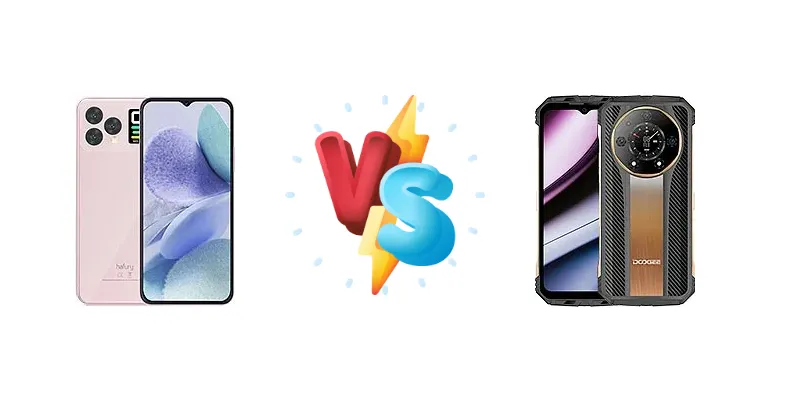
|
🏆 Quick Verdict
For most users, the Doogee S110 is the superior choice. Its Helio G99 chipset, built on a 6nm process, provides a noticeable performance boost over the Cubot Hafury V1’s older 12nm MT8788V. The 66W charging is a game-changer, drastically reducing recharge times compared to the V1’s 18W charging.
| PHONES | ||
|---|---|---|
| Phone Names | Cubot Hafury V1 | Doogee S110 |
| Network | ||
|---|---|---|
| 2G bands | GSM 850 / 900 / 1800 / 1900 | GSM 850 / 900 / 1800 / 1900 |
| 3G bands | HSDPA 800 / 850 / 900 / 1700(AWS) / 1900 / 2100 | HSDPA 800 / 850 / 900 / 1700(AWS) / 1900 / 2100 |
| 4G bands | 1, 2, 3, 4, 5, 7, 8, 12, 13, 17, 18, 19, 20, 26, 28, 34, 38, 39, 40, 41, 66 | 1, 2, 3, 4, 5, 7, 8, 12, 13, 17, 18, 19, 20, 25, 26, 28, 34, 38, 39, 40, 41, 66, 71 |
| Speed | HSPA, LTE | HSPA, LTE |
| Technology | GSM / HSPA / LTE | GSM / CDMA / HSPA / LTE |
| Launch | ||
|---|---|---|
| Announced | 2024, April 02 | 2023, August 03 |
| Status | Available. Released 2024, April | Available. Released 2023, August |
| Body | ||
|---|---|---|
| Dimensions | 165.8 x 75.8 x 9 mm (6.53 x 2.98 x 0.35 in) | 178.5 x 83.1 x 17.9 mm (7.03 x 3.27 x 0.70 in) |
| SIM | Nano-SIM + Nano-SIM | Nano-SIM + Nano-SIM |
| Weight | 200 g (7.05 oz) | 390 g (13.76 oz) |
| Display | ||
|---|---|---|
| Protection | - | Corning Gorilla Glass |
| Resolution | 1080 x 2408 pixels, 20:9 ratio (~401 ppi density) | 1080 x 2400 pixels, 20:9 ratio (~400 ppi density) |
| Size | 6.58 inches, 104.3 cm2 (~83.0% screen-to-body ratio) | 6.58 inches, 104.5 cm2 (~70.5% screen-to-body ratio) |
| Type | IPS LCD | IPS LCD, 120Hz |
| Platform | ||
|---|---|---|
| CPU | Octa-core (4x2.0 GHz Cortex-A73 & 4x2.0 GHz Cortex-A53) | Octa-core (2x2.2 GHz Cortex-A76 & 6x2.0 GHz Cortex-A55) |
| Chipset | Mediatek MT8788V/WA (12 nm) | Mediatek Helio G99 (6 nm) |
| GPU | Mali-G72 MP3 | Mali-G57 MC2 |
| OS | Android 13 | Android 13 |
| Memory | ||
|---|---|---|
| Card slot | microSDXC (uses shared SIM slot) | microSDXC (uses shared SIM slot) |
| Internal | 256GB 8GB RAM | 256GB 12GB RAM |
| Main Camera | ||
|---|---|---|
| Features | LED flash | Dual-LED flash, HDR, panorama |
| Triple | 64 MP, (wide), PDAF 2 MP (macro) Auxiliary lens | 50 MP, f/1.8, (wide), 1/1.67", PDAF 24 MP, f/1.8, (night vision), 2 infrared night vision lights 16 MP, f/2.2, 130˚ (ultrawide) |
| Video | 1080p@30fps | 1440p, 1080p |
| Selfie camera | ||
|---|---|---|
| Single | 32 MP | 32 MP, f/2.0, (wide), 1/2.8", 0.8µm |
| Video | 1080p@30fps | 1440p, 1080p |
| Sound | ||
|---|---|---|
| 35mm jack | No | No |
| Loudspeaker | Yes | Yes |
| Comms | ||
|---|---|---|
| Bluetooth | 4.2, A2DP | 5.2, A2DP, LE |
| NFC | Yes | Yes (market/region dependent) |
| Positioning | GPS, GALILEO, GLONASS | GPS, GLONASS, BDS, GALILEO |
| Radio | Unspecified | FM radio |
| USB | USB Type-C, OTG | USB Type-C 2.0, OTG |
| WLAN | Wi-Fi 802.11 a/b/g/n/ac, dual-band | Wi-Fi 802.11 a/b/g/n/ac, dual-band |
| Features | ||
|---|---|---|
| Sensors | Fingerprint (side-mounted), accelerometer, gyro, proximity, compass | Fingerprint (side-mounted), accelerometer, gyro, proximity, compass |
| Battery | ||
|---|---|---|
| Charging | 18W wired | 66W wired Reverse wired |
| Type | 4350 mAh | 10800 mAh |
| Misc | ||
|---|---|---|
| Colors | Black, Pink, Light Blue | Black, Silver, Gold |
| Price | About 150 EUR | About 320 EUR |
Cubot Hafury V1
- Lowest possible price point
- Functional for basic tasks
- Potentially longer standby time due to less powerful chipset
- Outdated chipset with limited performance
- Slow 18W charging
- Likely inferior camera performance
Doogee S110
- Significantly faster Helio G99 processor
- Ultra-fast 66W charging with reverse charging
- Improved power efficiency and thermal management
- Higher price compared to the Cubot Hafury V1
- May require more frequent charging if heavily used
- Potentially less standby time than the V1
Display Comparison
Neither device’s display specifications are provided, so a direct comparison is limited. However, given the target price points, both likely utilize IPS LCD panels. The Doogee S110, being a newer device, may benefit from improved color calibration and viewing angles. The absence of high refresh rate support on either device suggests a focus on power efficiency rather than visual fluidity.
Camera Comparison
Without detailed camera specifications, a comprehensive comparison is impossible. However, it’s reasonable to assume both phones feature budget-oriented camera systems. The Doogee S110, benefiting from the more powerful ISP within the Helio G99, likely offers better image processing capabilities, resulting in improved dynamic range and noise reduction. The absence of information regarding sensor sizes makes it difficult to assess low-light performance, but a larger sensor generally equates to better image quality in challenging lighting conditions.
Performance
The core difference lies in the chipsets. The Doogee S110’s MediaTek Helio G99 (6nm) is a substantial upgrade over the Cubot Hafury V1’s MediaTek MT8788V/WA (12nm). The 6nm process node of the G99 translates to significantly improved power efficiency and thermal performance, allowing for sustained performance under load. The G99’s CPU configuration – 2x2.2 GHz Cortex-A76 & 6x2.0 GHz Cortex-A55 – also offers a performance advantage over the V1’s 4x2.0 GHz Cortex-A73 & 4x2.0 GHz Cortex-A53. While both are octa-core, the Cortex-A76 cores in the G99 are architecturally superior, delivering better single-core performance. This will be noticeable in app launch times and general responsiveness.
Battery Life
The charging speed is a clear win for the Doogee S110. Its 66W wired charging is a massive leap over the Cubot Hafury V1’s 18W charging. This translates to significantly faster recharge times – potentially going from 0-100% in under an hour, compared to several hours on the V1. While battery capacity isn’t specified for either device, the G99’s superior power efficiency means the S110 will likely deliver comparable or better battery life despite potentially having a smaller battery capacity. The S110 also supports reverse wired charging, a feature absent on the V1, allowing it to act as a power bank for other devices.
Buying Guide
Buy the Cubot Hafury V1 if you prioritize absolute lowest cost and are primarily focused on basic smartphone tasks like calling, texting, and light social media use. Buy the Doogee S110 if you value smoother performance for gaming and multitasking, and if you need a phone that can be quickly recharged, minimizing downtime. The S110 is also a better choice for users who anticipate using more demanding applications.