
Cubot Hafury V1 vs KingKong 8: A Deep Dive into Rugged, Budget Performance
| Phones Images | |||||
|---|---|---|---|---|---|
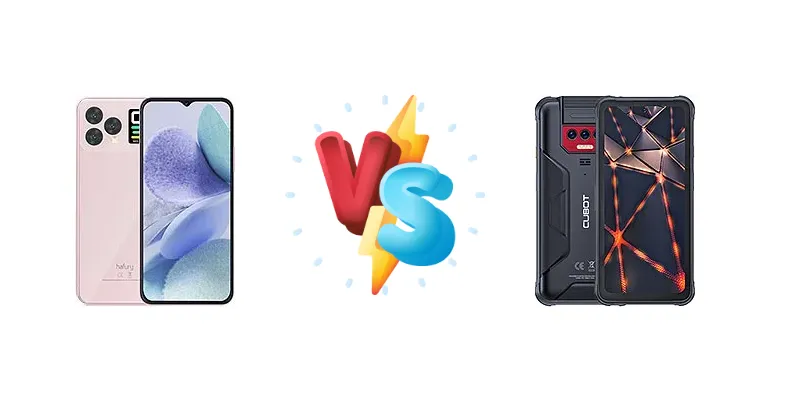
|
🏆 Quick Verdict
For most users, the Cubot KingKong 8 emerges as the slightly better choice. While both phones deliver similar performance thanks to the MT8788V chipset, the addition of reverse wired charging provides added utility, allowing it to function as a power bank for smaller devices. The Hafury V1 remains a viable option if found at a significantly lower price.
| PHONES | ||
|---|---|---|
| Phone Names | Cubot Hafury V1 | Cubot KingKong 8 |
| Network | ||
|---|---|---|
| 2G bands | GSM 850 / 900 / 1800 / 1900 | GSM 850 / 900 / 1800 / 1900 |
| 3G bands | HSDPA 800 / 850 / 900 / 1700(AWS) / 1900 / 2100 | HSDPA 850 / 900 / 1700(AWS) / 1900 / 2100 |
| 4G bands | 1, 2, 3, 4, 5, 7, 8, 12, 13, 17, 18, 19, 20, 26, 28, 34, 38, 39, 40, 41, 66 | 1, 2, 3, 4, 5, 7, 8, 12, 17, 20, 28, 41 |
| Speed | HSPA, LTE | HSPA, LTE |
| Technology | GSM / HSPA / LTE | GSM / HSPA / LTE |
| Launch | ||
|---|---|---|
| Announced | 2024, April 02 | 2023, October 23 |
| Status | Available. Released 2024, April | Available. Released 2023, October 23 |
| Body | ||
|---|---|---|
| Dimensions | 165.8 x 75.8 x 9 mm (6.53 x 2.98 x 0.35 in) | 169.9 x 80.2 x 20 mm (6.69 x 3.16 x 0.79 in) |
| SIM | Nano-SIM + Nano-SIM | Nano-SIM + Nano-SIM |
| Weight | 200 g (7.05 oz) | 382 g (13.47 oz) |
| Display | ||
|---|---|---|
| Resolution | 1080 x 2408 pixels, 20:9 ratio (~401 ppi density) | 720 x 1612 pixels, 20:9 ratio (~270 ppi density) |
| Size | 6.58 inches, 104.3 cm2 (~83.0% screen-to-body ratio) | 6.53 inches, 102.4 cm2 (~75.2% screen-to-body ratio) |
| Type | IPS LCD | IPS LCD |
| Platform | ||
|---|---|---|
| CPU | Octa-core (4x2.0 GHz Cortex-A73 & 4x2.0 GHz Cortex-A53) | Octa-core (4x2.0 GHz Cortex-A73 & 4x2.0 GHz Cortex-A53) |
| Chipset | Mediatek MT8788V/WA (12 nm) | Mediatek MT8788V/WA (12 nm) |
| GPU | Mali-G72 MP3 | - |
| OS | Android 13 | Android 13 |
| Memory | ||
|---|---|---|
| Card slot | microSDXC (uses shared SIM slot) | microSDXC (uses shared SIM slot) |
| Internal | 256GB 8GB RAM | 256GB 12GB RAM |
| Main Camera | ||
|---|---|---|
| Features | LED flash | LED flash |
| Triple | 64 MP, (wide), PDAF 2 MP (macro) Auxiliary lens | 48 MP, (wide), PDAF 2 MP (macro) 0.3 MP |
| Video | 1080p@30fps | Yes |
| Selfie camera | ||
|---|---|---|
| Single | 32 MP | 16 MP |
| Video | 1080p@30fps | Yes |
| Sound | ||
|---|---|---|
| 35mm jack | No | Unspecified |
| Loudspeaker | Yes | Yes |
| Comms | ||
|---|---|---|
| Bluetooth | 4.2, A2DP | 4.2, A2DP |
| NFC | Yes | Yes |
| Positioning | GPS, GALILEO, GLONASS | GPS, GLONASS, GALILEO |
| Radio | Unspecified | Unspecified |
| USB | USB Type-C, OTG | USB Type-C, OTG |
| WLAN | Wi-Fi 802.11 a/b/g/n/ac, dual-band | Wi-Fi 802.11 a/b/g/n/ac, dual-band |
| Features | ||
|---|---|---|
| Sensors | Fingerprint (side-mounted), accelerometer, gyro, proximity, compass | Fingerprint (side-mounted), accelerometer, gyro, proximity, compass |
| Battery | ||
|---|---|---|
| Charging | 18W wired | Wired Reverse wired |
| Type | 4350 mAh | 10600 mAh |
| Misc | ||
|---|---|---|
| Colors | Black, Pink, Light Blue | Black, Red, Green |
| Price | About 150 EUR | About 170 EUR |
Cubot Hafury V1
- Potentially lower price point
- Rugged design for durability
- Identical processing power to KingKong 8
- Lacks reverse wired charging
- Limited charging speed (18W)
- Display specs are unknown
Cubot KingKong 8
- Reverse wired charging for added utility
- Rugged design for durability
- Identical processing power to Hafury V1
- Likely a slightly higher price
- Display specs are unknown
- Charging speed not specified
Display Comparison
Both the Hafury V1 and KingKong 8 lack detailed display specifications in the provided data. Given their price point, we can anticipate IPS LCD panels with 720p+ resolution. The absence of information regarding peak brightness, color gamut coverage, or refresh rates suggests a focus on durability over visual fidelity. Bezels are likely to be substantial on both models, maximizing screen protection. Color accuracy will likely be standard for this segment.
Camera Comparison
Camera details are sparse. Both phones likely feature a multi-camera setup, but the provided data doesn't reveal sensor sizes or lens apertures. It's reasonable to assume a primary sensor around 13-20MP, accompanied by auxiliary lenses (depth, macro) of lower resolution. Image processing will likely prioritize quick capture over high dynamic range or low-light performance. The absence of Optical Image Stabilization (OIS) suggests reliance on software stabilization, which may be less effective.
Performance
The core of both devices is the Mediatek MT8788V/WA (12 nm) chipset, featuring an octa-core CPU configuration with 4x2.0 GHz Cortex-A73 and 4x2.0 GHz Cortex-A53 cores. This indicates identical processing power for everyday tasks and moderate gaming. The 12nm process node suggests reasonable, but not exceptional, thermal efficiency. Performance will be limited by the chipset itself, and RAM capacity (not specified) will be a key factor in multitasking. The lack of information on RAM type (LPDDR4x vs LPDDR5) prevents a deeper analysis of memory bandwidth.
Battery Life
The Hafury V1 supports 18W wired charging, while the KingKong 8 offers wired charging *and* reverse wired charging. While the exact battery capacity isn't specified, the inclusion of reverse charging on the KingKong 8 is a significant advantage. This allows the phone to act as a portable power bank for accessories like wireless earbuds or other smartphones. The 18W charging on the Hafury V1 is standard for this price range, likely resulting in a 0-100% charge time of around 2.5-3.5 hours. The KingKong 8’s charging speed is not specified, but the reverse charging feature adds substantial value.
Buying Guide
Buy the Cubot Hafury V1 if you prioritize the absolute lowest price point for a functional, rugged device and don't need the convenience of reverse charging. Buy the Cubot KingKong 8 if you value the added versatility of being able to charge other devices on the go, and are willing to spend a small premium for that feature. Both are suited for outdoor workers, adventurers, or anyone prone to dropping their phone.