
Cubot Hafury Meet vs Nokia XR20: Which Budget 5G Phone Reigns Supreme?
| Phones Images | |||||
|---|---|---|---|---|---|
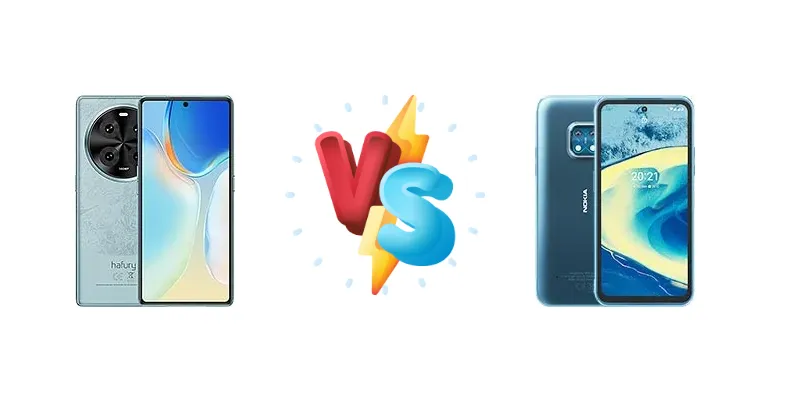
|
🏆 Quick Verdict
For users prioritizing gaming and demanding applications, the Cubot Hafury Meet is the better choice due to its more powerful Helio G99 chipset. However, the Nokia XR20’s rugged design, wireless charging, and Nokia’s software support make it ideal for those needing a durable, reliable device.
| PHONES | ||
|---|---|---|
| Phone Names | Cubot Hafury Meet | Nokia XR20 |
| Network | ||
|---|---|---|
| 2G bands | GSM 850 / 900 / 1800 / 1900 | GSM 850 / 900 / 1800 / 1900 |
| 3G bands | HSDPA 800 / 850 / 900 / 1700(AWS) / 1900 / 2100 | HSDPA 850 / 900 / 1700(AWS) / 1900 / 2100 |
| 4G bands | 1, 2, 3, 4, 5, 7, 8, 12, 13, 17, 18, 19, 20, 25, 26, 28, 38, 39, 40, 41, 66 | 1, 2, 3, 4, 5, 7, 8, 12, 13, 14, 20, 25, 26, 28, 30, 38, 40, 41, 48, 66, 71 |
| 5G bands | - | 2, 5, 25, 38, 41, 48, 66, 77, 78 SA/NSA |
| Speed | HSPA, LTE | HSPA, LTE, 5G |
| Technology | GSM / HSPA / LTE | GSM / CDMA / HSPA / EVDO / LTE / 5G |
| - | CDMA2000 1xEV-DO | |
| Launch | ||
|---|---|---|
| Announced | 2024, April 02 | 2021, July 27 |
| Status | Available. Released 2024, April | Available. Released 2021, August 04 |
| Body | ||
|---|---|---|
| Dimensions | 162.2 x 74 x 9.4 mm (6.39 x 2.91 x 0.37 in) | 171.6 x 81.5 x 10.6 mm (6.76 x 3.21 x 0.42 in) |
| SIM | Nano-SIM + Nano-SIM | · Nano-SIM· Nano-SIM + Nano-SIM |
| Weight | 211 g (7.44 oz) | 248 g (8.75 oz) |
| - | IP68 dust/water resistant (up to 1.5m for 60 min) Drop-to-concrete resistance from up to 1.8m MIL-STD-810H compliant | |
| Display | ||
|---|---|---|
| Protection | - | Corning Gorilla Glass Victus |
| Resolution | 1080 x 2400 pixels, 20:9 ratio (~395 ppi density) | 1080 x 2400 pixels, 20:9 ratio (~395 ppi density) |
| Size | 6.67 inches, 107.4 cm2 (~89.5% screen-to-body ratio) | 6.67 inches, 107.4 cm2 (~76.8% screen-to-body ratio) |
| Type | AMOLED, 1B colors, 120Hz, 1500 nits (peak) | IPS LCD, 550 nits |
| Platform | ||
|---|---|---|
| CPU | Octa-core (2x2.2 GHz Cortex-A76 & 6x2.0 GHz Cortex-A55) | Octa-core (2x2.0 GHz Kryo 460 & 6x1.8 GHz Kryo 460) |
| Chipset | Mediatek Helio G99 (6 nm) | Qualcomm SM4350 Snapdragon 480 5G (8 nm) |
| GPU | Mali-G57 MC2 | Adreno 619 |
| OS | Android 13 | Android 11, upgradable to Android 13 |
| Memory | ||
|---|---|---|
| Card slot | microSDXC (uses shared SIM slot) | microSDXC (uses shared SIM slot) |
| Internal | 256GB 12GB RAM | 64GB 4GB RAM, 128GB 6GB RAM |
| Main Camera | ||
|---|---|---|
| Dual | - | 48 MP, f/1.8, (wide), 1/2.25", 0.8µm, PDAF 13 MP, f/2.4, 123˚ (ultrawide), 1/3.0", 1.12µm |
| Features | LED flash | Zeiss optics, Dual-LED dual-tone flash, second LED flash, HDR, panorama |
| Single | - | 8 MP, f/2.0 (wide), 1/4.0", 1.12µm |
| Triple | 100 MP, (wide), PDAF 16 MP, 117˚ (ultrawide) 5 MP (macro) | - |
| Video | 1080p@30fps | 1080p@30fps |
| Selfie camera | ||
|---|---|---|
| Single | 32 MP | 8 MP, f/2.0 (wide), 1/4.0", 1.12µm |
| Video | 1080p@30fps | 1080p@30fps |
| Sound | ||
|---|---|---|
| 3.5mm jack | - | Yes |
| 35mm jack | No | Yes |
| Loudspeaker | Yes | Yes, with stereo speakers |
| Comms | ||
|---|---|---|
| Bluetooth | 5.2, A2DP | 5.1, A2DP, LE, aptX Adaptive |
| NFC | Yes | Yes |
| Positioning | GPS, GALILEO, GLONASS, BDS | GPS (L1+L5), GLONASS, BDS, GALILEO, QZSS, NavIC |
| Radio | Unspecified | Unspecified |
| USB | USB Type-C, OTG | USB Type-C 3.0 |
| WLAN | Wi-Fi 802.11 a/b/g/n/ac, dual-band | Wi-Fi 802.11 a/b/g/n/ac/6, dual-band, Wi-Fi Direct |
| Features | ||
|---|---|---|
| Sensors | Fingerprint (under display, optical), accelerometer, gyro, proximity, compass | Fingerprint (side-mounted), accelerometer, gyro, proximity, compass, barometer |
| Battery | ||
|---|---|---|
| Charging | 33W wired | 18W wired 15W wireless |
| Type | 5100 mAh | Li-Po 4630 mAh |
| Misc | ||
|---|---|---|
| Colors | Green | Ultra Blue, Granite Gray |
| Models | - | TA-1368, TA-1362 |
| Price | About 200 EUR | About 270 EUR |
| SAR EU | - | 1.13 W/kg (head) 1.43 W/kg (body) |
Cubot Hafury Meet
- More powerful processor (Helio G99)
- Faster wired charging (33W)
- Potentially better gaming performance
- No wireless charging
- Durability likely less robust than XR20
- Camera specs unknown
Nokia XR20
- Rugged design with Gorilla Glass Victus
- Wireless charging support
- Guaranteed software updates from Nokia
- Less powerful processor (Snapdragon 480)
- Slower wired charging (18W)
- Gaming performance limited
Display Comparison
Neither device boasts a flagship-level display. While specific display specs (resolution, panel type) are missing for the Hafury Meet, the Nokia XR20 features a 6.67-inch FHD+ display. The Hafury Meet’s focus on processing power suggests a potentially less expensive panel. The XR20’s Corning Gorilla Glass Victus provides superior scratch and drop resistance, a key benefit for its rugged positioning. The XR20’s 8nm Snapdragon 480 likely contributes to better power efficiency for the display, potentially extending battery life during video playback.
Camera Comparison
Without detailed camera specs for the Hafury Meet, a direct comparison is limited. The Nokia XR20 features a 48MP main sensor with OIS, a significant advantage for low-light photography and video stabilization. While the XR20 also includes an 8MP ultrawide and a 2MP macro (often of limited utility), the main sensor’s quality and OIS are the key differentiators. The Hafury Meet will likely rely on software processing to compensate for a potentially less capable sensor, but the G99’s processing power could help in this regard. The XR20’s image processing is geared towards natural colors, while the Hafury Meet’s is likely more saturated.
Performance
The Cubot Hafury Meet’s Mediatek Helio G99 (6nm) is the clear winner in raw processing power. Its octa-core configuration with 2x2.2 GHz Cortex-A76 cores significantly outperforms the Nokia XR20’s Snapdragon 480 (8nm) with 2x2.0 GHz Kryo 460 cores. The 6nm process node of the G99 also offers improved power efficiency compared to the 8nm Snapdragon 480, though real-world gains depend on software optimization. This translates to faster app loading times, smoother multitasking, and a better gaming experience on the Hafury Meet. The XR20’s Snapdragon 480 is sufficient for everyday tasks, but will struggle with graphically intensive games.
Battery Life
The Nokia XR20 offers the flexibility of both 18W wired and 15W wireless charging, a convenience the Cubot Hafury Meet lacks with its 33W wired charging only. While 33W is faster than 18W, the XR20’s wireless charging is a significant benefit for users who prefer cable-free charging. Battery capacity is not specified for the Hafury Meet, but the XR20’s 5000mAh battery provides all-day battery life for moderate usage. The G99’s 6nm efficiency could help the Hafury Meet achieve comparable battery life, but the lack of wireless charging is a drawback.
Buying Guide
Buy the Cubot Hafury Meet if you need a phone for mobile gaming, streaming, or running demanding apps and prioritize performance over all else. You'll benefit from the faster processor and potentially smoother multitasking. Buy the Nokia XR20 if you prefer a phone built to withstand drops and the elements, value long-term software support, and appreciate the convenience of wireless charging. It’s the better option for outdoor workers or those prone to accidents.