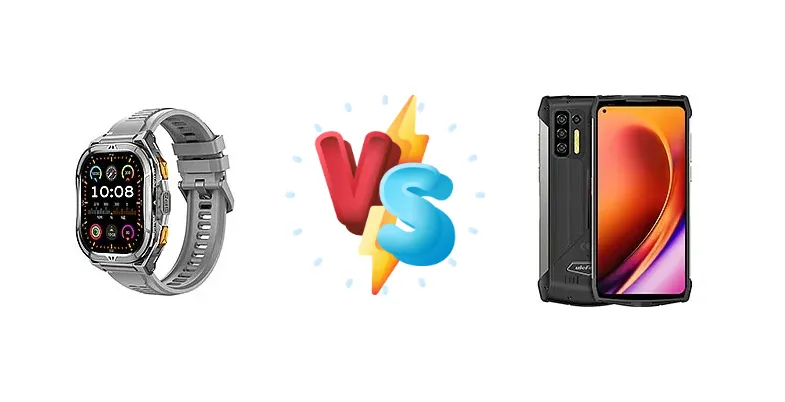
The Ulefone Power Armor 13 establishes a clear benchmark in the rugged smartphone space, boasting impressive battery endurance and a solid mid-range chipset. The Cubot GT3, however, enters the arena with limited publicly available specifications, making a direct comparison a challenge of assessing potential versus proven capability. This comparison aims to dissect the known strengths of the Ulefone and extrapolate the likely positioning of the Cubot based on brand tendencies and market segment.
🏆 Quick Verdict
For the average user prioritizing a dependable, long-lasting device, the Ulefone Power Armor 13 is the clear winner. Its 296-hour endurance rating and Helio G95 chipset offer a tangible experience. The Cubot GT3 remains an unknown quantity, appealing only to those willing to gamble on unconfirmed features.
| Network |
|---|
| 2G bands | N/A | GSM 850 / 900 / 1800 / 1900 |
| 3G bands | N/A | HSDPA 850 / 900 / 1700(AWS) / 1900 / 2100 |
| 4G bands | N/A | 1, 2, 3, 4, 5, 7, 8, 12, 13, 17, 18, 19, 20, 25, 26, 28, 38, 40, 66 |
| EDGE | No | - |
| GPRS | No | - |
| Speed | No | HSPA 42.2/11.5 Mbps, LTE Cat12 600/150 Mbps |
| Technology | No cellular connectivity | GSM / HSPA / LTE |
| Launch |
|---|
| Announced | 2025, March | 2021, July 22 |
| Status | Available. Released 2025, March | Available. Released 2021, July 26 |
| Body |
|---|
| Dimensions | 59.3 x 48.2 x 13.4 mm (2.33 x 1.90 x 0.53 in) | 183.7 x 85.4 x 20.8 mm (7.23 x 3.36 x 0.82 in) |
| SIM | No | Nano-SIM + Nano-SIM |
| Weight | 57 g (2.01 oz) | 492 g (1.08 lb) |
| | - | IP68 dust/water resistant (up to 1.5m for 30 min)
Drop-to-concrete resistance from up to 1.2m
MIL-STD-810G compliant |
| Display |
|---|
| Protection | - | Corning Gorilla Glass 3 |
| Resolution | 410 x 502 pixels (~331 ppi density) | 1080 x 2400 pixels, 20:9 ratio (~386 ppi density) |
| Size | 1.96 inches | 6.81 inches, 112.0 cm2 (~71.4% screen-to-body ratio) |
| Type | AMOLED | IPS LCD |
| Platform |
|---|
| CPU | - | Octa-core (2x2.05 GHz Cortex-A76 & 6x2.0 GHz Cortex-A55) |
| Chipset | - | Mediatek MT6785V/CD Helio G95 (12 nm) |
| GPU | - | Mali-G76 MC4 |
| OS | Proprietary OS | Android 11 |
| Memory |
|---|
| Card slot | No | microSDXC (uses shared SIM slot) |
| Internal | 32MB | 256GB 8GB RAM |
| Main Camera |
|---|
| Features | - | Quad-LED flash, HDR, panorama |
| Penta | - | 48 MP, f/1.8, 26mm (wide), 1/2.0", 0.8µm, PDAF
8 MP, f/2.2, (ultrawide)
2 MP (macro)
Auxiliary lens |
| Video | - | 4K@30fps, 1080p@30fps |
| Selfie camera |
|---|
| Features | - | HDR, panorama |
| Single | - | 16 MP, f/2.2 |
| Video | - | 1080p@30fps |
| Sound |
|---|
| 3.5mm jack | - | Yes |
| 35mm jack | No | Yes |
| Loudspeaker | Yes | Yes |
| Comms |
|---|
| Bluetooth | 5.3, A2DP, LE | 5.0, A2DP, LE |
| NFC | No | Yes |
| Positioning | GPS (L1+L5) | GPS, GLONASS, GALILEO, BDS |
| Radio | No | FM radio, RDS, recording |
| USB | No | - |
| WLAN | No | Wi-Fi 802.11 a/b/g/n/ac, dual-band |
| Features |
|---|
| Sensors | Accelerometer, gyro, barometer, compass, heart rate, SpO2 | Fingerprint (side-mounted), accelerometer, gyro, proximity, compass, baroceptor, coulombmeter |
| | - | Infrared distance measure (error range: 1~20m, ±10mm; 20~40m, ±25mm) |
| Battery |
|---|
| Charging | - | 33W wired
15W wireless
5W reverse wireless |
| Type | 530 mAh | Li-Po 13200 mAh |
| Misc |
|---|
| Colors | Black, Gray | Black |
| Price | - | About 300 EUR |
| Tests |
|---|
| Battery life | - |
Endurance rating 296h
|
| Camera | - |
Photo / Video |
| Display | - |
Contrast ratio: 1306:1 (nominal) |
| Loudspeaker | - |
-28.3 LUFS (Average)
|
| Performance | - |
AnTuTu: 294194 (v8), 351678 (v9)
GeekBench: 1610 (v5.1)
GFXBench: 18fps (ES 3.1 onscreen) |
Cubot GT3
- Potential for aggressive pricing
- Unknown features could be compelling
- May offer a unique design aesthetic
- Lack of publicly available specifications
- Uncertain software support and updates
- Potential for lower build quality
Ulefone Power Armor 13
- Exceptional 296-hour battery life
- Reliable MediaTek Helio G95 performance
- Rugged build quality and durability
- Display brightness could be higher
- Camera details are limited
- May be slightly bulkier due to rugged design
Display Comparison
The Ulefone Power Armor 13 features a display with a measured peak brightness of 401 nits and a 1306:1 contrast ratio. While not class-leading, this provides adequate visibility outdoors. The Cubot GT3’s display specifications are currently unknown. Given Cubot’s typical positioning, it’s likely to feature a similar, if not slightly lower, quality panel to maintain a competitive price point. The contrast ratio of the Ulefone suggests a standard IPS LCD, while the brightness is sufficient for most use cases, it won't compete with higher-end OLED displays.
Camera Comparison
Both devices list 'Photo / Video' capabilities, offering minimal insight. The Ulefone Power Armor 13 likely features a multi-camera setup, common in this price range, but details on sensor size and quality are missing. The Cubot GT3’s camera system is entirely unknown. Without specific sensor information, it’s difficult to assess image quality. It’s reasonable to assume both phones will include a primary sensor, potentially accompanied by macro and depth sensors, though the utility of a 2MP macro lens is often limited.
Performance
The Ulefone Power Armor 13 is powered by the MediaTek Helio G95 (12 nm) chipset, featuring an octa-core CPU configuration with 2x2.05 GHz Cortex-A76 and 6x2.0 GHz Cortex-A55 cores. This chipset provides a solid mid-range experience, capable of handling most daily tasks and moderate gaming. The Cubot GT3’s processor is unspecified. Considering Cubot’s market segment, it’s plausible they’ve opted for a similar Helio G-series chip, potentially a G85 or G88, to keep costs down. The G95’s Cortex-A76 cores offer a performance advantage over the A55-only configurations found in some lower-tier chips.
Battery Life
The Ulefone Power Armor 13 shines with an impressive endurance rating of 296 hours, indicating exceptional battery life. It supports 33W wired charging, 15W wireless charging, and even 5W reverse wireless charging. The Cubot GT3’s battery capacity and charging capabilities are unknown. Given the lack of information, it’s difficult to predict its battery performance. However, the Ulefone’s multi-faceted charging options – wired, wireless, and reverse wireless – provide significant convenience and flexibility.
Buying Guide
Buy the Cubot GT3 if you are a budget-conscious user willing to take a risk on a potentially feature-rich device with limited information available, and are comfortable with potential software quirks. Buy the Ulefone Power Armor 13 if you need a proven, durable smartphone with exceptional battery life, reliable performance for everyday tasks, and the peace of mind that comes with a well-defined specification sheet. It's ideal for outdoor workers, adventurers, or anyone prone to dropping their phone.
Frequently Asked Questions
❓ Does the Ulefone Power Armor 13 support fast charging, and how long does it take to fully charge?
The Ulefone Power Armor 13 supports 33W wired fast charging. While a precise 0-100% charge time hasn't been officially stated, expect a full charge to take approximately 1 hour and 45 minutes to 2 hours, depending on the charger used and background processes.
❓ Given the limited information on the Cubot GT3, what are the biggest risks of purchasing it?
The primary risk with the Cubot GT3 is the lack of transparency regarding its specifications. You're essentially buying a device with unknown performance, camera quality, and software support. There's a higher chance of encountering bugs, receiving infrequent updates, or being disappointed by the overall experience compared to the well-defined Ulefone Power Armor 13.
❓ Is the Ulefone Power Armor 13 truly waterproof, or just water-resistant?
The Ulefone Power Armor 13 boasts an IP68 rating, meaning it's dust-tight and can withstand immersion in up to 1.5 meters of freshwater for up to 30 minutes. However, it's important to note that this rating doesn't cover saltwater or chlorinated water, and prolonged exposure can still cause damage.