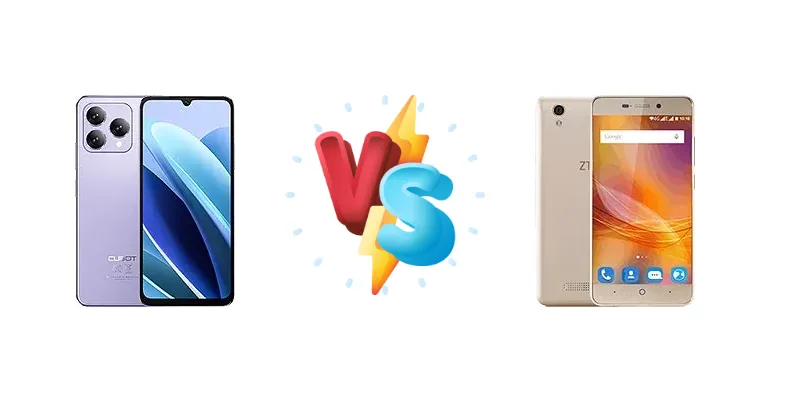
The smartphone market is flooded with ultra-affordable options, but performance and longevity vary wildly. We pit the Cubot A40, powered by a modern Unisoc T606 chipset, against the ZTE Blade A452, which relies on the older Mediatek MT6735P. This comparison isn't about raw power; it's about how efficiently each phone handles everyday tasks and how long they'll remain usable in the long run.
🏆 Quick Verdict
For the average user prioritizing battery life and future-proofing, the Cubot A40 is the clear winner. Its Unisoc T606 chipset, built on a 12nm process, offers significantly better performance and efficiency compared to the ZTE Blade A452’s aging 28nm Mediatek MT6735P. While the A452 may be cheaper upfront, the A40’s endurance and responsiveness provide superior value.
| Network |
|---|
| 2G bands | GSM 850 / 900 / 1800 / 1900 | GSM 850 / 900 / 1800 / 1900 - SIM 1 & SIM 2 |
| 3G bands | HSDPA 850 / 900 / 1700(AWS) / 1900 / 2100 | HSDPA 850 / 900 / 2100 |
| 4G bands | 1, 2, 3, 4, 5, 7, 8, 12, 17, 20, 26, 28, 38, 39, 40, 41, 66 | 1, 3, 7, 8, 20, 38, 40 |
| Speed | HSPA, LTE | HSPA 42.2/5.76 Mbps, LTE Cat4 150/50 Mbps |
| Technology | GSM / HSPA / LTE | GSM / HSPA / LTE |
| Launch |
|---|
| Announced | 2025, July | 2016, Q1. Released 2016, Q1 |
| Status | Available. Released 2025, July | Discontinued |
| Body |
|---|
| Dimensions | 172.3 x 78.1 x 8.8 mm (6.78 x 3.07 x 0.35 in) | 145 x 71.5 x 8.9 mm (5.71 x 2.81 x 0.35 in) |
| SIM | Nano-SIM + Nano-SIM | Dual SIM (Micro-SIM, dual stand-by) |
| Weight | - | 159 g (5.61 oz) |
| Display |
|---|
| Protection | Mohs level 6 | - |
| Resolution | 720 x 1640 pixels (~260 ppi density) | 720 x 1280 pixels, 16:9 ratio (~294 ppi density) |
| Size | 6.88 inches, 112.4 cm2 (~83.5% screen-to-body ratio) | 5.0 inches, 68.9 cm2 (~66.5% screen-to-body ratio) |
| Type | IPS LCD, 120Hz | IPS LCD |
| Platform |
|---|
| CPU | Octa-core (2x1.6 GHz Cortex-A75 & 6x1.6 GHz Cortex-A55) | Quad-core 1.0 GHz Cortex-A53 |
| Chipset | Unisoc T606 (12 nm) | Mediatek MT6735P (28 nm) |
| GPU | Mali-G57 MP1 | Mali-T720MP2 |
| OS | Android 15 | Android 5.1 (Lollipop) |
| Memory |
|---|
| Card slot | microSDXC | microSDHC (dedicated slot) |
| Internal | 64GB 4GB RAM, 256GB 8GB RAM | 8GB 1GB RAM |
| Main Camera |
|---|
| Dual | 48 MP, (wide), PDAF
2 MP, (ultrawide) | - |
| Features | LED flash | LED flash, HDR, panorama |
| Single | - | 8 MP, AF |
| Video | Yes | 1080p@30fps |
| Selfie camera |
|---|
| Single | 16 MP | 5 MP |
| Video | Yes | - |
| Sound |
|---|
| 3.5mm jack | - | Yes |
| 35mm jack | No | Yes |
| Loudspeaker | Yes, with stereo speakers | Yes |
| Comms |
|---|
| Bluetooth | 5.0, A2DP, LE | 4.0, A2DP |
| NFC | Yes | No |
| Positioning | GPS, GALILEO, GLONASS, BDS | GPS |
| Radio | Unspecified | FM radio |
| USB | USB Type-C, OTG | microUSB 2.0, OTG |
| WLAN | Wi-Fi 802.11 a/b/g/n/ac, dual-band | Wi-Fi 802.11 b/g/n, Wi-Fi Direct, hotspot |
| Features |
|---|
| Sensors | Accelerometer, proximity | Accelerometer, proximity |
| Battery |
|---|
| Charging | - | Reverse wired |
| Type | 5100 mAh | Li-Ion 4000 mAh, non-removable |
| Misc |
|---|
| Colors | Black, Purple, Titan Grey | Ion Gold, Black, White |
| Models | - | Blade A452 |
| EU LABEL |
|---|
| Battery | 43:53h endurance, 1300 cycles | - |
| Energy | Class C | - |
| Free fall | Class A (270 falls) | - |
| Repairability | Class B | - |
Cubot A40
- Significantly better performance with the Unisoc T606 chipset.
- Exceptional battery life (43:53h endurance).
- Modern 12nm fabrication process for improved efficiency.
- Display specifications are unknown.
- Camera details are limited.
ZTE Blade A452
- Potentially lower upfront cost.
- Reverse wired charging capability.
- Simple and straightforward user experience.
- Outdated Mediatek MT6735P chipset.
- Poor performance compared to the A40.
- Likely shorter battery life and reduced longevity.
Display Comparison
Neither device’s display specifications are provided, so a direct comparison is impossible. However, given the A452’s older chipset, it’s likely to feature an older LCD panel with lower brightness and color accuracy. The A40, benefiting from a more recent design, likely has a more modern display, potentially with improved viewing angles and color reproduction. The absence of details necessitates assuming a significant advantage for the A40 in display quality.
Camera Comparison
Without camera specifications, a detailed comparison is limited. However, it’s reasonable to assume the ZTE Blade A452, given its age, will feature a less sophisticated camera system. The A40 likely benefits from newer image processing algorithms and potentially a larger sensor, resulting in better image quality, especially in low-light conditions. The presence of a 2MP macro camera on either device is unlikely to significantly impact the overall camera experience.
Performance
The performance gap between these two devices is substantial. The Cubot A40’s Unisoc T606, an octa-core processor with a mix of Cortex-A75 and A55 cores, is a far more capable chipset than the ZTE Blade A452’s quad-core Cortex-A53 based Mediatek MT6735P. The T606’s 12nm fabrication process is significantly more efficient than the MT6735P’s 28nm process, resulting in lower power consumption and less heat generation. This translates to smoother multitasking, faster app loading times, and a more responsive user experience on the A40. The A75 cores in the A40 provide a noticeable performance boost for demanding tasks.
Battery Life
The Cubot A40 boasts an impressive 43:53h endurance rating and a reported 1300 charge cycles, indicating exceptional battery life and longevity. The ZTE Blade A452’s battery performance is not specified, but given its older, less efficient chipset, it will almost certainly fall short of the A40. The 12nm process of the Unisoc T606 contributes significantly to the A40’s extended battery life. The A40’s reverse wired charging capability, absent in the A452, adds further convenience.
Buying Guide
Buy the Cubot A40 if you need a phone that can comfortably last a full day on a single charge, handles multitasking without significant slowdown, and benefits from a more modern chipset architecture. Buy the ZTE Blade A452 if your primary concern is the absolute lowest possible price point and you only require basic functionality like calls, texts, and light web browsing – understanding that performance will be limited and battery life shorter.
Frequently Asked Questions
❓ Is the Unisoc T606 chipset in the Cubot A40 capable of handling modern mobile games?
While not a flagship gaming processor, the Unisoc T606 is capable of running many popular mobile games at medium settings. The Cortex-A75 cores provide a performance boost for gaming, and the efficient 12nm process helps prevent overheating during extended gaming sessions. Expect playable frame rates in titles like PUBG Mobile and Call of Duty Mobile, but don't expect maximum graphical settings.
❓ How does the 28nm process of the Mediatek MT6735P affect the ZTE Blade A452’s battery life and performance?
The 28nm process is significantly less efficient than the 12nm process used in the Unisoc T606. This means the MT6735P consumes more power for the same level of performance, resulting in shorter battery life and increased heat generation. The A452 will likely require more frequent charging and may experience performance throttling under sustained load.
❓ What is the practical benefit of 1300 charge cycles on the Cubot A40?
1300 charge cycles indicate the battery is designed to retain a significant portion of its original capacity after being fully charged and discharged 1300 times. This translates to a longer lifespan for the phone, meaning you'll be able to use it for years without experiencing a significant decline in battery performance. It's a key indicator of long-term value.