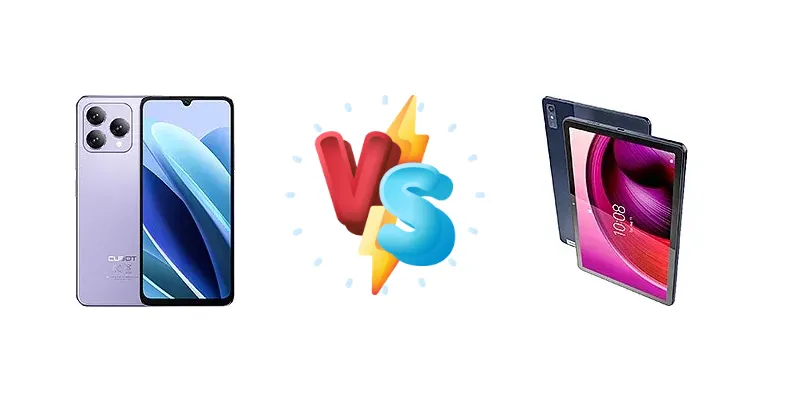
The tablet market offers a wide range of options, but finding the right balance between performance, battery life, and price can be challenging. We pit the Cubot A40, known for its impressive endurance, against the Lenovo Tab M10, which boasts 5G connectivity and a more modern chipset, to determine which tablet delivers the best value.
🏆 Quick Verdict
For users prioritizing all-day battery life and sustained usage, the Cubot A40 is the clear winner. However, the Lenovo Tab M10’s Snapdragon 695 5G chipset provides a noticeable performance boost and future-proofs connectivity, making it ideal for users who demand faster speeds and occasional gaming.
| Network |
|---|
| 2G bands | GSM 850 / 900 / 1800 / 1900 | GSM 850 / 900 / 1800 / 1900 |
| 3G bands | HSDPA 850 / 900 / 1700(AWS) / 1900 / 2100 | HSDPA 850 / 900 / 2100 |
| 4G bands | 1, 2, 3, 4, 5, 7, 8, 12, 17, 20, 26, 28, 38, 39, 40, 41, 66 | LTE |
| 5G bands | - | SA/NSA |
| Speed | HSPA, LTE | HSPA, LTE, 5G |
| Technology | GSM / HSPA / LTE | GSM / HSPA / LTE / 5G |
| Launch |
|---|
| Announced | 2025, July | 2023, July 14 |
| Status | Available. Released 2025, July | Available. Released 2023, July 15 |
| Body |
|---|
| Dimensions | 172.3 x 78.1 x 8.8 mm (6.78 x 3.07 x 0.35 in) | 160.3 x 252.7 x 8.3 mm (6.31 x 9.95 x 0.33 in) |
| SIM | Nano-SIM + Nano-SIM | Nano-SIM |
| Weight | - | 490 g (1.08 lb) |
| Display |
|---|
| Protection | Mohs level 6 | - |
| Resolution | 720 x 1640 pixels (~260 ppi density) | 1200 x 2000 pixels, 5:3 ratio (~220 ppi density) |
| Size | 6.88 inches, 112.4 cm2 (~83.5% screen-to-body ratio) | 10.6 inches, 319.8 cm2 (~79.0% screen-to-body ratio) |
| Type | IPS LCD, 120Hz | IPS LCD, 90Hz, 400 nits |
| Platform |
|---|
| CPU | Octa-core (2x1.6 GHz Cortex-A75 & 6x1.6 GHz Cortex-A55) | Octa-core (2x2.2 GHz Kryo 660 Gold & 6x1.7 GHz Kryo 660 Silver) |
| Chipset | Unisoc T606 (12 nm) | Qualcomm SM6375 Snapdragon 695 5G (6 nm) |
| GPU | Mali-G57 MP1 | Adreno 619 |
| OS | Android 15 | Android 13 |
| Memory |
|---|
| Card slot | microSDXC | microSDXC (dedicated slot) |
| Internal | 64GB 4GB RAM, 256GB 8GB RAM | 128GB 4GB RAM, 128GB 6GB RAM |
| Main Camera |
|---|
| Dual | 48 MP, (wide), PDAF
2 MP, (ultrawide) | - |
| Features | LED flash | LED flash |
| Single | - | 13 MP, AF |
| Video | Yes | 1080p@30fps |
| Selfie camera |
|---|
| Single | 16 MP | 8 MP |
| Video | Yes | 1080p@30fps |
| Sound |
|---|
| 35mm jack | No | Yes |
| Loudspeaker | Yes, with stereo speakers | Yes, with stereo speakers |
| Comms |
|---|
| Bluetooth | 5.0, A2DP, LE | 5.1, A2DP, LE |
| NFC | Yes | No |
| Positioning | GPS, GALILEO, GLONASS, BDS | GPS, GLONASS, BDS |
| Radio | Unspecified | No |
| USB | USB Type-C, OTG | USB Type-C 2.0 |
| WLAN | Wi-Fi 802.11 a/b/g/n/ac, dual-band | Wi-Fi 802.11 a/b/g/n/ac, dual-band |
| Features |
|---|
| Sensors | Accelerometer, proximity | Unspecified |
| Battery |
|---|
| Charging | - | 20W, PD3.0, QC3 |
| Type | 5100 mAh | Li-Po 7700 mAh |
| Misc |
|---|
| Colors | Black, Purple, Titan Grey | Abyss Blue |
| Price | - | About 400 EUR |
| EU LABEL |
|---|
| Battery | 43:53h endurance, 1300 cycles | - |
| Energy | Class C | - |
| Free fall | Class A (270 falls) | - |
| Repairability | Class B | - |
Cubot A40
- Exceptional battery life (43:53h endurance)
- Efficient Unisoc T606 chipset
- Potentially lower price point
- Less powerful processor
- No 5G connectivity
- Likely slower charging speeds
Lenovo Tab M10
- Faster Snapdragon 695 5G chipset
- 20W fast charging with PD3.0/QC3
- 5G connectivity for faster data speeds
- Shorter battery life compared to Cubot A40
- Potentially higher price
- May experience more thermal throttling under sustained load
Display Comparison
Neither device’s display specifications are provided, so we must infer. Given the price point of both tablets, expect IPS LCD panels with 1080p resolution. The Lenovo Tab M10 likely benefits from a slightly more refined panel due to Lenovo’s brand reputation. However, without specific brightness or color accuracy data, it’s difficult to definitively declare a winner. Bezels are likely comparable, reflecting the budget nature of both devices.
Camera Comparison
Camera specifications are absent for both devices. Given their market segment, we can assume both tablets feature modest camera setups. Image quality will likely be sufficient for casual snapshots and video calls, but neither device is positioned as a photography powerhouse. Without sensor size or aperture information, a meaningful comparison is impossible. Expect Lenovo to have slightly better image processing algorithms.
Performance
The Lenovo Tab M10’s Qualcomm Snapdragon 695 (6nm) represents a significant architectural leap over the Cubot A40’s Unisoc T606 (12nm). The 6nm process node inherently offers better power efficiency and thermal performance. The Snapdragon 695’s Kryo 660 cores, with a peak clock speed of 2.2 GHz, outperform the Unisoc T606’s Cortex-A75 cores (1.6 GHz) in both single-core and multi-core tasks. This translates to snappier app launches, smoother multitasking, and a more responsive user experience on the Lenovo Tab M10. The Unisoc T606 is adequate for basic tasks, but will struggle with demanding applications.
Battery Life
The Cubot A40’s standout feature is its exceptional battery endurance – a reported 43 hours and 53 minutes. This is likely achieved through a combination of the less power-hungry Unisoc T606 chipset and a potentially larger battery capacity (though not specified). The Lenovo Tab M10, while offering 20W charging with PD3.0 and QC3 support for faster replenishment, will likely have shorter battery life due to the more powerful Snapdragon 695 and 5G connectivity. The faster charging is a significant advantage for the Lenovo Tab M10, mitigating the potential for shorter runtimes.
Buying Guide
Buy the Cubot A40 if you need a tablet primarily for media consumption, reading, or basic productivity tasks and require exceptional battery life. It’s perfect for travelers or anyone away from power outlets for extended periods. Buy the Lenovo Tab M10 if you prioritize faster download speeds, smoother multitasking, and occasional gaming, and value the convenience of 5G connectivity for on-the-go use.
Frequently Asked Questions
❓ Will the Lenovo Tab M10’s Snapdragon 695 overheat during extended gaming sessions?
While the Snapdragon 695 is a capable chipset, sustained gaming on a tablet without robust cooling can lead to thermal throttling. Expect some performance reduction after prolonged use, but the 6nm process node should mitigate overheating compared to older, larger-node chipsets. The Cubot A40, with its less powerful processor, will likely experience less thermal throttling.
❓ How does the 5G connectivity on the Lenovo Tab M10 impact real-world battery life?
Actively using 5G connectivity significantly drains battery life compared to Wi-Fi. While the Lenovo Tab M10 offers fast charging, relying heavily on 5G will reduce overall usage time. Users should consider switching to Wi-Fi whenever possible to conserve battery.
❓ Is the Cubot A40 suitable for video editing or other demanding tasks?
The Unisoc T606 chipset in the Cubot A40 is not ideal for demanding tasks like video editing. While it can handle basic productivity, it will struggle with resource-intensive applications. The Lenovo Tab M10’s Snapdragon 695 offers a more responsive experience for these workloads, but it’s still a budget-oriented chipset and won’t match the performance of high-end tablets.