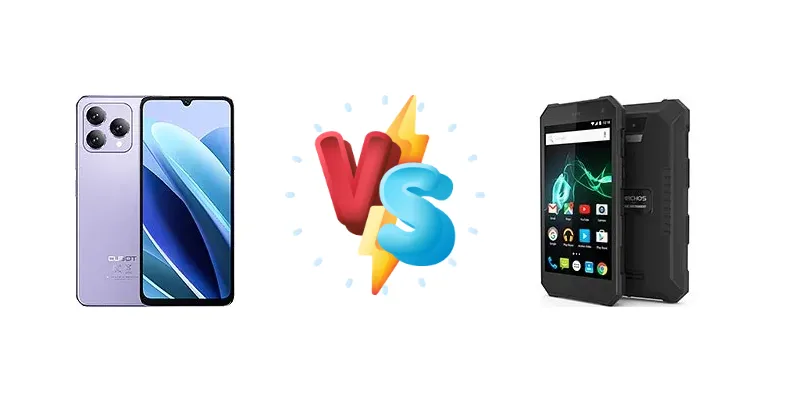
In the crowded budget smartphone market, the Cubot A40 and Archos 50 Saphir represent distinct approaches. The A40 leverages a newer chipset for improved performance and endurance, while the Saphir aims for ultimate affordability. This comparison dissects their key differences to help you choose the right device for your needs.
🏆 Quick Verdict
For the average user, the Cubot A40 is the clear winner. Its Unisoc T606 chipset delivers a significantly smoother experience and its exceptional 43:53h battery endurance dwarfs the Archos 50 Saphir. While the Saphir is cheaper, the performance trade-offs are substantial.
| Network |
|---|
| 2G bands | GSM 850 / 900 / 1800 / 1900 | GSM 850 / 900 / 1800 / 1900 - SIM 1 & SIM 2 |
| 3G bands | HSDPA 850 / 900 / 1700(AWS) / 1900 / 2100 | HSDPA 900 / 2100 |
| 4G bands | 1, 2, 3, 4, 5, 7, 8, 12, 17, 20, 26, 28, 38, 39, 40, 41, 66 | LTE 800 / 1800 / 2100 / 2600 |
| Speed | HSPA, LTE | HSPA 42.2/11.5 Mbps, LTE Cat4 150/50 Mbps |
| Technology | GSM / HSPA / LTE | GSM / HSPA / LTE |
| Launch |
|---|
| Announced | 2025, July | 2017, February. Released 2017, June |
| Status | Available. Released 2025, July | Discontinued |
| Body |
|---|
| Dimensions | 172.3 x 78.1 x 8.8 mm (6.78 x 3.07 x 0.35 in) | 146.6 x 75.9 x 13.9 mm (5.77 x 2.99 x 0.55 in) |
| SIM | Nano-SIM + Nano-SIM | Nano-SIM + Nano-SIM |
| Weight | - | - |
| | - | IP68 dust/water resistant (up to 1m for 30 mins) |
| Display |
|---|
| Protection | Mohs level 6 | Corning Gorilla Glass 4 |
| Resolution | 720 x 1640 pixels (~260 ppi density) | 720 x 1280 pixels, 16:9 ratio (~294 ppi density) |
| Size | 6.88 inches, 112.4 cm2 (~83.5% screen-to-body ratio) | 5.0 inches, 68.9 cm2 (~61.9% screen-to-body ratio) |
| Type | IPS LCD, 120Hz | IPS LCD |
| Platform |
|---|
| CPU | Octa-core (2x1.6 GHz Cortex-A75 & 6x1.6 GHz Cortex-A55) | Quad-core 1.5 GHz Cortex-A53 |
| Chipset | Unisoc T606 (12 nm) | Mediatek MT6737 (28 nm) |
| GPU | Mali-G57 MP1 | Mali-T720MP2 |
| OS | Android 15 | Android 6.0 (Marshmallow) |
| Memory |
|---|
| Card slot | microSDXC | microSDXC |
| Internal | 64GB 4GB RAM, 256GB 8GB RAM | 16GB 2GB RAM |
| | - | eMMC 5.0 |
| Main Camera |
|---|
| Dual | 48 MP, (wide), PDAF
2 MP, (ultrawide) | - |
| Features | LED flash | LED flash |
| Single | - | 8 MP, AF |
| Video | Yes | 1080p@30fps |
| Selfie camera |
|---|
| Single | 16 MP | 2 MP |
| Video | Yes | - |
| Sound |
|---|
| 3.5mm jack | - | Yes |
| 35mm jack | No | Yes |
| Loudspeaker | Yes, with stereo speakers | Yes |
| Comms |
|---|
| Bluetooth | 5.0, A2DP, LE | 4.0, A2DP, LE |
| NFC | Yes | No |
| Positioning | GPS, GALILEO, GLONASS, BDS | GPS |
| Radio | Unspecified | FM radio |
| USB | USB Type-C, OTG | microUSB 2.0, OTG |
| WLAN | Wi-Fi 802.11 a/b/g/n/ac, dual-band | Wi-Fi 802.11 b/g/n, Wi-Fi Direct, DLNA |
| Features |
|---|
| Sensors | Accelerometer, proximity | Accelerometer, proximity, compass |
| Battery |
|---|
| Charging | - | 10W wired |
| Stand-by | - | Up to 740 h (2G) / Up to 550 h (3G) |
| Talk time | - | Up to 37 h (2G) / Up to 27 h (3G) |
| Type | 5100 mAh | Li-Ion 5000 mAh, non-removable |
| Misc |
|---|
| Colors | Black, Purple, Titan Grey | Black |
| SAR EU | - | 0.55 W/kg (head) 0.80 W/kg (body) |
| EU LABEL |
|---|
| Battery | 43:53h endurance, 1300 cycles | - |
| Energy | Class C | - |
| Free fall | Class A (270 falls) | - |
| Repairability | Class B | - |
Cubot A40
- Significantly faster processor for smoother performance
- Exceptional battery life (43:53h endurance)
- More modern chipset with better efficiency
- Display specifications are unknown
- Camera details are limited
Archos 50 Saphir
- Lower price point
- Basic functionality for essential tasks
- Potentially more compact size (based on '50' in the name)
- Outdated and slow processor
- Poor performance for multitasking or gaming
- Slow 10W charging
Display Comparison
Display specifications are not provided for either device. However, given the price points, both likely utilize IPS LCD panels. The Archos 50 Saphir's name suggests a 5-inch display, while the Cubot A40's size is unknown. Expect 720p resolution on both. The lack of information prevents a detailed comparison of brightness, color accuracy, or refresh rates, but the Saphir's older chipset suggests it's unlikely to support advanced display features.
Camera Comparison
Camera details are limited. Both devices likely feature basic camera setups geared towards casual photography. Without sensor size or aperture information, it’s difficult to make a definitive judgment. However, the A40’s more powerful chipset allows for more sophisticated image processing algorithms, potentially resulting in better image quality, especially in low-light conditions. The Saphir’s older chipset will struggle with complex image processing tasks. Any 2MP macro sensors on either device are likely to offer minimal benefit.
Performance
The performance gap between these two devices is substantial. The Cubot A40’s Unisoc T606, built on a 12nm process, features an octa-core configuration (2x1.6 GHz Cortex-A75 & 6x1.6 GHz Cortex-A55). This architecture provides a significant uplift in both single-core and multi-core performance compared to the Archos 50 Saphir’s quad-core 1.5 GHz Cortex-A53 processor, fabricated on a much older 28nm process. The A75 cores in the A40 are considerably more powerful than the A53 cores in the Saphir, resulting in faster app loading times, smoother multitasking, and improved gaming performance. The 12nm process also contributes to better thermal efficiency, reducing the likelihood of throttling under sustained load.
Battery Life
The Cubot A40 boasts an impressive 43:53h endurance and a reported 1300 charge cycles, indicating a focus on longevity. The Archos 50 Saphir, while likely having a respectable battery capacity for its class, lacks the efficiency of the Unisoc T606. The Saphir’s 10W wired charging is significantly slower than what the A40 likely supports (though specific wattage is unknown), meaning longer times to reach a full charge. The A40’s superior endurance means users will likely need to charge it less frequently, a significant advantage for those on the go.
Buying Guide
Buy the Cubot A40 if you prioritize a responsive user experience, extended battery life for all-day use, and future-proofing with a more modern chipset. Buy the Archos 50 Saphir if your primary need is a basic smartphone for essential tasks like calls and messaging, and you are on an extremely tight budget where every dollar counts.
Frequently Asked Questions
❓ Will the Archos 50 Saphir struggle with modern apps like Facebook or WhatsApp?
Yes, the Mediatek MT6737 chipset is quite old and lacks the processing power to run modern apps smoothly. You may experience significant lag and slowdowns, especially with multiple apps open. The Cubot A40, with its Unisoc T606, will handle these apps with considerably more ease.
❓ How does the Unisoc T606 in the Cubot A40 perform in gaming compared to the Mediatek MT6737?
The Unisoc T606 is vastly superior for gaming. The A75 cores provide a significant performance boost, allowing for playable frame rates in many popular mobile games. The MT6737 will struggle with even less demanding titles, offering a poor gaming experience. Expect low frame rates and frequent stuttering on the Archos 50 Saphir.
❓ Is the 1300 charge cycle claim for the Cubot A40 realistic?
While 1300 cycles is a high number, Unisoc chipsets are known for their power efficiency, and the A40's reported endurance suggests a well-optimized power management system. This claim indicates the battery should maintain a significant portion of its capacity even after extended use, offering long-term value.