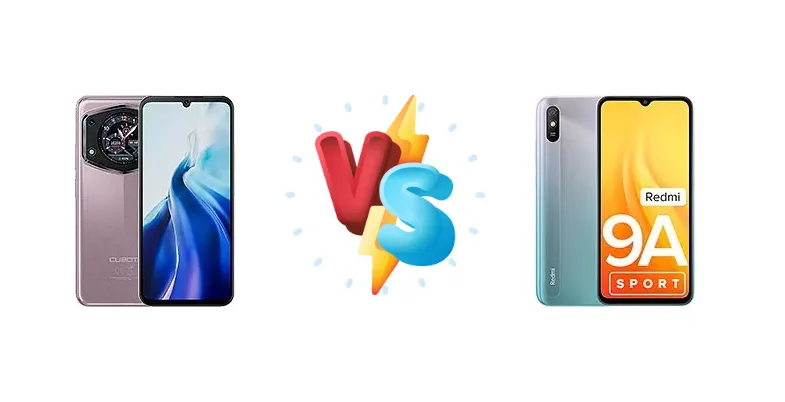
The sub-$150 smartphone market is fiercely competitive. Both the Cubot A30 and Xiaomi Redmi 9A Sport aim to deliver essential smartphone functionality at an accessible price. However, they take different approaches to achieving this, particularly in their core processing power and battery optimization. This comparison dissects those differences to determine which device offers the best value.
🏆 Quick Verdict
For the average user prioritizing longevity and consistent performance, the Cubot A30 is the better choice. Its Unisoc Tiger T616 chipset, featuring Cortex-A75 cores, provides a noticeable performance advantage over the Redmi 9A Sport’s Helio G25, and its exceptional 52:43h endurance rating makes it a true battery champion.
| Network |
|---|
| 2G bands | GSM 850 / 900 / 1800 / 1900 | GSM 850 / 900 / 1800 / 1900 |
| 3G bands | HSDPA 850 / 900 / 1700(AWS) / 1900 / 2100 | HSDPA 850 / 900 / 2100 |
| 4G bands | 1, 2, 3, 4, 5, 7, 8, 12, 17, 20, 28, 41 | 1, 3, 5, 8, 40, 41 |
| Speed | HSPA, LTE | HSPA, LTE |
| Technology | GSM / HSPA / LTE | GSM / HSPA / LTE |
| Launch |
|---|
| Announced | 2024 | 2021, September 28 |
| Status | Available. Released 2024 | Available. Released 2021, September 28 |
| Body |
|---|
| Dimensions | 170.4 x 77.5 x 9.6 mm (6.71 x 3.05 x 0.38 in) | 164.9 x 77.1 x 9 mm (6.49 x 3.04 x 0.35 in) |
| SIM | Nano-SIM + Nano-SIM | Nano-SIM + Nano-SIM |
| Weight | 216 g (7.62 oz) | 194 g (6.84 oz) |
| | - | Water-repellent coating |
| Display |
|---|
| Protection | Mohs level 6 | - |
| Resolution | 720 x 1600 pixels, 20:9 ratio (~260 ppi density) | 720 x 1600 pixels, 20:9 ratio (~269 ppi density) |
| Size | 6.75 inches, 110.0 cm2 (~83.3% screen-to-body ratio) | 6.53 inches, 102.9 cm2 (~81.0% screen-to-body ratio) |
| Type | IPS LCD, 90Hz | IPS LCD, 400 nits (typ) |
| Platform |
|---|
| CPU | Octa-core (2x2.0 GHz Cortex-A75 & 6x1.8 GHz Cortex-A55) | Octa-core (4x2.0 GHz Cortex-A53 & 4x1.5 GHz Cortex-A53) |
| Chipset | Unisoc Tiger T616 (12 nm) | Mediatek MT6762G Helio G25 (12 nm) |
| GPU | Mali-G57 MP1 | PowerVR GE8320 |
| OS | Android 14 | Android 10, MIUI 12 |
| Memory |
|---|
| Card slot | microSDXC (uses shared SIM slot) | microSDXC (dedicated slot) |
| Internal | 128GB 6GB RAM | 32GB 2GB RAM, 32GB 3GB RAM |
| | - | eMMC 5.1 |
| Main Camera |
|---|
| Features | LED flash | LED flash, HDR |
| Single | 48 MP, (wide), PDAF
Auxiliary lens | 13 MP, f/2.2, 28mm (wide), 1.0µm, PDAF |
| Video | Yes | 1080p@30/60fps |
| Selfie camera |
|---|
| Features | - | HDR |
| Single | 16 MP | 5 MP, f/2.2, (wide), 1.12µm |
| Video | Yes | 1080p@30fps |
| Sound |
|---|
| 3.5mm jack | - | Yes |
| 35mm jack | Yes | Yes |
| Loudspeaker | Yes | Yes |
| Comms |
|---|
| Bluetooth | 5.0, A2DP, LE | 5.0, A2DP, LE |
| NFC | No | No |
| Positioning | GPS, GALILEO, GLONASS, BDS | GPS, GLONASS, BDS |
| Radio | Unspecified | FM radio |
| USB | USB Type-C, OTG | microUSB 2.0, OTG |
| WLAN | Wi-Fi 802.11 a/b/g/n/ac, dual-band | Wi-Fi 802.11 a/b/g/n, Wi-Fi Direct |
| Features |
|---|
| Sensors | Accelerometer, proximity | Accelerometer, proximity |
| Battery |
|---|
| Charging | - | 10W wired |
| Type | 5100 mAh | Li-Po 5000 mAh |
| Misc |
|---|
| Colors | Gray, Pink | Carbon Black, Coral Green, Metallic Blue |
| Price | - | About 100 EUR |
| EU LABEL |
|---|
| Battery | 52:43h endurance, 800 cycles | - |
| Energy | Class B | - |
| Free fall | Class A (270 falls) | - |
| Repairability | Class B | - |
Cubot A30
- Superior CPU performance thanks to Cortex-A75 cores
- Exceptional battery life (52:43h endurance)
- Longer battery lifespan (800 charge cycles)
- Brand recognition is lower than Xiaomi
- Camera specs are currently unknown
Xiaomi Redmi 9A Sport
- Well-known brand (Xiaomi)
- Potentially wider availability of accessories
- Simple and user-friendly MIUI software (likely)
- Inferior CPU performance (Cortex-A53 cores)
- Slower 10W charging
- Shorter battery life compared to Cubot A30
Display Comparison
Neither device boasts a standout display. Both likely utilize LCD panels, common in this price bracket. Detailed specs like resolution and brightness are missing, but the focus here is on internal components. Display quality is likely similar, making it a non-differentiator.
Camera Comparison
Without detailed camera specifications, a direct comparison is difficult. However, it’s safe to assume both phones feature basic camera setups geared towards casual photography. The Redmi 9A Sport often includes a 13MP main sensor, while the Cubot A30's main sensor resolution is unknown. The presence of low-resolution auxiliary sensors (often 2MP) on both devices suggests limited utility beyond marketing. Image processing will likely be the key differentiator, but without sample images, it's impossible to assess.
Performance
The core difference lies in the chipsets. The Cubot A30’s Unisoc Tiger T616, built on a 12nm process, features a heterogeneous core configuration with 2x 2.0 GHz Cortex-A75 cores and 6x 1.8 GHz Cortex-A55 cores. This architecture provides a significant boost in single-core and multi-core performance compared to the Redmi 9A Sport’s MediaTek Helio G25. The G25 utilizes a homogenous octa-core setup of 4x 2.0 GHz Cortex-A53 and 4x 1.5 GHz Cortex-A53 cores. The A75 cores in the A30 are substantially more powerful than the A53 cores in the G25, resulting in snappier app launches and smoother multitasking. While both are 12nm chips, the architectural advantage favors the Cubot A30.
Battery Life
The Cubot A30 truly shines in battery endurance, achieving a remarkable 52:43 hours of usage. This is likely due to a combination of efficient chipset design and optimized software. The Redmi 9A Sport, while offering a decent battery capacity (spec not provided), is limited by its 10W wired charging. This slower charging speed means longer downtime to replenish the battery, making the A30’s superior endurance even more valuable. The A30 also boasts 800 charge cycles, suggesting a longer lifespan before significant battery degradation.
Buying Guide
Buy the Cubot A30 if you need a phone that can reliably last through a full day of heavy use, and you value a more responsive user experience for multitasking and moderate gaming. Buy the Xiaomi Redmi 9A Sport if you prioritize brand recognition within the Xiaomi ecosystem and are primarily focused on basic communication tasks with minimal performance demands, accepting a shorter battery life and potentially slower app loading times.
Frequently Asked Questions
❓ Will the Unisoc Tiger T616 in the Cubot A30 handle demanding games like PUBG Mobile?
While the T616 isn't a flagship gaming chip, it's capable of running PUBG Mobile at medium settings with reasonable frame rates. The Cortex-A75 cores provide a performance boost over the Helio G25, but don't expect a high-end gaming experience. Expect some frame drops during intense action.
❓ How long will it take to fully charge the Cubot A30, given the lack of fast charging information?
The charging speed for the Cubot A30 isn't specified. However, given the large battery and lack of fast charging support, expect a full charge to take several hours – likely between 3-5 hours. The 800 charge cycle rating suggests the battery is designed to withstand frequent charging, even at slower speeds.
❓ Is the Redmi 9A Sport a good option for someone who primarily uses WhatsApp and makes occasional calls?
Yes, the Redmi 9A Sport is perfectly adequate for basic communication tasks like WhatsApp and calls. The Helio G25 is sufficient for these everyday functions, and the Xiaomi brand offers a degree of software stability. However, be aware of the shorter battery life compared to the Cubot A30.
❓ Does the Cubot A30 support software updates and security patches?
Software update support for Cubot devices can be less consistent than for larger brands like Xiaomi. While Cubot does provide updates, the frequency and duration of support are typically shorter. It's important to check Cubot's official website for the latest software information.