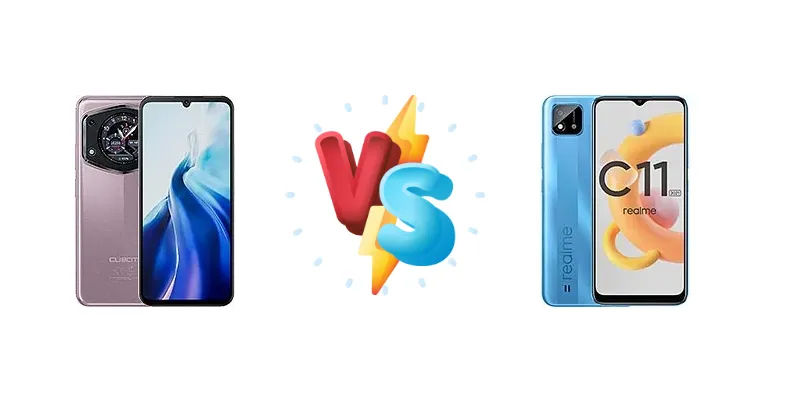
The sub-$150 smartphone market is fiercely competitive. Both the Cubot A30 and the Realme C11 (2021) aim to deliver essential smartphone functionality at an accessible price. However, they take drastically different approaches to achieving this, particularly in their core processing power and battery optimization. This comparison dissects these differences to determine which device offers the best value.
🏆 Quick Verdict
For the average user prioritizing responsiveness and future-proofing, the Cubot A30 is the clear winner. Its Unisoc Tiger T616 chipset provides significantly more processing power than the Realme C11’s SC9863A, translating to a smoother user experience. While the Realme C11 offers reverse wired charging, the A30’s superior endurance and performance outweigh this feature.
| Network |
|---|
| 2G bands | GSM 850 / 900 / 1800 / 1900 | GSM 850 / 900 / 1800 / 1900 |
| 3G bands | HSDPA 850 / 900 / 1700(AWS) / 1900 / 2100 | HSDPA 850 / 900 / 1900 / 2100 |
| 4G bands | 1, 2, 3, 4, 5, 7, 8, 12, 17, 20, 28, 41 | 1, 3, 5, 8, 38, 40, 41 |
| Speed | HSPA, LTE | HSPA, LTE |
| Technology | GSM / HSPA / LTE | GSM / HSPA / LTE |
| Launch |
|---|
| Announced | 2024 | 2021, June 28 |
| Status | Available. Released 2024 | Available. Released 2021, June 28 |
| Body |
|---|
| Build | - | Glass front, plastic frame, plastic back |
| Dimensions | 170.4 x 77.5 x 9.6 mm (6.71 x 3.05 x 0.38 in) | 165.2 x 76.4 x 8.9 mm (6.50 x 3.01 x 0.35 in) |
| SIM | Nano-SIM + Nano-SIM | Nano-SIM + Nano-SIM |
| Weight | 216 g (7.62 oz) | 190 g (6.70 oz) |
| | - | Splash resistant design |
| Display |
|---|
| Protection | Mohs level 6 | - |
| Resolution | 720 x 1600 pixels, 20:9 ratio (~260 ppi density) | 720 x 1600 pixels, 20:9 ratio (~269 ppi density) |
| Size | 6.75 inches, 110.0 cm2 (~83.3% screen-to-body ratio) | 6.52 inches, 102.6 cm2 (~81.3% screen-to-body ratio) |
| Type | IPS LCD, 90Hz | IPS LCD, 400 nits (typ) |
| Platform |
|---|
| CPU | Octa-core (2x2.0 GHz Cortex-A75 & 6x1.8 GHz Cortex-A55) | Octa-core (4x1.6 GHz Cortex-A55 & 4x1.2 GHz Cortex-A55) |
| Chipset | Unisoc Tiger T616 (12 nm) | Unisoc SC9863A (28 nm) |
| GPU | Mali-G57 MP1 | IMG8322 |
| OS | Android 14 | Android 11, Realme Go UI |
| Memory |
|---|
| Card slot | microSDXC (uses shared SIM slot) | microSDXC (dedicated slot) |
| Internal | 128GB 6GB RAM | 32GB 2GB RAM, 64GB 4GB RAM |
| | - | eMMC 5.1 |
| Main Camera |
|---|
| Features | LED flash | LED flash, HDR, panorama |
| Single | 48 MP, (wide), PDAF
Auxiliary lens | 8 MP, f/2.0, (wide), AF |
| Video | Yes | 1080p@30fps |
| Selfie camera |
|---|
| Features | - | HDR, panorama |
| Single | 16 MP | 5 MP, f/2.2, (wide) |
| Video | Yes | 1080p@30fps |
| Sound |
|---|
| 3.5mm jack | - | Yes |
| 35mm jack | Yes | Yes |
| Loudspeaker | Yes | Yes |
| Comms |
|---|
| Bluetooth | 5.0, A2DP, LE | 4.2, A2DP |
| NFC | No | No |
| Positioning | GPS, GALILEO, GLONASS, BDS | GPS, GLONASS, GALILEO, BDS |
| Radio | Unspecified | Unspecified |
| USB | USB Type-C, OTG | microUSB 2.0, OTG |
| WLAN | Wi-Fi 802.11 a/b/g/n/ac, dual-band | Wi-Fi 802.11 b/g/n |
| Features |
|---|
| Sensors | Accelerometer, proximity | Accelerometer, gyro, proximity, compass |
| Battery |
|---|
| Charging | - | 10W wired
Reverse wired |
| Type | 5100 mAh | 5000 mAh |
| Misc |
|---|
| Colors | Gray, Pink | Cool Blue, Cool Grey |
| Models | - | RMX3231 |
| Price | - | About 80 EUR |
| EU LABEL |
|---|
| Battery | 52:43h endurance, 800 cycles | - |
| Energy | Class B | - |
| Free fall | Class A (270 falls) | - |
| Repairability | Class B | - |
Cubot A30
- Significantly more powerful processor (Unisoc Tiger T616)
- Exceptional battery life (52:43h endurance)
- Potentially longer battery lifespan (800 charge cycles)
- Reverse charging not supported
- Display specs are unknown and likely basic
Realme C11 (2021)
- Reverse wired charging for accessories
- Simple and straightforward user experience
- Potentially lower price point (depending on retailer)
- Significantly weaker processor (Unisoc SC9863A)
- Slower charging speed (10W)
- Lower overall performance and responsiveness
Display Comparison
Neither device boasts a standout display. Both are likely to feature LCD panels, typical for this price bracket. However, detailed display specs (resolution, brightness, color gamut) are unavailable. The focus here is on internal components, and display quality is likely similar, prioritizing cost-effectiveness over premium features. Bezels are expected to be noticeable on both.
Camera Comparison
Camera details are limited, but it’s safe to assume both phones feature basic camera setups geared towards casual photography. Without sensor size or aperture information, a direct comparison is difficult. However, the Realme C11’s inclusion of reverse wired charging suggests a potential focus on accessory support, which might extend to bundled accessories like basic headphones, potentially impacting camera quality trade-offs. The A30’s focus appears to be on core performance, potentially leaving less budget for camera enhancements.
Performance
The performance gap is the most significant differentiator. The Cubot A30’s Unisoc Tiger T616, built on a 12nm process, features a more modern CPU architecture – two Cortex-A75 cores alongside six Cortex-A55 cores – compared to the Realme C11’s Unisoc SC9863A (28nm). The A75 cores in the A30 provide a substantial boost in single-core performance, crucial for app launch speeds and general responsiveness. The SC9863A’s quad-core A55 setup, while efficient, is significantly less powerful. The 12nm fabrication process of the T616 also contributes to better power efficiency compared to the older 28nm process of the SC9863A. This translates to less heat generation and potentially more sustained performance.
Battery Life
The Cubot A30 shines in battery endurance, boasting a tested 52:43h runtime and a claimed 800 charge cycles. This suggests a larger battery capacity and optimized power management. The Realme C11 (2021) offers 10W wired charging and reverse wired charging, allowing it to function as a power bank for other devices. However, 10W charging is relatively slow, and the A30’s superior endurance likely negates the need for frequent charging. The A30’s 800 cycle claim also indicates a more durable battery over the long term.
Buying Guide
Buy the Cubot A30 if you need a phone capable of handling multitasking, moderate gaming, and demanding applications without significant lag. It’s ideal for users who value performance and long-term usability. Buy the Realme C11 (2021) if your primary needs are basic communication – calls, texts, and light social media – and you prioritize a very simple, straightforward experience with the added convenience of reverse charging for accessories.
Frequently Asked Questions
❓ Will the Cubot A30 handle popular apps like WhatsApp and Facebook smoothly?
Yes, the Unisoc Tiger T616 chipset in the Cubot A30 is more than capable of running apps like WhatsApp and Facebook smoothly, even with multiple apps open simultaneously. The A75 cores provide a noticeable performance boost over the Realme C11’s processor, ensuring a responsive user experience.
❓ Is the 10W charging on the Realme C11 (2021) a significant drawback?
Yes, 10W charging is relatively slow by today’s standards. While the reverse wired charging is a convenient feature, the Cubot A30’s significantly longer battery life means you’ll likely need to charge it less frequently, mitigating the slower charging speed.
❓ How does the older 28nm process of the Realme C11’s chipset affect performance?
The 28nm process used in the Unisoc SC9863A is less efficient than the 12nm process in the Cubot A30’s Tiger T616. This means the SC9863A consumes more power for the same level of performance, leading to shorter battery life and potentially more heat generation, which can throttle performance during sustained tasks.