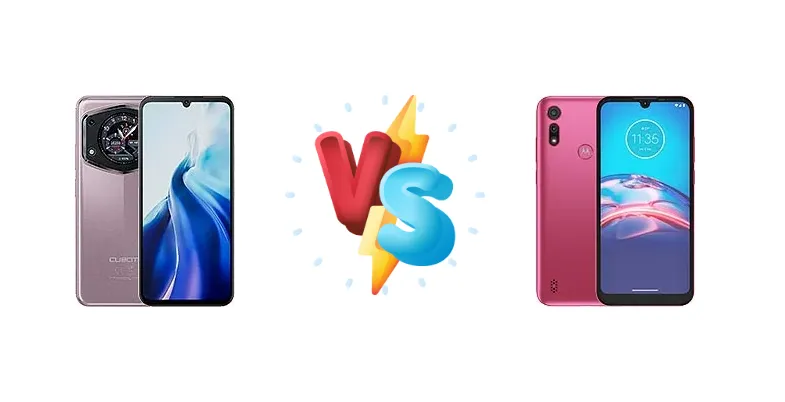
The sub-$150 smartphone market is fiercely competitive. The Cubot A30 and Motorola Moto E6i both aim to deliver essential smartphone functionality at an accessible price point, but they take drastically different approaches to achieving this. The A30 prioritizes processing power with a newer Unisoc chipset, while the E6i relies on Motorola’s established brand and software optimization with an older, more power-efficient design.
🏆 Quick Verdict
For users prioritizing performance and extended battery life, the Cubot A30 is the clear winner. Its Unisoc Tiger T616 chipset and impressive 52:43h endurance significantly outperform the Moto E6i. However, the Moto E6i offers the reassurance of Motorola’s software and a potentially more refined user experience for those less concerned with raw speed.
| Network |
|---|
| 2G bands | GSM 850 / 900 / 1800 / 1900 | GSM 850 / 900 / 1800 / 1900 |
| 3G bands | HSDPA 850 / 900 / 1700(AWS) / 1900 / 2100 | HSDPA 850 / 900 / 1700(AWS) / 1900 / 2100 |
| 4G bands | 1, 2, 3, 4, 5, 7, 8, 12, 17, 20, 28, 41 | 1, 2, 3, 4, 5, 7, 8, 19, 28, 66 |
| Speed | HSPA, LTE | HSPA, LTE |
| Technology | GSM / HSPA / LTE | GSM / HSPA / LTE |
| Launch |
|---|
| Announced | 2024 | 2021, February 11 |
| Status | Available. Released 2024 | Available. Released 2021, February 11 |
| Body |
|---|
| Build | - | Glass front, plastic back, plastic frame |
| Dimensions | 170.4 x 77.5 x 9.6 mm (6.71 x 3.05 x 0.38 in) | 155.6 x 73 x 8.5 mm (6.13 x 2.87 x 0.33 in) |
| SIM | Nano-SIM + Nano-SIM | Nano-SIM + Nano-SIM |
| Weight | 216 g (7.62 oz) | 160 g (5.64 oz) |
| Display |
|---|
| Protection | Mohs level 6 | - |
| Resolution | 720 x 1600 pixels, 20:9 ratio (~260 ppi density) | 720 x 1560 pixels, 19.5:9 ratio (~282 ppi density) |
| Size | 6.75 inches, 110.0 cm2 (~83.3% screen-to-body ratio) | 6.1 inches, 91.3 cm2 (~80.4% screen-to-body ratio) |
| Type | IPS LCD, 90Hz | IPS LCD |
| Platform |
|---|
| CPU | Octa-core (2x2.0 GHz Cortex-A75 & 6x1.8 GHz Cortex-A55) | Octa-core (4x1.6 GHz Cortex-A55 & 4x1.2 GHz Cortex-A55) |
| Chipset | Unisoc Tiger T616 (12 nm) | Unisoc SC9863A (28 nm) |
| GPU | Mali-G57 MP1 | IMG8322 |
| OS | Android 14 | Android 10 (Go edition) |
| Memory |
|---|
| Card slot | microSDXC (uses shared SIM slot) | microSDXC (uses shared SIM slot) |
| Internal | 128GB 6GB RAM | 32GB 2GB RAM |
| | - | eMMC 5.1 |
| Main Camera |
|---|
| Dual | - | 13 MP, f/2.2, 26mm (wide), 1/3.1", 1.12µm, PDAF
Auxiliary lens |
| Features | LED flash | LED flash, HDR, panorama |
| Single | 48 MP, (wide), PDAF
Auxiliary lens | - |
| Video | Yes | 1080p@30fps |
| Selfie camera |
|---|
| Single | 16 MP | 5 MP, f/2.2, 27mm (wide), 1.12µm |
| Video | Yes | 1080p@30fps |
| Sound |
|---|
| 3.5mm jack | - | Yes |
| 35mm jack | Yes | Yes |
| Loudspeaker | Yes | Yes |
| Comms |
|---|
| Bluetooth | 5.0, A2DP, LE | 4.2, A2DP, LE |
| NFC | No | No |
| Positioning | GPS, GALILEO, GLONASS, BDS | GPS, GLONASS |
| Radio | Unspecified | Unspecified |
| USB | USB Type-C, OTG | microUSB 2.0, OTG |
| WLAN | Wi-Fi 802.11 a/b/g/n/ac, dual-band | Wi-Fi 802.11 b/g/n |
| Features |
|---|
| Sensors | Accelerometer, proximity | Fingerprint (rear-mounted), accelerometer, proximity |
| Battery |
|---|
| Charging | - | 10W wired |
| Type | 5100 mAh | Li-Ion 3000 mAh |
| Misc |
|---|
| Colors | Gray, Pink | Titanium Gray, Pink |
| Models | - | XT2053-5 |
| Price | - | About 170 EUR |
| EU LABEL |
|---|
| Battery | 52:43h endurance, 800 cycles | - |
| Energy | Class B | - |
| Free fall | Class A (270 falls) | - |
| Repairability | Class B | - |
Cubot A30
- Superior processing power with Unisoc Tiger T616
- Exceptional battery life (52:43h endurance)
- Longer battery lifespan (800 charge cycles)
- Brand recognition is lower than Motorola
- Software support may be less frequent
Motorola Moto E6i
- Reliable Motorola brand and software experience
- Potentially better software optimization
- Simpler user interface
- Significantly weaker processor (Unisoc SC9863A)
- Lower performance for demanding tasks
- Slower charging (10W)
Display Comparison
Display specifications are not provided for either device. However, given the price point, both likely feature 720p LCD panels. The Moto E6i, benefiting from a more mature software stack, may offer slightly better color calibration. Bezels are expected to be substantial on both devices, reflecting their budget nature. Without specific data, it's difficult to assess brightness or color accuracy, but the E6i's software optimization could provide a marginally better viewing experience.
Camera Comparison
Camera details are limited. Both phones likely feature basic camera setups. Without sensor size or aperture information, it’s difficult to make a definitive judgment. However, the A30’s more powerful chipset could enable more sophisticated image processing algorithms, potentially leading to better image quality in favorable lighting conditions. The presence of a 2MP macro lens on either device is unlikely to provide significant photographic value, serving primarily as a marketing feature.
Performance
The performance gap between these two devices is substantial. The Cubot A30’s Unisoc Tiger T616, built on a 12nm process, features a combination of Cortex-A75 and Cortex-A55 cores, offering significantly higher peak performance than the Moto E6i’s Unisoc SC9863A. The SC9863A, fabricated on a larger 28nm node, utilizes only Cortex-A55 cores, resulting in slower processing speeds (1.6GHz vs 2.0GHz peak). This translates to noticeably faster app loading times, smoother multitasking, and a more responsive user interface on the A30. The A30’s architecture is better suited for modern applications and gaming.
Battery Life
The Cubot A30 boasts an impressive 52:43h endurance rating, indicating exceptional battery life. While the Moto E6i’s battery capacity isn’t specified, its older, less power-hungry chipset and 10W charging suggest a focus on efficiency rather than rapid charging. The A30’s 800 charge cycles suggest a longer lifespan before significant battery degradation. The E6i’s 10W charging will take considerably longer to reach a full charge compared to a potentially faster charging solution on the A30 (though charging speed isn't specified for the A30).
Buying Guide
Buy the Cubot A30 if you need a phone for demanding tasks like gaming, video editing, or multitasking, and value long battery life. Its octa-core processor and efficient chipset will handle these workloads better. Buy the Motorola Moto E6i if you prioritize simplicity, reliability, and a clean Android experience, and primarily use your phone for basic communication, social media, and light web browsing. The E6i is a solid choice for first-time smartphone users or those seeking a dependable daily driver.
Frequently Asked Questions
❓ Will the Unisoc Tiger T616 in the Cubot A30 handle demanding games like PUBG Mobile?
The Unisoc Tiger T616 is capable of running PUBG Mobile, but you’ll likely need to lower the graphics settings to achieve a smooth frame rate. It’s not a gaming powerhouse, but it’s significantly more capable than the Unisoc SC9863A in the Moto E6i.
❓ How long will it take to fully charge the Motorola Moto E6i with its 10W charging?
With 10W charging, expect the Moto E6i to take approximately 3-4 hours to fully charge from 0%. This is considerably slower than many modern smartphones, but it’s a trade-off for the potentially more efficient chipset.
❓ Is the Cubot A30’s software experience as polished as Motorola’s?
Motorola is known for its clean Android experience with minimal bloatware. Cubot’s software is likely to be less refined, potentially including pre-installed apps and a less intuitive user interface. However, this can often be mitigated with custom launchers.
❓ Does the Moto E6i receive regular security updates?
Motorola typically provides at least a few years of security updates for its budget phones, but the frequency and duration are less consistent than with flagship devices. Check Motorola’s official website for the specific update schedule for the Moto E6i in your region.