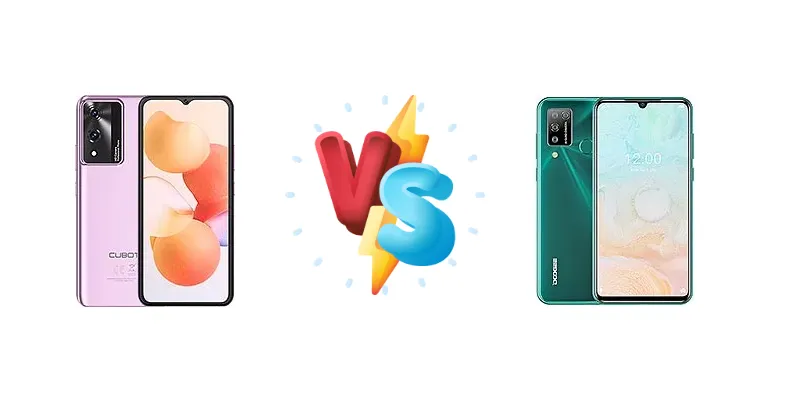
The sub-$150 smartphone market is fiercely competitive. Both the Cubot A10 and Doogee N20 Pro aim to deliver essential features at an accessible price point. However, they take different approaches to achieving this, primarily through their chipset choices. This comparison dissects the key differences to determine which device offers the best value for your money.
🏆 Quick Verdict
For most users, the Cubot A10 emerges as the slightly better choice. While the Doogee N20 Pro boasts a marginally faster CPU clock speed, the Unisoc T606 in the A10 offers a more modern architecture and potentially better efficiency, making it a more future-proof option within this price bracket.
| Network |
|---|
| 2G bands | GSM 850 / 900 / 1800 / 1900 | GSM 850 / 900 / 1800 / 1900 |
| 3G bands | HSDPA 850 / 900 / 1700(AWS) / 1900 / 2100 | HSDPA 850 / 900 / 2100 |
| 4G bands | 1, 2, 3, 4, 5, 7, 8, 12, 17, 20, 28, 41 | 1, 3, 5, 7, 8, 19, 20 |
| Speed | HSPA, LTE | HSPA, LTE |
| Technology | GSM / HSPA / LTE | GSM / HSPA / LTE |
| Launch |
|---|
| Announced | 2024, June | 2020, August 04. Released 2020, August |
| Status | Available. Released 2024, June | Discontinued |
| Body |
|---|
| Dimensions | 165.6 x 75.5 x 10.4 mm (6.52 x 2.97 x 0.41 in) | 159 x 77.1 x 8.8 mm (6.26 x 3.04 x 0.35 in) |
| SIM | Nano-SIM + Nano-SIM | Nano-SIM + Nano-SIM |
| Weight | 200 g (7.05 oz) | 175 g (6.17 oz) |
| Display |
|---|
| Resolution | 720 x 1612 pixels, 20:9 ratio (~269 ppi density) | 1080 x 2280 pixels, 19:9 ratio (~400 ppi density) |
| Size | 6.56 inches, 103.4 cm2 (~82.7% screen-to-body ratio) | 6.3 inches, 99.1 cm2 (~80.8% screen-to-body ratio) |
| Type | IPS LCD, 90Hz | IPS LCD |
| Platform |
|---|
| CPU | Octa-core (2x1.6 GHz Cortex-A75 & 6x1.6 GHz Cortex-A55) | Octa-core (4x2.0 GHz Cortex-A73 & 4x2.0 GHz Cortex-A53) |
| Chipset | Unisoc T606 (12 nm) | Mediatek MT6771V/CA Helio P60 (12 nm) |
| GPU | Mali-G57 MP1 | Mali-G72 MP3 |
| OS | Android 14 | Android 10 |
| Memory |
|---|
| Card slot | microSDXC (uses shared SIM slot) | microSDXC (uses shared SIM slot) |
| Internal | 128GB 4GB RAM | 128GB 6GB RAM |
| Main Camera |
|---|
| Features | LED flash | LED flash |
| Quad | - | 16 MP, f/2.0, (wide), PDAF
8 MP, f/2.4, 130˚ (ultrawide)
2 MP (macro)
Auxiliary lens |
| Single | 48 MP, (wide), AF
Auxiliary lens | - |
| Video | Yes | 1080p |
| Selfie camera |
|---|
| Single | 16 MP | 16 MP, f/2.0, (wide) |
| Video | Yes | 1080p |
| Sound |
|---|
| 35mm jack | Yes | Yes |
| Loudspeaker | Yes | Yes |
| Comms |
|---|
| Bluetooth | 5.0, A2DP, LE | 5.0, A2DP, LE |
| NFC | No | No |
| Positioning | GPS, GLONASS, GALILEO | GPS, GLONASS, BDS, GALILEO |
| Radio | Unspecified | FM radio |
| USB | USB Type-C, OTG | microUSB 2.0 |
| WLAN | Wi-Fi 802.11 a/b/g/n/ac, dual-band | Wi-Fi 802.11 a/b/g/n/ac, dual-band |
| Features |
|---|
| Sensors | Accelerometer, proximity | Fingerprint (rear-mounted), accelerometer, proximity |
| Battery |
|---|
| Charging | - | 10W wired |
| Type | 5100 mAh | 4400 mAh |
| Misc |
|---|
| Colors | Black, Blue, Purple | Gray, Purple, Forest |
| Price | About 90 EUR | About 170 EUR |
Cubot A10
- More modern chipset architecture (Unisoc T606)
- Potentially better power efficiency
- Likely smoother multitasking
- Lower CPU clock speed compared to Doogee N20 Pro
- Display specs unknown, likely basic
Doogee N20 Pro
- Higher CPU clock speed (2.0 GHz)
- Potentially faster burst performance
- Established MediaTek chipset
- Older chipset architecture (Helio P60)
- Slow 10W charging
- Potentially lower battery life due to less efficient chip
Display Comparison
Neither device's display specifications are provided, so we must infer. Given the price point, both likely feature 720p+ LCD panels. The absence of details like peak brightness or color gamut suggests neither phone will excel in outdoor visibility or color accuracy. Bezels are likely to be substantial on both, prioritizing cost reduction over premium aesthetics. Expect standard 60Hz refresh rates.
Camera Comparison
Without detailed camera specs, a direct comparison is difficult. Both phones likely feature a primary camera alongside auxiliary lenses (potentially a depth or macro sensor). The image processing capabilities will heavily influence the final image quality. Given the price bracket, expect limited dynamic range and noise reduction. The absence of Optical Image Stabilization (OIS) on either device suggests low-light performance will be a weakness. The usefulness of any 2MP macro lens on either phone is questionable; image quality will likely be poor.
Performance
The core difference lies in the chipsets. The Cubot A10’s Unisoc T606 (12nm) utilizes a combination of Cortex-A75 and A55 cores, a more modern design than the Doogee N20 Pro’s MediaTek Helio P60 (12nm). The P60’s Cortex-A73 and A53 cores, while clocked slightly higher (2.0 GHz vs 1.6 GHz), are an older generation. This means the A75 cores in the A10 will generally offer better single-core performance and improved efficiency. While the P60 has 4 performance cores versus the A10’s 2, the architectural improvements of the A75 often outweigh the core count advantage in real-world usage. The A10 is likely to handle multitasking and demanding apps more smoothly over the long term.
Battery Life
Battery capacity isn't specified for either device. However, the Doogee N20 Pro’s 10W wired charging is a significant disadvantage. This slow charging speed will require considerably longer to reach a full charge compared to phones supporting faster charging standards. The Unisoc T606 in the Cubot A10, being a more efficient chip, may allow for slightly better battery life even with a similar capacity battery. Users who frequently top up their phones throughout the day will find the N20 Pro’s charging speed particularly frustrating.
Buying Guide
Buy the Cubot A10 if you prioritize a more modern chipset architecture for sustained performance and potential software updates. It's ideal for everyday tasks, social media, and light gaming. Buy the Doogee N20 Pro if you absolutely need the slightly higher peak CPU clock speed for specific, bursty workloads, and if the 10W charging isn't a significant drawback for your usage patterns.
Frequently Asked Questions
❓ Will the Doogee N20 Pro struggle with demanding games like PUBG Mobile?
The Helio P60 can run PUBG Mobile, but likely at lower graphics settings and frame rates to maintain stable performance. The older architecture may lead to more noticeable frame drops during intense gameplay compared to the Cubot A10.
❓ How long will it take to fully charge the Doogee N20 Pro with the 10W charger?
With a 10W charger, expect a full charge to take well over 3 hours, potentially closer to 4-5 hours depending on the battery capacity. This is significantly slower than phones supporting fast charging technologies.
❓ Is the Unisoc T606 in the Cubot A10 likely to receive software updates?
Unisoc chipsets historically have had less consistent software update support compared to MediaTek or Qualcomm. However, Cubot's commitment to updates will ultimately determine the longevity of software support for the A10.
❓ Are either of these phones suitable for video editing or content creation?
Neither phone is ideally suited for demanding tasks like video editing. The chipsets lack the processing power and RAM to handle these workloads efficiently. Basic photo editing is possible, but expect slow processing times.