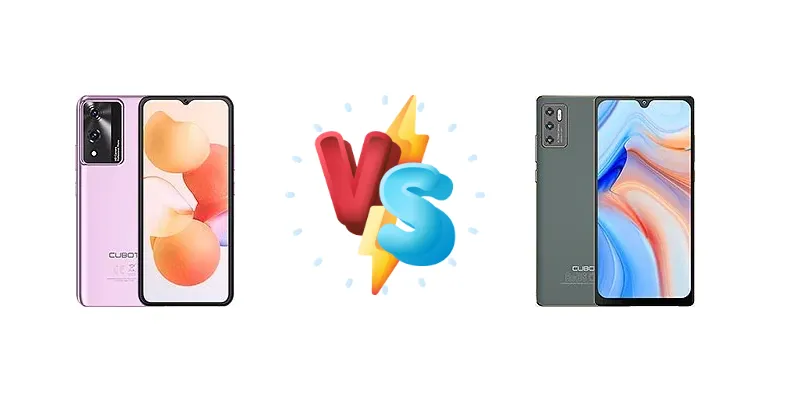
Cubot consistently targets the ultra-budget smartphone market, and the A10 and P50 represent two of their recent offerings. While both aim to deliver affordability, they diverge significantly in their core processing power. This comparison dissects the key differences between the Unisoc T606-powered A10 and the MediaTek Helio P22-equipped P50, helping you determine which device best suits your needs.
🏆 Quick Verdict
For the average user prioritizing responsiveness and future-proofing, the Cubot A10 emerges as the better choice. Its Unisoc T606 chipset, utilizing newer Cortex-A75 cores, provides a noticeable performance advantage over the P50’s older Helio P22, despite both being fabricated on a 12nm process. While the P50 isn't unusable, the A10 offers a smoother experience for everyday tasks.
| Network |
|---|
| 2G bands | GSM 850 / 900 / 1800 / 1900 | GSM 850 / 900 / 1800 / 1900 |
| 3G bands | HSDPA 850 / 900 / 1700(AWS) / 1900 / 2100 | HSDPA 900 / 2100 |
| 4G bands | 1, 2, 3, 4, 5, 7, 8, 12, 17, 20, 28, 41 | 1, 3, 5, 7, 8, 19, 20, 40 |
| Speed | HSPA, LTE | HSPA, LTE |
| Technology | GSM / HSPA / LTE | GSM / HSPA / LTE |
| Launch |
|---|
| Announced | 2024, June | 2022 |
| Status | Available. Released 2024, June | Available. Released 2022 |
| Body |
|---|
| Dimensions | 165.6 x 75.5 x 10.4 mm (6.52 x 2.97 x 0.41 in) | 156.2 x 74.6 x 9.4 mm (6.15 x 2.94 x 0.37 in) |
| SIM | Nano-SIM + Nano-SIM | Nano-SIM + Nano-SIM |
| Weight | 200 g (7.05 oz) | - |
| Display |
|---|
| Resolution | 720 x 1612 pixels, 20:9 ratio (~269 ppi density) | 720 x 1520 pixels, 19:9 ratio (~270 ppi density) |
| Size | 6.56 inches, 103.4 cm2 (~82.7% screen-to-body ratio) | 6.22 inches, 96.6 cm2 (~82.9% screen-to-body ratio) |
| Type | IPS LCD, 90Hz | IPS LCD |
| Platform |
|---|
| CPU | Octa-core (2x1.6 GHz Cortex-A75 & 6x1.6 GHz Cortex-A55) | Octa-core 2.0 GHz Cortex-A53 |
| Chipset | Unisoc T606 (12 nm) | Mediatek MT6762 Helio P22 (12 nm) |
| GPU | Mali-G57 MP1 | PowerVR GE8320 |
| OS | Android 14 | Android 11 |
| Memory |
|---|
| Card slot | microSDXC (uses shared SIM slot) | microSDXC (dedicated slot) |
| Internal | 128GB 4GB RAM | 128GB 6GB RAM |
| Main Camera |
|---|
| Features | LED flash | LED flash |
| Single | 48 MP, (wide), AF
Auxiliary lens | - |
| Triple | - | 12 MP, (wide), 1/2.9"
5 MP (macro)
Auxiliary lens |
| Video | Yes | Yes |
| Selfie camera |
|---|
| Single | 16 MP | 20 MP, (wide), 1/2.8" |
| Video | Yes | Yes |
| Sound |
|---|
| 35mm jack | Yes | Yes |
| Loudspeaker | Yes | Yes |
| Comms |
|---|
| Bluetooth | 5.0, A2DP, LE | 5.0, A2DP, LE |
| NFC | No | Yes |
| Positioning | GPS, GLONASS, GALILEO | GPS, GLONASS, GALILEO, BDS |
| Radio | Unspecified | Unspecified |
| USB | USB Type-C, OTG | USB Type-C, OTG |
| WLAN | Wi-Fi 802.11 a/b/g/n/ac, dual-band | Wi-Fi 802.11 a/b/g/n |
| Features |
|---|
| Sensors | Accelerometer, proximity | Accelerometer, gyro, proximity, compass |
| Battery |
|---|
| Type | 5100 mAh | 4200 mAh |
| Misc |
|---|
| Colors | Black, Blue, Purple | Black, Green |
| Price | About 90 EUR | - |
Cubot A10
- More powerful Unisoc T606 chipset for smoother performance.
- Modern CPU architecture with Cortex-A75 cores.
- Potentially better power efficiency leading to longer battery life.
- Detailed display specs are unknown.
- Camera quality relies heavily on software optimization.
Cubot P50
- Lower price point (likely).
- Functional for basic communication tasks.
- Simple and straightforward user experience.
- Older and less efficient MediaTek Helio P22 chipset.
- Struggles with multitasking and demanding apps.
- Potentially shorter battery life.
Display Comparison
Neither Cubot provides detailed display specifications beyond resolution. However, given their price points, both likely utilize IPS LCD panels. The real difference lies in the processing power driving the display. A more powerful chipset, like the A10’s Unisoc T606, can handle smoother animations and faster refresh rates (if supported, which is unconfirmed) resulting in a more fluid visual experience. Without knowing the peak brightness or color accuracy, it’s difficult to definitively declare a winner, but the A10’s superior processing capability indirectly benefits the display experience.
Camera Comparison
Without detailed camera specifications, a direct comparison is challenging. Both phones likely feature a primary camera and potentially a depth or macro sensor. However, image processing is heavily reliant on the chipset’s ISP (Image Signal Processor). The Unisoc T606 in the A10 likely has a more capable ISP than the Helio P22 in the P50, resulting in better image quality, particularly in low-light conditions. The P50’s older chipset may produce softer images with less dynamic range. Any 2MP macro sensors on either device should be considered marketing filler rather than a significant photographic asset.
Performance
The core distinction between these phones is their chipsets. The Cubot A10’s Unisoc T606 features a more modern CPU architecture with 2x 1.6 GHz Cortex-A75 cores and 6x 1.6 GHz Cortex-A55 cores. This contrasts with the Cubot P50’s MediaTek Helio P22, which utilizes 8x 2.0 GHz Cortex-A53 cores. While the P22 has a higher clock speed, the A75 cores in the T606 offer significantly better single-core performance, crucial for app launch times and general responsiveness. The T606’s architecture translates to a more efficient and capable processor for everyday tasks and even light gaming. The P22, while adequate for basic functions, will struggle with demanding applications.
Battery Life
Battery capacity isn’t specified in the provided data. However, given the P50’s less efficient chipset, it’s likely to drain faster than the A10, even with a similar battery size. The Unisoc T606’s 12nm process, combined with its more efficient CPU architecture, contributes to better power management. While charging wattage is also unknown, the A10’s more modern chipset may support faster charging protocols, potentially reducing 0-100% charge times.
Buying Guide
Buy the Cubot A10 if you need a phone capable of handling multitasking, light gaming, and modern app usage without significant lag. It’s ideal for users who want a device that feels relatively snappy for its price point. Buy the Cubot P50 if your primary needs are basic communication – calls, texts, and very light web browsing – and you prioritize minimizing cost above all else. It’s a functional device for those with extremely limited budgets.
Frequently Asked Questions
❓ Will the Cubot P50 struggle with popular social media apps like Facebook and Instagram?
The MediaTek Helio P22 in the Cubot P50 can run these apps, but you may experience noticeable lag when scrolling through feeds or loading images. The processor is simply not powerful enough to handle these apps as smoothly as the Unisoc T606 in the A10.
❓ Can the Cubot A10 handle basic mobile games like Candy Crush or Subway Surfers?
Yes, the Cubot A10’s Unisoc T606 chipset is capable of running casual mobile games like Candy Crush and Subway Surfers without significant issues. However, don’t expect to play graphically demanding games like PUBG Mobile at high settings.
❓ Is the difference in CPU architecture (Cortex-A75 vs Cortex-A53) really that noticeable in everyday use?
Absolutely. The Cortex-A75 cores in the Unisoc T606 are significantly more powerful than the Cortex-A53 cores in the Helio P22. This translates to faster app launch times, smoother multitasking, and a more responsive overall user experience. It’s the difference between a phone that feels sluggish and one that feels relatively snappy.
❓ If I primarily use my phone for calls and texts, is the Cubot P50 a good enough option?
For basic communication, the Cubot P50 is functional. However, even for calls and texts, a more responsive phone (like the A10) will provide a better user experience. The P50’s slower processor can make even simple tasks feel less fluid.