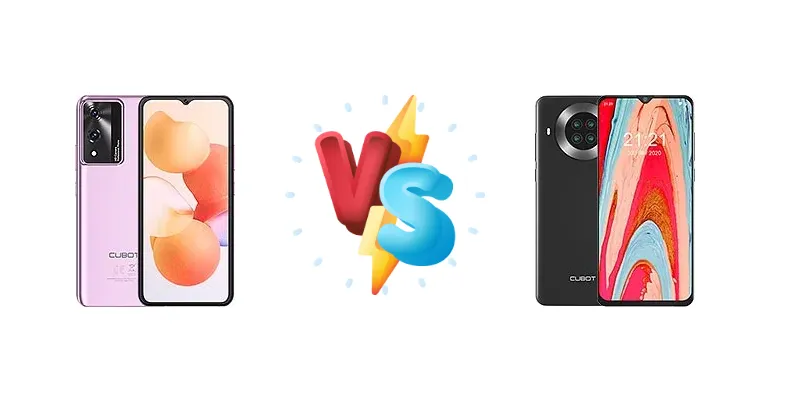
Cubot offers compelling value in the budget smartphone space, but choosing between models like the A10 and Note 20 Pro requires a closer look at their internal components. Both devices target price-conscious consumers, but diverge in their chipset choices, impacting performance and overall user experience. This comparison dissects those differences to determine which phone delivers the most bang for your buck.
🏆 Quick Verdict
For the average user prioritizing responsiveness and multitasking, the Cubot Note 20 Pro is the better choice. Its MediaTek Helio P60, featuring Cortex-A73 cores, provides a noticeable performance advantage over the Unisoc T606 in the A10, despite both being fabricated on a 12nm process. However, the A10 remains a viable option for basic usage.
| Network |
|---|
| 2G bands | GSM 850 / 900 / 1800 / 1900 | GSM 850 / 900 / 1800 / 1900 |
| 3G bands | HSDPA 850 / 900 / 1700(AWS) / 1900 / 2100 | HSDPA 900 / 2100 |
| 4G bands | 1, 2, 3, 4, 5, 7, 8, 12, 17, 20, 28, 41 | 1, 3, 7, 8, 19, 20 |
| Speed | HSPA, LTE | HSPA, LTE |
| Technology | GSM / HSPA / LTE | GSM / HSPA / LTE |
| Launch |
|---|
| Announced | 2024, June | 2020. Released 2020 |
| Status | Available. Released 2024, June | Discontinued |
| Body |
|---|
| Dimensions | 165.6 x 75.5 x 10.4 mm (6.52 x 2.97 x 0.41 in) | 162.8 x 75.4 x 9.1 mm (6.41 x 2.97 x 0.36 in) |
| SIM | Nano-SIM + Nano-SIM | Nano-SIM + Nano-SIM |
| Weight | 200 g (7.05 oz) | 200 g (7.05 oz) |
| Display |
|---|
| Resolution | 720 x 1612 pixels, 20:9 ratio (~269 ppi density) | 720 x 1600 pixels, 20:9 ratio (~270 ppi density) |
| Size | 6.56 inches, 103.4 cm2 (~82.7% screen-to-body ratio) | 6.5 inches, 102.0 cm2 (~83.1% screen-to-body ratio) |
| Type | IPS LCD, 90Hz | IPS LCD |
| Platform |
|---|
| CPU | Octa-core (2x1.6 GHz Cortex-A75 & 6x1.6 GHz Cortex-A55) | Octa-core (4x2.0 GHz Cortex-A73 & 4x2.0 GHz Cortex-A53) |
| Chipset | Unisoc T606 (12 nm) | Mediatek MT6771 Helio P60 (12 nm) |
| GPU | Mali-G57 MP1 | Mali-G72 MP3 |
| OS | Android 14 | Android 10 |
| Memory |
|---|
| Card slot | microSDXC (uses shared SIM slot) | microSDXC (dedicated slot) |
| Internal | 128GB 4GB RAM | 128GB 8GB RAM |
| Main Camera |
|---|
| Features | LED flash | LED flash |
| Quad | - | 12 MP, (wide), 1/2.9", AF
20 MP, (depth), 1/2.78"
Auxiliary lenses |
| Single | 48 MP, (wide), AF
Auxiliary lens | - |
| Video | Yes | Yes |
| Selfie camera |
|---|
| Single | 16 MP | 8 MP |
| Video | Yes | Yes |
| Sound |
|---|
| 35mm jack | Yes | Yes |
| Loudspeaker | Yes | Yes |
| Comms |
|---|
| Bluetooth | 5.0, A2DP, LE | 4.2, A2DP |
| NFC | No | Yes |
| Positioning | GPS, GLONASS, GALILEO | GPS |
| Radio | Unspecified | Unspecified |
| USB | USB Type-C, OTG | microUSB, OTG |
| WLAN | Wi-Fi 802.11 a/b/g/n/ac, dual-band | Wi-Fi 802.11 a/b/g/n |
| Features |
|---|
| Sensors | Accelerometer, proximity | Accelerometer, gyro, proximity, compass |
| Battery |
|---|
| Type | 5100 mAh | 4200 mAh, removable |
| Misc |
|---|
| Colors | Black, Blue, Purple | Black, Blue, Green |
| Price | About 90 EUR | - |
Cubot A10
- Likely more affordable price point
- Sufficient for basic smartphone tasks
- Unisoc T606 is relatively power efficient
- Noticeably slower performance than Note 20 Pro
- Less capable image processing
- May struggle with demanding apps
Cubot Note 20 Pro
- Faster and more responsive performance
- Better multitasking capabilities
- Improved image processing potential
- Potentially slightly higher price
- Helio P60 is an older chipset
- May not offer significant gaming performance
Display Comparison
Both the Cubot A10 and Note 20 Pro likely feature IPS LCD panels, common in this price bracket. Specific details like resolution and refresh rate are missing, but the focus here is on processing power to drive the display. Without knowing the display specs, it's difficult to assess visual quality differences, but the more powerful GPU in the Note 20 Pro *could* translate to slightly smoother animations if the display is capable of higher refresh rates.
Camera Comparison
Without detailed camera specifications beyond the presence of sensors, a direct comparison is limited. However, the processing capabilities of the Helio P60 in the Note 20 Pro likely provide better image processing algorithms, potentially resulting in sharper images and more accurate colors. The A10's Unisoc T606 may struggle with complex image processing tasks, especially in low-light conditions. It's reasonable to assume the Note 20 Pro will deliver a more consistently pleasing camera experience.
Performance
The core difference lies in the chipsets. The Cubot A10 utilizes the Unisoc T606, an octa-core processor with 2x 1.6 GHz Cortex-A75 and 6x 1.6 GHz Cortex-A55 cores. The Note 20 Pro boasts the MediaTek Helio P60, also octa-core, but with a more potent configuration: 4x 2.0 GHz Cortex-A73 and 4x 2.0 GHz Cortex-A53 cores. The Cortex-A73 cores in the Helio P60 represent a significant architectural improvement over the A75 in the T606, offering better single-core performance and improved efficiency. This translates to faster app launch times and a more fluid multitasking experience on the Note 20 Pro. While both are 12nm chips, the architectural advantages of the Helio P60 are key.
Battery Life
Battery capacity details are missing for both devices. However, the more efficient Helio P60 in the Note 20 Pro *could* lead to slightly better battery life, even with a similar capacity battery. The chipset's ability to handle tasks more efficiently reduces power draw. Charging wattage is also unknown, making it impossible to compare charging speeds. The Note 20 Pro's superior processing power could also be beneficial for power management features, optimizing battery usage based on app activity.
Buying Guide
Buy the Cubot A10 if you need a highly affordable smartphone for essential tasks like calling, texting, and light social media browsing. Its focus is on minimizing cost. Buy the Cubot Note 20 Pro if you prefer a smoother experience with more demanding apps, occasional gaming, and a more responsive user interface. It represents a step up in performance for a modest price increase.
Frequently Asked Questions
❓ Will the Cubot Note 20 Pro handle popular games like PUBG Mobile smoothly?
While the Helio P60 isn't a gaming powerhouse, it should be capable of running PUBG Mobile at medium settings with acceptable frame rates. Expect some occasional stuttering, especially in intense scenes. The A10's Unisoc T606 will likely struggle with consistent performance in PUBG.
❓ Is the difference in performance between the Unisoc T606 and Helio P60 noticeable in everyday use?
Yes, the difference is noticeable. The Helio P60's Cortex-A73 cores provide a significant boost in single-core performance, resulting in faster app launch times, smoother scrolling, and a more responsive user interface. The A10 will feel sluggish in comparison when multitasking or running demanding apps.
❓ Does the Cubot Note 20 Pro support fast charging?
Charging wattage information is unavailable for either device. However, the Note 20 Pro's more advanced chipset *may* support faster charging protocols if the included charger is compatible. Without specific details, it's impossible to confirm.
❓ Which phone is better for taking photos in low-light conditions?
The Cubot Note 20 Pro is likely to perform better in low-light conditions. The Helio P60's image signal processor (ISP) is more capable of handling noise reduction and detail preservation in challenging lighting scenarios.