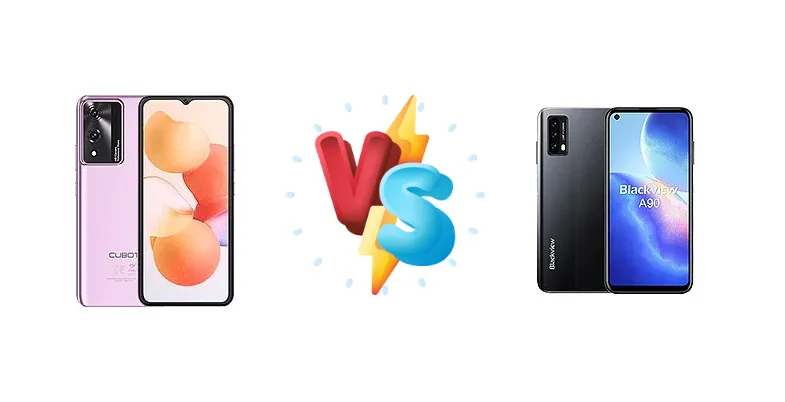
The sub-$150 smartphone market is fiercely competitive. Both the Cubot A10 and Blackview A90 aim to deliver essential smartphone functionality at an incredibly affordable price. However, they take different approaches to achieving this, primarily through their choice of chipset. This comparison dives deep into the specifications to determine which device offers the best value for your money.
🏆 Quick Verdict
For most users, the Blackview A90 edges out the Cubot A10. While both phones offer similar battery life, the Helio P60 chipset in the A90 provides a noticeable performance advantage in CPU-intensive tasks and gaming, making it a more responsive daily driver. The 10W charging is a drawback, but the core performance difference is significant.
| Network |
|---|
| 2G bands | GSM 850 / 900 / 1800 / 1900 | GSM 850 / 900 / 1800 / 1900 |
| 3G bands | HSDPA 850 / 900 / 1700(AWS) / 1900 / 2100 | HSDPA 850 / 900 / 2100 |
| 4G bands | 1, 2, 3, 4, 5, 7, 8, 12, 17, 20, 28, 41 | 1, 3, 7, 8, 20, 40 |
| Speed | HSPA, LTE | HSPA, LTE |
| Technology | GSM / HSPA / LTE | GSM / HSPA / LTE |
| Launch |
|---|
| Announced | 2024, June | 2021, May 04 |
| Status | Available. Released 2024, June | Available. Released 2021, May |
| Body |
|---|
| Dimensions | 165.6 x 75.5 x 10.4 mm (6.52 x 2.97 x 0.41 in) | 166.3 x 77.6 x 8.8 mm (6.55 x 3.06 x 0.35 in) |
| SIM | Nano-SIM + Nano-SIM | Nano-SIM + Nano-SIM |
| Weight | 200 g (7.05 oz) | 185 g (6.53 oz) |
| Display |
|---|
| Resolution | 720 x 1612 pixels, 20:9 ratio (~269 ppi density) | 720 x 1560 pixels, 19.5:9 ratio (~269 ppi density) |
| Size | 6.56 inches, 103.4 cm2 (~82.7% screen-to-body ratio) | 6.39 inches, 100.2 cm2 (~77.7% screen-to-body ratio) |
| Type | IPS LCD, 90Hz | IPS LCD |
| Platform |
|---|
| CPU | Octa-core (2x1.6 GHz Cortex-A75 & 6x1.6 GHz Cortex-A55) | Octa-core (4x2.0 GHz Cortex-A73 & 4x2.0 GHz Cortex-A53) |
| Chipset | Unisoc T606 (12 nm) | Mediatek MT6771 Helio P60 (12 nm) |
| GPU | Mali-G57 MP1 | Mali-G72 MP3 |
| OS | Android 14 | Android 11 |
| Memory |
|---|
| Card slot | microSDXC (uses shared SIM slot) | microSDXC |
| Internal | 128GB 4GB RAM | 64GB 4GB RAM |
| | - | eMMC 5.1 |
| Main Camera |
|---|
| Features | LED flash | LED flash, HDR |
| Single | 48 MP, (wide), AF
Auxiliary lens | 8 MP, f/2.2, (wide) |
| Triple | - | 12 MP, f/1.8, (wide), AF
other unspecified cameras |
| Video | Yes | 1080p@30fps, HDR |
| Selfie camera |
|---|
| Single | 16 MP | 8 MP, f/2.2, (wide) |
| Video | Yes | 1080p@30fps |
| Sound |
|---|
| 3.5mm jack | - | No |
| 35mm jack | Yes | No |
| Loudspeaker | Yes | Yes |
| Comms |
|---|
| Bluetooth | 5.0, A2DP, LE | 4.2, A2DP, LE |
| NFC | No | Yes |
| Positioning | GPS, GLONASS, GALILEO | GPS, GLONASS, BDS |
| Radio | Unspecified | FM radio |
| USB | USB Type-C, OTG | USB Type-C 2.0, OTG |
| WLAN | Wi-Fi 802.11 a/b/g/n/ac, dual-band | Wi-Fi 802.11 a/b/g/n/ac, dual-band |
| Features |
|---|
| Sensors | Accelerometer, proximity | Fingerprint (side-mounted), accelerometer, gyro, proximity, compass |
| Battery |
|---|
| Charging | - | 10W wired |
| Type | 5100 mAh | 4280 mAh |
| Misc |
|---|
| Colors | Black, Blue, Purple | Black, Blue, Orange, Purple |
| Price | About 90 EUR | About 150 EUR |
Cubot A10
- More modern chipset architecture (Unisoc T606)
- Potentially better long-term software support
- Competitive price point
- Lower CPU performance compared to Helio P60
- Likely slower app loading times
- Charging speed not specified
Blackview A90
- More powerful CPU (Helio P60 with Cortex-A73 cores)
- Better multitasking and gaming performance
- More responsive user experience
- Slower 10W charging
- Older chipset generation
- Potentially less frequent software updates
Display Comparison
Neither Cubot nor Blackview provide display specifications beyond the basic panel size. Given the price point, expect both to utilize IPS LCD panels with 720p+ resolutions. The absence of details like peak brightness or color gamut coverage suggests neither phone will excel in outdoor visibility or color accuracy. Bezels are likely to be substantial on both devices, contributing to a less immersive viewing experience. The lack of high refresh rate support is standard for this segment.
Camera Comparison
Camera details are sparse for both devices. Expect basic image quality suitable for social media sharing in good lighting conditions. The absence of Optical Image Stabilization (OIS) on either phone means low-light performance will be limited. While both likely include a primary camera and potentially a depth sensor, the quality will heavily rely on software processing. The inclusion of a 2MP macro camera on either device is largely a marketing tactic, offering minimal practical benefit due to the low resolution and lack of autofocus. Focusing on the primary sensor’s megapixel count (if available) is a better indicator of potential image quality.
Performance
The core difference lies in the chipsets. The Blackview A90’s MediaTek Helio P60, featuring four Cortex-A73 cores clocked at 2.0 GHz, offers a significant CPU performance advantage over the Cubot A10’s Unisoc T606. While both are 12nm chips, the A73 architecture is demonstrably more efficient and powerful than the A75 cores in the T606 (2x1.6 GHz). This translates to faster app loading times and smoother multitasking on the A90. The A90’s GPU will also outperform the T606’s integrated graphics, providing a better gaming experience. The A10 benefits from a newer chipset generation, potentially offering better long-term software support, but the immediate performance advantage goes to the A90.
Battery Life
Battery capacity is not specified for either device, but both likely house batteries in the 4000-5000 mAh range, typical for this price bracket. The Blackview A90’s 10W wired charging is a significant drawback, meaning a full charge will take a considerable amount of time. The Cubot A10’s charging speed is not specified, but it’s unlikely to be significantly faster. Real-world battery life will depend heavily on usage patterns, but both phones should comfortably last a full day with moderate use. The A90’s more powerful processor may consume slightly more power, but the difference is unlikely to be substantial.
Buying Guide
Buy the Cubot A10 if you prioritize a newer chipset architecture and anticipate primarily light usage – browsing, social media, and basic communication. Its Unisoc T606 is more modern, even if not as powerful. Buy the Blackview A90 if you need a phone that can handle multitasking, moderate gaming, and demanding apps without significant lag. The Helio P60’s more powerful Cortex-A73 cores provide a tangible benefit for power users on a tight budget.
Frequently Asked Questions
❓ Will the Helio P60 in the Blackview A90 struggle with demanding games like PUBG Mobile?
While the Helio P60 isn't a gaming powerhouse, it's capable of running PUBG Mobile at medium settings with acceptable frame rates. Expect some occasional stuttering, but it's a playable experience, significantly better than the Unisoc T606 in the Cubot A10. Lowering the graphics settings will improve performance.
❓ Is the Unisoc T606 in the Cubot A10 a good choice for someone who primarily uses their phone for social media and browsing?
Yes, the Unisoc T606 is perfectly adequate for basic tasks like social media, web browsing, and messaging. It won't offer the same responsiveness as the Helio P60, but for light usage, the difference will be minimal. The newer architecture may also offer better long-term software support.
❓ How long will it take to fully charge the Blackview A90 with its 10W charging?
Expect a full charge to take approximately 3-4 hours with the Blackview A90’s 10W charger. This is a significant drawback compared to phones with faster charging capabilities, so overnight charging is recommended.
❓ Can either of these phones handle video editing or other resource-intensive tasks?
Neither the Cubot A10 nor the Blackview A90 are well-suited for video editing or other demanding tasks. The processors lack the power and the RAM is likely insufficient for smooth performance. These phones are best suited for basic smartphone functions.