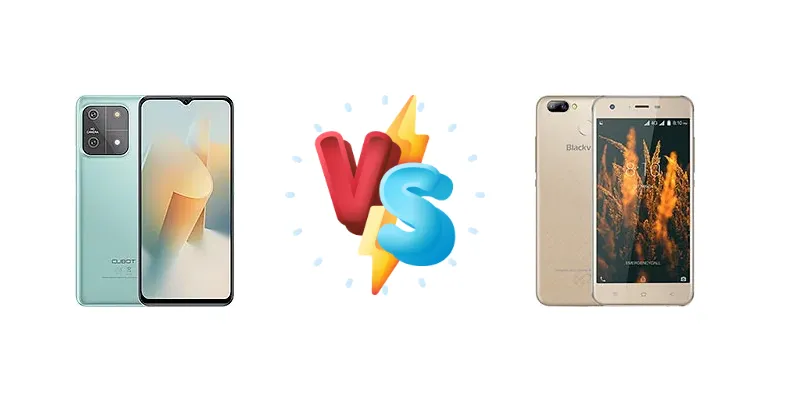
The Cubot A1 and Blackview A7 Pro represent the extreme end of the budget smartphone market, targeting users who prioritize affordability above all else. Both devices aim to deliver basic smartphone functionality at a minimal cost, but significant differences in their core hardware – specifically the chipset – dictate their real-world performance and suitability for different users.
🏆 Quick Verdict
For the average user, the Cubot A1 emerges as the better choice. Its Unisoc SC9863A chipset, featuring an octa-core CPU, provides a noticeable performance advantage over the Blackview A7 Pro’s quad-core Mediatek MT6737, making it more responsive for everyday tasks and light multitasking. While both offer limited features, the A1’s processing power justifies the likely small price difference.
| Network |
|---|
| 2G bands | GSM 850 / 900 / 1800 / 1900 | GSM 850 / 900 / 1800 / 1900 |
| 3G bands | HSDPA 850 / 900 / 1700(AWS) / 1900 / 2100 | HSDPA 900 / 2100 |
| 4G bands | 1, 2, 3, 4, 5, 7, 8, 12, 17, 20, 28, 41 | 1, 3, 7, 8, 20 |
| Speed | HSPA, LTE | HSPA |
| Technology | GSM / HSPA / LTE | GSM / HSPA / LTE |
| Launch |
|---|
| Announced | 2024, March | 2017. Released 2017 |
| Status | Available. Released 2024, April | Discontinued |
| Body |
|---|
| Dimensions | 165.6 x 75.5 x 10.4 mm (6.52 x 2.97 x 0.41 in) | 143 x 71 x 9.5 mm (5.63 x 2.80 x 0.37 in) |
| SIM | Nano-SIM + Nano-SIM | Dual SIM |
| Weight | 205 g (7.23 oz) | 176 g (6.21 oz) |
| Display |
|---|
| Resolution | 720 x 1612 pixels, 20:9 ratio (~269 ppi density) | 720 x 1280 pixels, 16:9 ratio (~294 ppi density) |
| Size | 6.56 inches, 103.4 cm2 (~82.7% screen-to-body ratio) | 5.0 inches, 68.9 cm2 (~67.9% screen-to-body ratio) |
| Type | IPS LCD | IPS LCD |
| Platform |
|---|
| CPU | Octa-core (4x1.6 GHz Cortex-A55 & 4x1.2 GHz Cortex-A55) | Quad-core 1.3 GHz Cortex-A53 |
| Chipset | Unisoc SC9863A (28 nm) | Mediatek MT6737 (28 nm) |
| GPU | IMG8322 | Mali-T720 |
| OS | Android 13 | Android 7.0 (Nougat) |
| Memory |
|---|
| Card slot | microSDXC (uses shared SIM slot) | microSDHC |
| Internal | 128GB 4GB RAM | 16GB 2GB RAM |
| | - | eMMC 5.0 |
| Main Camera |
|---|
| Dual | - | 8 MP, AF
Auxiliary lens |
| Features | LED flash | LED flash |
| Single | 13 MP, (wide), AF
Auxiliary lens | - |
| Video | Yes | 1080p@30fps |
| Selfie camera |
|---|
| Single | 8 MP | 5 MP |
| Video | Yes | - |
| Sound |
|---|
| 3.5mm jack | - | Yes |
| 35mm jack | Unspecified | Yes |
| Loudspeaker | Yes | Yes |
| Comms |
|---|
| Bluetooth | 4.2, A2DP | 4.0, A2DP |
| NFC | No | No |
| Positioning | GPS, GLONASS, GALILEO | GPS |
| Radio | Unspecified | No |
| USB | OTG | microUSB 2.0 |
| WLAN | Wi-Fi 802.11 a/b/g/n/ac | Wi-Fi 802.11 b/g/n |
| Features |
|---|
| Sensors | Accelerometer, proximity | Fingerprint (rear-mounted), accelerometer |
| Battery |
|---|
| Charging | 10W wired | - |
| Type | 5100 mAh | 2800 mAh, removable |
| Misc |
|---|
| Colors | Black, Blue, Green | Champagne Gold, Chocolate Black, Cream White, Jelly Blue |
| Price | About 80 EUR | About 80 EUR |
Cubot A1
- More powerful octa-core processor
- Improved multitasking capabilities
- Potentially better battery efficiency
- Limited detailed specifications available
- 10W charging is slow
Blackview A7 Pro
- Extremely affordable price point
- Simple and easy-to-use interface
- Reliable for basic communication
- Outdated quad-core processor
- Slow performance for modern apps
- Limited multitasking capabilities
Display Comparison
Neither Cubot nor Blackview provide display specifications beyond the basic panel size. Given the price point, both likely utilize IPS LCD panels with 720p resolution. The absence of details like peak brightness or color gamut suggests neither device will excel in outdoor visibility or color accuracy. Bezels are expected to be substantial on both, maximizing screen real estate within a compact form factor. The display is unlikely to be a differentiating factor.
Camera Comparison
Both devices likely feature basic camera setups, and detailed specifications are unavailable. It’s safe to assume both will include a primary rear camera and a front-facing camera for video calls. Without sensor size or aperture information, it’s impossible to assess image quality. The presence of a 2MP macro camera on either device is largely marketing fluff; its limited resolution and lack of optical image stabilization will result in subpar macro photography. The image processing capabilities of both chipsets are likely basic, prioritizing speed over detail and dynamic range.
Performance
The core difference lies in the chipsets. The Cubot A1’s Unisoc SC9863A is an octa-core processor built on a 28nm process, featuring four Cortex-A55 cores clocked at 1.6 GHz and four at 1.2 GHz. This configuration provides a significant advantage over the Blackview A7 Pro’s Mediatek MT6737, a quad-core processor with Cortex-A53 cores clocked at 1.3 GHz. The A55 architecture is more efficient and offers improved performance per clock cycle compared to the older A53. This translates to smoother app launches, faster web browsing, and a more responsive user experience on the Cubot A1. The 28nm fabrication process is identical on both, meaning thermal management will be similar, but the A1 will likely complete tasks faster before generating heat.
Battery Life
Battery capacity is not specified for either device. However, given their budget nature, both likely house batteries in the 3000-4000 mAh range. The Cubot A1’s more efficient Unisoc SC9863A processor will likely result in slightly better battery life despite potentially having a similar capacity to the Blackview A7 Pro. Both devices feature 10W wired charging, meaning a full charge will take several hours – likely exceeding 3 hours from 0 to 100%. Battery life will be heavily dependent on usage patterns, but the A1’s processor efficiency provides a slight advantage.
Buying Guide
Buy the Cubot A1 if you need a smartphone capable of handling more than just basic calling and texting – if you plan to use social media apps, browse the web with multiple tabs, or occasionally play simple games. Buy the Blackview A7 Pro if your primary need is a very basic, reliable phone for calls, texts, and minimal app usage, and you are prioritizing the absolute lowest possible price point.
Frequently Asked Questions
❓ Will the Cubot A1 handle popular social media apps like Facebook and Instagram smoothly?
Yes, the Cubot A1’s octa-core Unisoc SC9863A processor is significantly more capable of running social media apps smoothly compared to the Blackview A7 Pro’s quad-core Mediatek MT6737. While it won’t offer a flagship-level experience, you should expect acceptable performance for browsing feeds, posting updates, and viewing photos.
❓ Is the Blackview A7 Pro suitable for someone who primarily uses their phone for calls and texts?
Absolutely. The Blackview A7 Pro is ideally suited for users who prioritize basic communication features. Its quad-core processor is sufficient for making calls, sending texts, and managing contacts. If your smartphone needs are minimal, the A7 Pro offers a very affordable solution.
❓ Can either of these phones run multiple apps simultaneously without significant slowdown?
Multitasking is where the Cubot A1 truly shines. While neither phone has a large amount of RAM (specifications are unavailable, but likely 2GB or 3GB), the A1’s octa-core processor handles app switching and background processes more efficiently than the A7 Pro’s quad-core chip. The A7 Pro will likely struggle with more than two apps open at once.