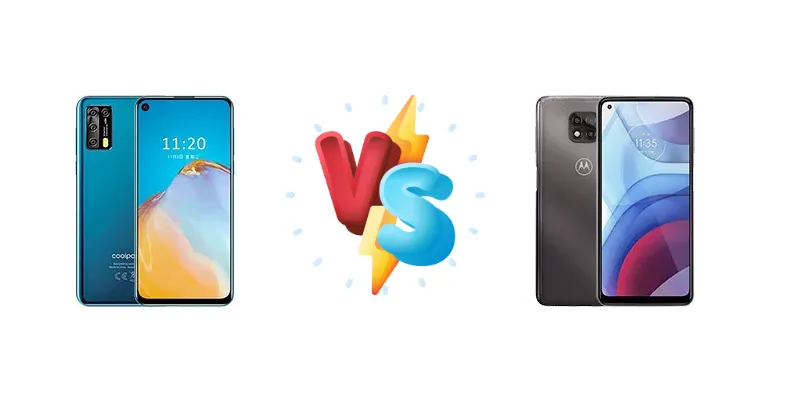
The sub-$200 smartphone market is fiercely competitive. The Coolpad Cool S and Motorola Moto G Power (2021) both aim to deliver essential features at an accessible price. However, they take different approaches to achieving this, primarily diverging in their chipset choices and charging capabilities. This comparison dissects these differences to determine which device offers the best value for your money.
🏆 Quick Verdict
For the average user prioritizing consistent performance and slightly faster charging, the Motorola Moto G Power (2021) is the better choice. Its Snapdragon 662, built on an 11nm process, offers a more efficient and generally smoother experience than the Coolpad Cool S’s older Helio P60. While the Cool S is a viable option, the Moto G Power provides a more refined user experience.
| Network |
|---|
| 2G bands | GSM 850 / 900 / 1800 / 1900 | GSM 850 / 900 / 1800 / 1900 |
| 3G bands | HSDPA 850 / 900 / 2100 | HSDPA 850 / 900 / 1700(AWS) / 1900 / 2100 |
| 4G bands | LTE | 1, 2, 3, 4, 5, 7, 8, 12, 13, 14, 17, 25, 26, 29, 30, 38, 41, 66, 71 |
| Speed | HSPA, LTE | HSPA, LTE |
| Technology | GSM / HSPA / LTE | GSM / CDMA / HSPA / EVDO / LTE |
| | - | CDMA2000 1xEV-DO |
| Launch |
|---|
| Announced | 2021, January 08. Released 2021, January 08 | 2021, January 08 |
| Status | Discontinued | Available. Released 2021, January 14 |
| Body |
|---|
| Build | Glass front, glass back, plastic frame | Glass front, plastic back, plastic frame |
| Dimensions | 161.2 x 76.2 x 8.9 mm (6.35 x 3.00 x 0.35 in) | 165.3 x 75.9 x 9.5 mm (6.51 x 2.99 x 0.37 in) |
| SIM | Nano-SIM + Nano-SIM | Nano-SIM |
| Weight | - | 206.5 g (7.30 oz) |
| | - | Water-repellent coating |
| Display |
|---|
| Resolution | 1080 x 2340 pixels, 19.5:9 ratio (~395 ppi density) | 720 x 1600 pixels, 20:9 ratio (~266 ppi density) |
| Size | 6.53 inches, 104.7 cm2 (~85.2% screen-to-body ratio) | 6.6 inches, 105.2 cm2 (~83.8% screen-to-body ratio) |
| Type | IPS LCD | IPS LCD |
| Platform |
|---|
| CPU | Octa-core (4x2.0 GHz Cortex-A73 & 4x2.0 GHz Cortex-A53) | Octa-core (4x2.0 GHz Kryo 260 Gold & 4x1.8 GHz Kryo 260 Silver) |
| Chipset | Mediatek MT6771 Helio P60 (12 nm) | Qualcomm SM6115 Snapdragon 662 (11 nm) |
| GPU | Mali-G72 MP3 | Adreno 610 |
| OS | Android 10 | Android 10 |
| Memory |
|---|
| Card slot | microSDXC | microSDXC (dedicated slot) |
| Internal | 128GB 4GB RAM | 32GB 3GB RAM, 64GB 4GB RAM |
| | - | eMMC 5.1 |
| Main Camera |
|---|
| Features | Dual-LED flash, panorama, HDR | LED flash, HDR, panorama |
| Quad | 48 MP, f/1.8, (wide), 1/2.0", 0.8µm, PDAF
8 MP, f/2.0, 120˚ (ultrawide)
5 MP (macro)
Auxiliary lens | - |
| Triple | - | 48 MP, f/1.7, (wide), 1/2.0", 0.8µm, PDAF
2 MP (macro)
Auxiliary lens |
| Video | 1080p@30fps | 1080p@30/60fps, gyro-EIS |
| Selfie camera |
|---|
| Features | - | HDR |
| Single | 25 MP, f/2.0, (wide), 1/2.78", 0.9µm | 8 MP, f/2.0, 1.12µm |
| Video | 1080p@30fps | 1080p@30fps, gyro-EIS |
| Sound |
|---|
| 3.5mm jack | No | Yes |
| 35mm jack | No | Yes |
| Loudspeaker | Yes | Yes |
| Comms |
|---|
| Bluetooth | Yes | 5.0, A2DP, LE |
| NFC | No | No |
| Positioning | GPS | GPS, GLONASS, GALILEO |
| Radio | Unspecified | FM radio |
| USB | USB Type-C 2.0 | USB Type-C 2.0 |
| WLAN | Yes | Wi-Fi 802.11 a/b/g/n/ac, dual-band, Wi-Fi Direct |
| Features |
|---|
| Sensors | Fingerprint (side-mounted), accelerometer, proximity, compass | Fingerprint (side-mounted), accelerometer, gyro, proximity, compass, barometer |
| Battery |
|---|
| Charging | 10W wired | 15W wired |
| Type | Li-Po 5000 mAh | Li-Po 5000 mAh |
| Misc |
|---|
| Colors | Moon White, Lapis Blue, Night Black | Flash Gray, Polar Silver |
| Models | 2039 | - |
| Price | About 160 EUR | About 60 EUR |
Coolpad Cool S
- Potentially lower price point
- May offer slightly longer battery life due to potentially larger battery capacity (spec not confirmed)
- Functional for basic smartphone tasks
- Older Helio P60 chipset offers less performance
- Slower 10W charging
- Likely to exhibit more throttling under load
Motorola Moto G Power (2021)
- More efficient Snapdragon 662 chipset
- Faster 15W charging
- Better graphics performance for casual gaming
- Generally smoother user experience
- May be slightly more expensive
- Battery life may be marginally shorter due to more powerful processor
Display Comparison
Neither device boasts a standout display. Both likely utilize LCD panels, common in this price bracket. The focus here isn't on visual fidelity, but on practicality. Without specific display specs, we can infer that both will offer adequate viewing angles and color reproduction for everyday tasks. The absence of high refresh rates or advanced features like LTPO is expected.
Camera Comparison
Camera performance is likely to be similar, with both phones targeting basic photography needs. Without detailed sensor information, it’s safe to assume both feature a primary sensor and potentially depth or macro lenses. The image processing algorithms will likely be the differentiating factor, with Motorola generally offering more natural-looking images, while Coolpad may lean towards more saturated colors. The absence of Optical Image Stabilization (OIS) on either device suggests low-light performance will be limited.
Performance
The core difference lies in the chipsets. The Motorola Moto G Power (2021) features the Qualcomm Snapdragon 662 (11nm), while the Coolpad Cool S uses the MediaTek Helio P60 (12nm). While both are octa-core CPUs with similar clock speeds (2.0 GHz), the Snapdragon 662 benefits from Qualcomm’s Kryo architecture and a more modern 11nm manufacturing process. This translates to better power efficiency and sustained performance under load. The Helio P60, while capable, is an older design and will likely exhibit more throttling during prolonged use. The Snapdragon 662’s Adreno 610 GPU also provides a noticeable advantage in graphics performance, making it the better choice for casual gaming.
Battery Life
The Motorola Moto G Power (2021) has a clear advantage in charging speed with its 15W wired charging, compared to the Coolpad Cool S’s 10W charging. While both likely have similar battery capacities (around 5000mAh is typical for this segment), the faster charging of the Moto G Power means less time tethered to an outlet. The Snapdragon 662’s improved power efficiency also contributes to potentially longer real-world battery life, despite the Cool S potentially having a slightly larger battery.
Buying Guide
Buy the Coolpad Cool S if you need a phone primarily for basic tasks like calls, texts, and light social media, and are comfortable with potentially slower app loading times. Buy the Motorola Moto G Power (2021) if you prefer a more responsive experience for everyday use, enjoy occasional gaming, and value the benefit of faster 15W charging for extended battery life.
Frequently Asked Questions
❓ Will the Helio P60 in the Coolpad Cool S struggle with multitasking?
The Helio P60 is capable of handling basic multitasking, but it may exhibit slowdowns when running multiple demanding apps simultaneously. The Snapdragon 662 in the Moto G Power offers a smoother multitasking experience due to its more efficient architecture and better memory management.
❓ How long will it take to fully charge the Motorola Moto G Power (2021) with the 15W charger?
While a precise time isn't available, expect a full charge from 0% to 100% to take approximately 2-3 hours with the included 15W charger. This is significantly faster than the Coolpad Cool S, which will likely take 3-4 hours with its 10W charger.
❓ Is the Snapdragon 662 in the Moto G Power powerful enough for playing games like PUBG Mobile?
The Snapdragon 662 can run PUBG Mobile at medium settings with acceptable frame rates. However, don't expect a high-end gaming experience. The Helio P60 in the Coolpad Cool S will likely struggle to maintain consistent frame rates even at lower settings.
❓ Does either phone support fast charging standards like Quick Charge or Power Delivery?
Neither phone officially supports Quick Charge or Power Delivery. They both utilize standard USB charging protocols. While they may work with some Quick Charge chargers, they won't benefit from the faster charging speeds.