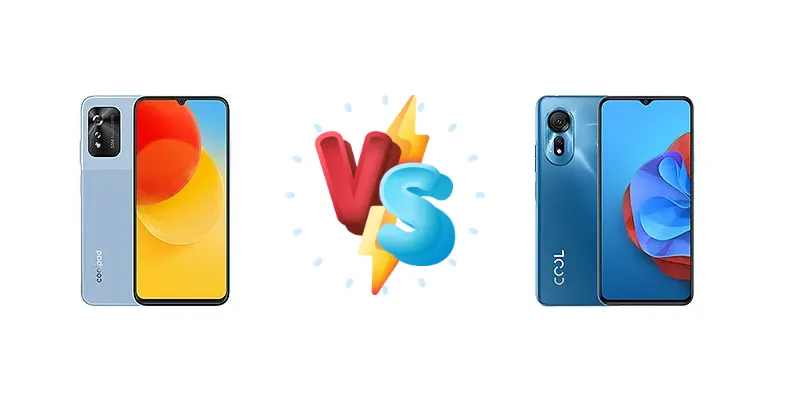
Coolpad's Cool series aims to deliver affordable smartphones, but the Cool 30i and Cool 20s represent distinct approaches. The Cool 30i focuses on maximizing value with a newer design, while the Cool 20s prioritizes processing power with a more capable chipset. This comparison dissects the key differences to determine which phone best suits your needs.
🏆 Quick Verdict
For most users, the Coolpad Cool 20s is the superior choice. Its Mediatek Dimensity 700 chipset provides a substantial performance uplift over the Cool 30i’s Helio G37, making it better suited for multitasking, gaming, and future-proofing. While the 30i offers a slightly newer design, the performance gap is too significant to ignore.
| Network |
|---|
| 2G bands | GSM 850 / 900 / 1800 / 1900 | GSM 850 / 900 / 1800 / 1900 |
| 3G bands | HSDPA 850 / 900 / 1900 / 2100 - International | HSDPA 850 / 900 / 1900 / 2100 |
| 4G bands | 1, 3, 5, 7, 8, 20, 28, 34, 38, 40, 41 - International | 1, 3, 5, 8, 34, 39, 40, 41 |
| 5G bands | - | 1, 28, 41, 77, 78 SA/NSA |
| Speed | HSPA, LTE | HSPA, LTE, 5G |
| Technology | GSM / CDMA / HSPA / LTE | GSM / CDMA / HSPA / EVDO / LTE / 5G |
| Launch |
|---|
| Announced | 2023, December | 2022, June 14 |
| Status | Available. Released 2023, December | Available. Released 2022, June 14 |
| Body |
|---|
| Dimensions | 166.2 x 76.7 x 8.3 mm (6.54 x 3.02 x 0.33 in) | 163 x 74.8 x 8.3 mm (6.42 x 2.94 x 0.33 in) |
| SIM | Nano-SIM + Nano-SIM | Nano-SIM + Nano-SIM |
| Weight | 197.6 g (6.98 oz) | 180 g (6.35 oz) |
| Display |
|---|
| Resolution | 720 x 1600 pixels, 20:9 ratio (~267 ppi density) | 1080 x 2408 pixels, 20:9 ratio (~401 ppi density) |
| Size | 6.56 inches, 103.9 cm2 (~81.5% screen-to-body ratio) | 6.58 inches, 104.3 cm2 (~85.5% screen-to-body ratio) |
| Type | IPS LCD | IPS LCD, 90Hz |
| Platform |
|---|
| CPU | Octa-core (4x2.3 GHz Cortex-A53 & 4x1.7 GHz Cortex-A53) | Octa-core (2x2.2 GHz Cortex-A76 & 6x2.0 GHz Cortex-A55) |
| Chipset | Mediatek MT6765 Helio G37 (12 nm) | Mediatek Dimensity 700 (7 nm) |
| GPU | PowerVR GE8320 | Mali-G57 MC2 |
| OS | Android 13, CoolOS | Android 13, CoolOS |
| Memory |
|---|
| Card slot | microSDXC (dedicated slot) | microSDXC |
| Internal | 256GB 6GB RAM | 128GB 6GB RAM, 256GB 8GB RAM |
| Main Camera |
|---|
| Dual | 50 MP, f/1.6 (wide), PDAF
Depth camera | 50 MP, f/1.8 (wide), PDAF
2 MP (macro) |
| Features | LED flash, panorama, HDR | LED flash, panorama, HDR |
| Single | - | 8 MP |
| Video | 1080p@30fps | 1080p@30fps |
| Selfie camera |
|---|
| Features | - | HDR |
| Single | 8 MP | 8 MP |
| Video | 1080p@30fps | 1080p@30fps |
| Sound |
|---|
| 3.5mm jack | - | Yes |
| 35mm jack | Unspecified | Yes |
| Loudspeaker | Yes | Yes, with stereo speakers |
| Comms |
|---|
| Bluetooth | 5.0, A2DP, LE | 5.1, A2DP, LE |
| NFC | No | No |
| Positioning | GPS, GLONASS, BDS, GALILEO | GPS, GLONASS, BDS, GALILEO, QZSS |
| Radio | No | FM radio |
| USB | USB Type-C 2.0 | USB Type-C 2.0, OTG |
| WLAN | Wi-Fi 802.11 a/b/g/n/ac | Wi-Fi 802.11 a/b/g/n/ac, dual-band, Wi-Fi Direct |
| Features |
|---|
| Sensors | Fingerprint (side-mounted), accelerometer, proximity | Fingerprint (side-mounted), accelerometer, proximity, compass |
| Battery |
|---|
| Charging | 10W wired | 18W wired |
| Type | 4500 mAh | Li-Po 4500 mAh |
| Misc |
|---|
| Colors | Cream White, Desert Gold, Lavender Purple, Sky Blue | Black, Blue, White |
| Price | - | About 140 EUR |
Coolpad Cool 30i
- Potentially more modern design
- Lower price point (likely)
- Acceptable for basic tasks
- Significantly weaker processor
- Slower charging speed
- Less future-proof
Coolpad Cool 20s
- Much faster processor (Dimensity 700)
- Faster 18W charging
- 5G connectivity
- Better multitasking capabilities
- Potentially slightly higher price
- May have a less refined design
Display Comparison
Neither Coolpad provides detailed display specifications beyond resolution. However, the focus here isn't on display quality. Both likely utilize LCD panels common in this price bracket. The real difference lies elsewhere. Bezels are expected to be similar, given the budget nature of both devices. Color accuracy is unlikely to be a strong point on either.
Camera Comparison
Camera details are sparse for both devices. It's safe to assume both feature a primary camera and potentially depth/macro sensors. Given the price point, image quality will be heavily reliant on software processing. Without specific sensor size information, it’s difficult to make a definitive judgment. However, the superior processing power of the Dimensity 700 in the Cool 20s *could* translate to slightly better image processing and faster capture times. The presence of 5G on the 20s also suggests a more modern ISP (Image Signal Processor).
Performance
The core difference between these phones is the chipset. The Coolpad Cool 20s’ Mediatek Dimensity 700, built on a 7nm process, is a significant upgrade over the Cool 30i’s Mediatek Helio G37 (12nm). The Dimensity 700 features a more modern CPU architecture – Cortex-A76 cores versus the G37’s Cortex-A53 cores – resulting in substantially faster processing speeds. The 2x2.2 GHz A76 cores in the 20s will handle demanding apps far more efficiently than the 4x2.3 GHz A53 cores in the 30i. Furthermore, the 7nm process of the Dimensity 700 translates to better power efficiency and less heat generation under load. This is crucial for sustained performance during gaming or prolonged use.
Battery Life
Battery capacity isn't specified, but both phones likely feature batteries in the 5000mAh range, typical for this segment. The Cool 20s boasts 18W wired charging, a clear advantage over the Cool 30i’s 10W charging. This means the Cool 20s will recharge significantly faster, reducing downtime. While a larger battery capacity would be ideal, the faster charging speed of the 20s mitigates the impact of a potentially slightly smaller battery.
Buying Guide
Buy the Coolpad Cool 30i if you prioritize a modern aesthetic and basic smartphone functionality – calls, texts, and light social media use. You'll appreciate its potentially lower price point. Buy the Coolpad Cool 20s if you need a phone capable of handling more demanding tasks like gaming, streaming, or running multiple apps simultaneously, and if 5G connectivity is a must-have.
Frequently Asked Questions
❓ Will the Dimensity 700 in the Cool 20s handle demanding games like PUBG Mobile?
Yes, the Dimensity 700 is capable of running PUBG Mobile at medium to high settings with acceptable frame rates. While it won't deliver a flagship gaming experience, it's a significant improvement over the Helio G37 and will provide a much smoother gaming experience.
❓ Is the 10W charging on the Cool 30i noticeably slow in daily use?
Yes, 10W charging is quite slow by today's standards. Expect a full charge to take well over 2.5 hours. This can be inconvenient if you frequently need to top up your battery quickly. The Cool 20s' 18W charging is a much more practical solution.
❓ Does the Cool 20s support carrier aggregation for faster 5G speeds?
While not explicitly stated, the Dimensity 700 chipset *generally* supports carrier aggregation, which can significantly improve 5G download speeds. However, actual speeds will depend on your carrier and network conditions.
❓ How much of a real-world performance difference will I see between the Helio G37 and Dimensity 700?
You'll notice a substantial difference in everyday tasks. Apps will launch faster, multitasking will be smoother, and the Cool 20s will handle demanding apps without significant lag. Benchmarks show the Dimensity 700 consistently outperforms the Helio G37 by a significant margin (often 50-100%).