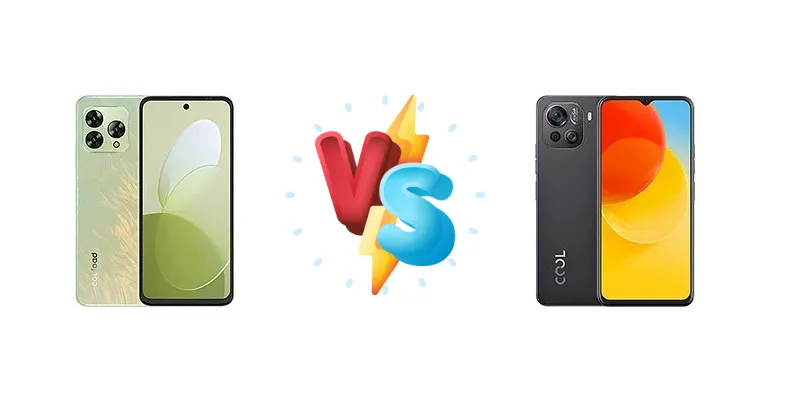
Coolpad has been aggressively targeting the budget and mid-range smartphone markets with the Cool series. The Cool 30 Play and Cool 20 Pro represent distinct approaches within this lineup. The Cool 30 Play focuses on delivering a modern experience at an ultra-affordable price, while the Cool 20 Pro aims for a step up in processing power. This comparison dissects the key differences to help you determine which Coolpad best suits your needs.
🏆 Quick Verdict
For most users, the Coolpad Cool 20 Pro is the better choice. Its Dimensity 900 chipset provides a noticeable performance advantage over the Cool 30 Play’s Helio G99, translating to smoother multitasking and gaming. While both offer 33W charging, the Pro’s superior processing power justifies the likely price premium.
| Network |
|---|
| 2G bands | GSM 850 / 900 / 1800 / 1900 | GSM 850 / 900 / 1800 / 1900 |
| 3G bands | HSDPA 850 / 900 / 1900 / 2100 - version 1 | HSDPA 850 / 900 / 2100 |
| 4G bands | 1, 3, 5, 7, 8, 20, 28, 34, 38, 39, 40, 41 - version 1 | LTE |
| 5G bands | - | SA/NSA |
| Speed | HSPA, LTE | HSPA, LTE, 5G |
| Technology | GSM / CDMA / HSPA / EVDO / LTE | GSM / CDMA / HSPA / CDMA2000 / LTE / 5G |
| | - | CDMA2000 1x |
| Launch |
|---|
| Announced | Expected announcement 2024, July | 2021, December 02. Released 2021, December 02 |
| Status | Available. Released 2024, July | Discontinued |
| Body |
|---|
| Dimensions | 169.6 x 76.6 x 8.5 mm (6.68 x 3.02 x 0.33 in) | 162.8 x 74.8 x 8.3 mm (6.41 x 2.94 x 0.33 in) |
| SIM | Nano-SIM + Nano-SIM | Nano-SIM + Nano-SIM |
| Weight | 208 g (7.34 oz) | 193 g (6.81 oz) |
| Display |
|---|
| Resolution | 720 x 1640 pixels (~264 ppi density) | 1080 x 2400 pixels, 20:9 ratio (~400 ppi density) |
| Size | 6.79 inches, 109.5 cm2 (~84.3% screen-to-body ratio) | 6.58 inches, 104.5 cm2 (~85.8% screen-to-body ratio) |
| Type | IPS LCD, 450 nits | IPS LCD, 120Hz |
| Platform |
|---|
| CPU | Octa-core (2x2.2 GHz Cortex-A76 & 6x2.0 GHz Cortex-A55) | Octa-core (2x2.4 GHz Cortex-A78 & 6x2.0 GHz Cortex-A55) |
| Chipset | Mediatek Helio G99 (6 nm) | Mediatek Dimensity 900 (6 nm) |
| GPU | Mali-G57 MC2 | Mali-G68 MC4 |
| OS | Android 14 | Android 11, CoolOS 2 |
| Memory |
|---|
| Card slot | microSDXC (uses shared SIM slot) | microSDXC |
| Internal | 128GB 6GB RAM, 256GB 8GB RAM | 128GB 6GB RAM, 128GB 8GB RAM |
| | - | UFS 2.2 |
| Main Camera |
|---|
| Features | LED flash, panorama | LED flash, panorama, HDR |
| Single | - | 8 MP |
| Triple | 64 MP, f/1.8, (wide), AF
2 MP (macro)
Auxiliary lens | 50 MP, f/1.8 (wide), PDAF
8 MP, (ultrawide)
2 MP (macro) |
| Video | 1080p@30fps | 1080p@30fps |
| Selfie camera |
|---|
| Features | - | HDR |
| Single | 8 MP, f/2.0, (wide) | 8 MP |
| Video | 1080p@30fps | 1080p@30fps |
| Sound |
|---|
| 3.5mm jack | - | Yes |
| 35mm jack | No | Yes |
| Loudspeaker | Yes | Yes, with stereo speakers |
| Comms |
|---|
| Bluetooth | 5.2, A2DP, LE | 5.1, A2DP, LE |
| NFC | Yes (market/region dependent) | No |
| Positioning | GPS, GLONASS, BDS | - |
| Radio | Unspecified | Unspecified |
| USB | USB Type-C | USB Type-C 2.0, OTG |
| WLAN | Wi-Fi 802.11 a/b/g/n/ac | Wi-Fi 802.11 a/b/g/n/ac/6, dual-band, Wi-Fi Direct |
| Features |
|---|
| Sensors | Fingerprint (side-mounted), accelerometer, gyro, proximity, compass | Fingerprint (side-mounted), unspecified sensors |
| Battery |
|---|
| Charging | 33W wired | 33W wired |
| Type | 5000 mAh | Li-Po 4500 mAh |
| Misc |
|---|
| Colors | Aurora Purple, Flowing Gold, Velvet Black | Black, Blue, White, Gold |
| Models | - | CP05 |
| Price | - | About 250 EUR |
Coolpad Cool 30 Play
- More affordable price point
- Efficient Helio G99 chipset
- 33W fast charging
- Lower CPU performance compared to the Cool 20 Pro
- Likely less capable GPU for gaming
Coolpad Cool 20 Pro
- Faster Dimensity 900 processor
- Improved gaming performance
- Potentially better camera image quality
- Likely higher price tag
- May not offer significantly better battery life despite efficiency gains
Display Comparison
Both devices utilize 6nm chipsets, suggesting a focus on efficiency. However, display specifications are not provided in the context data. Given the Cool 20 Pro’s positioning, it’s reasonable to expect a slightly higher peak brightness and potentially a higher refresh rate compared to the Cool 30 Play. Color accuracy is likely similar across both models, typical for this price segment. Bezels are also likely comparable, with both aiming for a modern, maximized screen-to-body ratio.
Camera Comparison
Camera details are absent, but we can infer some differences. The Cool 20 Pro, being the higher-tier model, likely features a larger primary sensor and potentially a more sophisticated image processing pipeline. While both may include standard features like HDR and portrait mode, the Dimensity 900’s ISP (Image Signal Processor) will likely offer better noise reduction and dynamic range. The inclusion of a 2MP macro camera on either device is largely a marketing tactic, offering limited practical benefit due to the small sensor size and lack of optical image stabilization (OIS).
Performance
The core difference lies in the chipsets. The Coolpad Cool 20 Pro’s Mediatek Dimensity 900, featuring 2x2.4 GHz Cortex-A78 cores, offers a significant CPU performance boost over the Cool 30 Play’s Helio G99 with its 2x2.2 GHz Cortex-A76 cores. The A78 architecture is a generation ahead, providing better single-core and multi-core performance. While both use the same Cortex-A55 efficiency cores, the Dimensity 900’s higher clock speed and architectural improvements will result in faster app loading times and smoother multitasking. The GPU within the Dimensity 900 will also deliver a more capable gaming experience. Both phones likely utilize LPDDR4X RAM, but the Cool 20 Pro’s faster processor will be less bottlenecked by memory speeds.
Battery Life
Both phones share the same 33W wired charging, suggesting similar 0-100% charging times – likely around 60-75 minutes. Without battery capacity information, it’s difficult to definitively say which offers better battery life. However, the Dimensity 900’s improved efficiency could partially offset a potentially smaller battery in the Cool 20 Pro, resulting in comparable real-world usage. The 6nm process node in both chipsets contributes to improved power efficiency compared to older manufacturing processes.
Buying Guide
Buy the Coolpad Cool 30 Play if you prioritize extreme affordability and need a reliable daily driver for basic tasks like calling, texting, and social media. It’s ideal for users who don’t heavily game or require demanding app performance. Buy the Coolpad Cool 20 Pro if you value smoother performance for gaming, video editing, or running multiple apps simultaneously. It’s the better option for users who want a phone that can handle more intensive workloads without significant slowdowns.
Frequently Asked Questions
❓ Will the Dimensity 900 in the Cool 20 Pro get noticeably hotter during extended gaming sessions compared to the Helio G99?
While the Dimensity 900 is more powerful, it also generates more heat. However, both chipsets are built on a 6nm process, which helps with thermal efficiency. The Cool 20 Pro likely has a more robust cooling system to manage the increased heat output, but prolonged, intensive gaming will still result in some warming. The Helio G99 will likely run cooler, but at the cost of performance.
❓ Is the performance difference between the Helio G99 and Dimensity 900 significant enough to justify the price difference for everyday tasks?
For basic tasks like browsing, social media, and calling, the performance difference will be minimal. However, if you frequently switch between apps, edit photos or videos, or play demanding games, the Dimensity 900’s extra processing power will provide a noticeably smoother and more responsive experience. The price difference is worth considering if you prioritize performance over absolute affordability.
❓ Does either phone support expandable storage via microSD card?
This information is not provided in the context data. However, given the target market of these phones, it's likely that at least one, if not both, offer microSD card support. Check the official specifications before purchasing if expandable storage is a requirement.