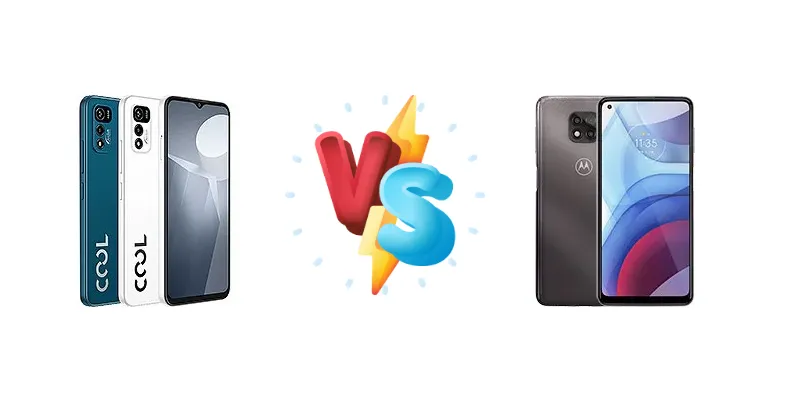
The sub-$200 smartphone market is fiercely competitive. The Coolpad Cool 20 and Motorola Moto G Power (2021) both aim to deliver essential features at an accessible price. However, they take different approaches: Coolpad prioritizes a more modern chipset, while Motorola focuses on maximizing battery life. This comparison dissects their key differences to determine which phone best suits your needs.
🏆 Quick Verdict
For the average user prioritizing sustained performance and a slightly more responsive experience, the Coolpad Cool 20 emerges as the winner. Its Mediatek Helio G80 chipset, built on a smaller 12nm process, offers a modest edge over the Motorola’s Snapdragon 662. However, the Moto G Power’s 15W charging and potentially longer software support remain compelling advantages.
| Network |
|---|
| 2G bands | GSM 850 / 900 / 1800 / 1900 | GSM 850 / 900 / 1800 / 1900 |
| 3G bands | HSDPA 850 / 900 / 2100 | HSDPA 850 / 900 / 1700(AWS) / 1900 / 2100 |
| 4G bands | 1, 3, 5, 8, 34, 39, 40, 41 | 1, 2, 3, 4, 5, 7, 8, 12, 13, 14, 17, 25, 26, 29, 30, 38, 41, 66, 71 |
| Speed | HSPA, LTE | HSPA, LTE |
| Technology | GSM / CDMA / HSPA / CDMA2000 / LTE | GSM / CDMA / HSPA / EVDO / LTE |
| | CDMA2000 1x | CDMA2000 1xEV-DO |
| Launch |
|---|
| Announced | 2021, May 26. Released 2021, June 01 | 2021, January 08 |
| Status | Discontinued | Available. Released 2021, January 14 |
| Body |
|---|
| Build | - | Glass front, plastic back, plastic frame |
| Dimensions | 164.3 x 75.7 x 8.7 mm (6.47 x 2.98 x 0.34 in) | 165.3 x 75.9 x 9.5 mm (6.51 x 2.99 x 0.37 in) |
| SIM | Nano-SIM + Nano-SIM | Nano-SIM |
| Weight | 199.6 g (7.05 oz) | 206.5 g (7.30 oz) |
| | - | Water-repellent coating |
| Display |
|---|
| Resolution | 720 x 1600 pixels, 20:9 ratio (~269 ppi density) | 720 x 1600 pixels, 20:9 ratio (~266 ppi density) |
| Size | 6.52 inches, 102.6 cm2 (~82.5% screen-to-body ratio) | 6.6 inches, 105.2 cm2 (~83.8% screen-to-body ratio) |
| Type | IPS LCD | IPS LCD |
| Platform |
|---|
| CPU | Octa-core (2x2.0 GHz Cortex-A75 & 6x1.8 GHz Cortex-A55) | Octa-core (4x2.0 GHz Kryo 260 Gold & 4x1.8 GHz Kryo 260 Silver) |
| Chipset | Mediatek MT6769V/CU Helio G80 (12 nm) | Qualcomm SM6115 Snapdragon 662 (11 nm) |
| GPU | Mali-G52 MP3 | Adreno 610 |
| OS | Android 11, CoolOS 2 | Android 10 |
| Memory |
|---|
| Card slot | microSDXC (uses shared SIM slot) | microSDXC (dedicated slot) |
| Internal | 64GB 4GB RAM, 128GB 4GB RAM, 128GB 6GB RAM | 32GB 3GB RAM, 64GB 4GB RAM |
| | - | eMMC 5.1 |
| Main Camera |
|---|
| Dual | 48 MP, f/1.8 (wide), PDAF
Auxiliary lens | - |
| Features | LED flash, panorama, HDR | LED flash, HDR, panorama |
| Single | 5 MP | - |
| Triple | - | 48 MP, f/1.7, (wide), 1/2.0", 0.8µm, PDAF
2 MP (macro)
Auxiliary lens |
| Video | 1080p@30fps | 1080p@30/60fps, gyro-EIS |
| Selfie camera |
|---|
| Features | - | HDR |
| Single | 5 MP | 8 MP, f/2.0, 1.12µm |
| Video | Yes | 1080p@30fps, gyro-EIS |
| Sound |
|---|
| 3.5mm jack | Yes | Yes |
| 35mm jack | Yes | Yes |
| Loudspeaker | Yes | Yes |
| Comms |
|---|
| Bluetooth | 5.0, A2DP, LE | 5.0, A2DP, LE |
| NFC | No | No |
| Positioning | GPS, GLONASS, BDS, GALILEO, QZSS | GPS, GLONASS, GALILEO |
| Radio | No | FM radio |
| USB | USB Type-C 2.0, OTG | USB Type-C 2.0 |
| WLAN | Wi-Fi 802.11 a/b/g/n/ac, dual-band, Wi-Fi Direct | Wi-Fi 802.11 a/b/g/n/ac, dual-band, Wi-Fi Direct |
| Features |
|---|
| Sensors | Accelerometer, proximity, compass | Fingerprint (side-mounted), accelerometer, gyro, proximity, compass, barometer |
| Battery |
|---|
| Charging | - | 15W wired |
| Type | Li-Po 4500 mAh | Li-Po 5000 mAh |
| Misc |
|---|
| Colors | Black, Blue, White | Flash Gray, Polar Silver |
| Price | About 90 EUR | About 60 EUR |
Coolpad Cool 20
- Potentially better CPU performance with the Helio G80
- More modern chipset architecture
- Likely more responsive user experience
- Battery life likely inferior to the Moto G Power
- Charging speed is unknown and potentially slower
Motorola Moto G Power (2021)
- Exceptional battery life
- Reliable Qualcomm Snapdragon 662 chipset
- 15W wired charging for overnight top-ups
- Slightly less powerful CPU compared to the Helio G80
- Potentially slower app loading times
Display Comparison
Neither device is a display standout. Both likely feature LCD panels, common in this price bracket. The Coolpad Cool 20’s display specs are unavailable, but given its positioning, it likely targets a 60Hz refresh rate. The Moto G Power (2021) also lacks a high refresh rate. The key difference lies in potential panel quality and color calibration, which would require direct comparison. Without specific nit brightness data, it’s difficult to declare a clear winner, but Motorola’s history suggests a reasonably well-calibrated display.
Camera Comparison
Camera performance is likely similar in real-world usage. Both phones likely feature a primary camera as the main selling point, with auxiliary lenses of limited utility. Without specific sensor size or aperture information, it’s difficult to assess image quality. Motorola’s image processing tends towards more natural colors, while Coolpad’s may be more saturated. The absence of Optical Image Stabilization (OIS) on either device suggests that low-light performance will be a challenge. Focusing on the main sensor’s megapixel count is misleading; sensor size and software processing are far more critical.
Performance
The core of the difference lies in the chipsets. The Coolpad Cool 20 utilizes the Mediatek Helio G80, fabricated on a 12nm process, featuring an octa-core configuration with 2x2.0 GHz Cortex-A75 and 6x1.8 GHz Cortex-A55 cores. The Motorola Moto G Power (2021) employs the Qualcomm Snapdragon 662, built on an 11nm process, with an octa-core setup of 4x2.0 GHz Kryo 260 Gold and 4x1.8 GHz Kryo 260 Silver cores. While both CPUs have similar peak clock speeds, the 12nm process of the Helio G80 *should* offer slightly better power efficiency and potentially higher sustained performance under load. The Snapdragon 662 benefits from Qualcomm’s optimized software and potentially better GPU performance for some titles. However, the G80’s CPU architecture provides a slight edge in multi-core tasks.
Battery Life
The Motorola Moto G Power (2021) is the clear winner in battery endurance. While the Coolpad Cool 20’s battery capacity is unknown, the Moto G Power’s large battery, combined with the relatively efficient Snapdragon 662, delivers exceptional longevity. The 15W wired charging on the Moto G Power is slower than what some competitors offer, but it’s sufficient to top up the battery overnight. The Coolpad Cool 20’s charging speed is unknown, but it’s unlikely to significantly outperform the Moto G Power in this area.
Buying Guide
Buy the Coolpad Cool 20 if you need a phone capable of handling moderate gaming and multitasking with a bit more fluidity. It’s ideal for users who frequently switch between apps or enjoy casual mobile games. Buy the Motorola Moto G Power (2021) if you prioritize exceptional battery life above all else and prefer a phone that can reliably last two full days on a single charge, even with moderate usage. It’s the better choice for users who are often away from a power outlet.
Frequently Asked Questions
❓ Will the Mediatek Helio G80 in the Coolpad Cool 20 handle demanding games like PUBG Mobile?
The Helio G80 can run PUBG Mobile, but you’ll likely need to lower the graphics settings to medium or low to maintain a stable frame rate. It’s not a gaming powerhouse, but it’s capable of providing a playable experience for casual gamers.
❓ How long can the Motorola Moto G Power (2021) realistically last on a single charge with typical usage?
With typical usage – including browsing, social media, and some video streaming – the Moto G Power (2021) can easily last two full days, and potentially even three, on a single charge. Heavy users may still get a full day of use, but lighter users will benefit the most from its exceptional battery life.
❓ Does the Motorola Moto G Power (2021) support fast charging, and how long does it take to fully charge?
The Moto G Power (2021) supports 15W wired charging. While not particularly fast by today’s standards, it’s sufficient to fully charge the phone in approximately 3-4 hours. It’s best to charge it overnight for optimal convenience.