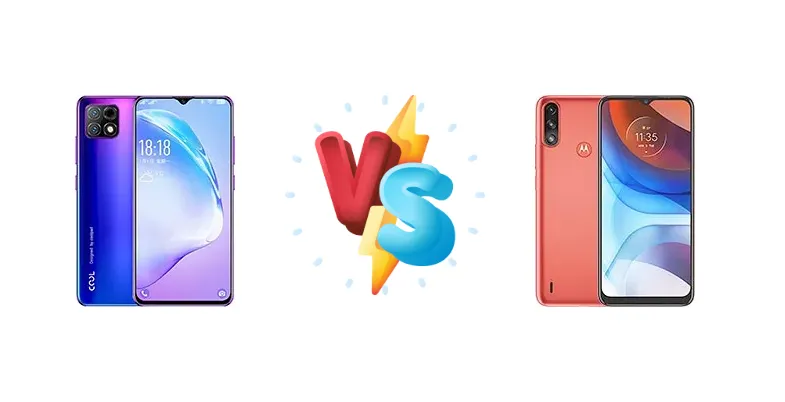
The sub-$150 smartphone market is fiercely competitive. The Coolpad Cool 12A and Motorola Moto E7 Power represent two distinct approaches to delivering value: the Cool 12A prioritizes a more modern CPU architecture, while the Moto E7 Power focuses on maximizing battery life. This comparison dissects their key differences to determine which device best suits your needs.
🏆 Quick Verdict
For the average user prioritizing longevity, the Motorola Moto E7 Power is the better choice. Its larger battery and efficient chipset translate to significantly longer runtimes. However, the Coolpad Cool 12A offers a potentially snappier experience for basic tasks thanks to its Cortex-A75 core, but this comes at the cost of battery life.
| Network |
|---|
| 2G bands | GSM 850 / 900 / 1800 / 1900 | GSM 850 / 900 / 1800 / 1900 |
| 3G bands | HSDPA 2100 | HSDPA 850 / 900 / 1700(AWS) / 1900 / 2100 |
| 4G bands | LTE | 1, 3, 5, 7, 8, 20, 38, 40, 41 |
| Speed | HSPA, LTE | HSPA, LTE |
| Technology | GSM / HSPA / LTE | GSM / HSPA / LTE |
| Launch |
|---|
| Announced | 2020, October 05. Released 2020, October 05 | 2021, February 19 |
| Status | Discontinued | Available. Released 2021, February 26 |
| Body |
|---|
| Build | Glass front, plastic frame, glass back | Glass front, plastic back, plastic frame |
| Dimensions | 156.2 x 75.2 x 8.9 mm (6.15 x 2.96 x 0.35 in) | 165.1 x 75.9 x 9.2 mm (6.5 x 2.99 x 0.36 in) |
| SIM | Nano-SIM | Nano-SIM + Nano-SIM |
| Weight | 202.5 g (7.16 oz) | 200 g (7.05 oz) |
| | - | Water-repellent design |
| Display |
|---|
| Protection | Corning Gorilla Glass 3 | - |
| Resolution | 720 x 1560 pixels, 19.5:9 ratio (~273 ppi density) | 720 x 1600 pixels, 20:9 ratio (~269 ppi density) |
| Size | 6.3 inches, 97.4 cm2 (~82.9% screen-to-body ratio) | 6.51 inches, 103.1 cm2 (~82.3% screen-to-body ratio) |
| Type | IPS LCD | IPS LCD, 380 nits (typ) |
| Platform |
|---|
| CPU | Quad-core (1x2.0 GHz Cortex-A75 & 3x1.8 GHz Cortex-A55) | Octa-core (4x2.0 GHz Cortex-A53 & 4x1.5 GHz Cortex-A53) |
| Chipset | Spreadtrum | Mediatek MT6762G Helio G25 (12 nm) |
| GPU | Adreno 418 | PowerVR GE8320 |
| OS | Android | Android 10 |
| Memory |
|---|
| Card slot | microSD | microSDXC (uses shared SIM slot) |
| Internal | 64GB 4GB RAM | 32GB 2GB RAM, 64GB 4GB RAM |
| | eMMC 5.1 | eMCP |
| Main Camera |
|---|
| Dual | 16 MP, PDAF
2 MP | 13 MP, f/2.0, 26mm (wide), 1/3.1", 1.12µm, PDAF
2 MP (macro) |
| Features | LED flash, panorama, HDR | LED flash, HDR, panorama |
| Single | 21 MP, f/2.0, 27mm (wide), PDAF | - |
| Video | 1080p@30fps | 1080p@30fps |
| Selfie camera |
|---|
| Features | - | HDR |
| Single | 8 MP | 5 MP, f/2.2, 27mm (wide), 1.12µm |
| Video | 1080p@30fps | 1080p@30fps |
| Sound |
|---|
| 3.5mm jack | Yes | Yes |
| 35mm jack | Yes | Yes |
| Loudspeaker | Yes | Yes |
| Comms |
|---|
| Bluetooth | 4.2, A2DP | 5.0, A2DP, LE |
| Infrared port | Yes | - |
| NFC | No | No |
| Positioning | GPS | GPS, GLONASS, GALILEO |
| Radio | FM radio | FM radio |
| USB | USB Type-C 2.0 | USB Type-C 2.0, OTG |
| WLAN | Wi-Fi 802.11 b/g/n, Wi-Fi Direct, hotspot | Wi-Fi 802.11 b/g/n |
| Features |
|---|
| Sensors | Fingerprint (side-mounted), accelerometer, proximity | Fingerprint (rear-mounted), accelerometer, proximity |
| Battery |
|---|
| Charging | 18W wired, QC2 (market dependent) | 10W wired |
| Stand-by | Up to 618 h (3G) | - |
| Talk time | Up to 31 h (3G) | - |
| Type | Li-Po 4000 mAh | Li-Ion 5000 mAh |
| Misc |
|---|
| Colors | Dream Black, Dream Blue, Fantasy Silver | Tahiti Blue, Coral Red |
| Models | X3a40, X3c50 | PAMH0001IN, PAMH0010IN, PAMH0019IN |
| Price | About 70 EUR | About 140 EUR |
Coolpad Cool 12A
- Potentially faster CPU performance due to Cortex-A75 core
- Faster charging speeds (18W with QC2)
- More modern CPU architecture
- Likely shorter battery life
- Spreadtrum chipsets often lack software optimization
Motorola Moto E7 Power
- Superior battery life due to efficient chipset and likely larger battery
- Motorola’s clean software experience
- Reliable brand reputation for software updates (within its segment)
- Slower CPU performance
- Slower charging speeds (10W)
Display Comparison
Neither device boasts a standout display. Both likely utilize LCD panels, a common trait in this price bracket. The focus here isn't on visual fidelity, but on practicality. Without specific display specs, it's safe to assume both offer basic viewing experiences. The absence of high refresh rates or advanced features like LTPO is expected.
Camera Comparison
Camera performance is likely to be similar on both devices, leaning towards basic functionality. Without detailed sensor information, it’s reasonable to assume both feature a primary sensor paired with a depth or macro lens. The Moto E7 Power’s camera system is unlikely to offer significant advantages, and the Cool 12A’s is similarly positioned. Image processing will likely be the differentiating factor, but neither is expected to compete with higher-end smartphones.
Performance
The chipset is where the most significant difference lies. The Coolpad Cool 12A’s Spreadtrum chipset features a quad-core configuration with a Cortex-A75 core clocked at 2.0 GHz, paired with three Cortex-A55 cores at 1.8 GHz. This architecture, while not cutting-edge, offers a performance boost over the Moto E7 Power’s MediaTek Helio G25. The G25 utilizes an octa-core setup, but all eight cores are Cortex-A53, clocked at 2.0 GHz and 1.5 GHz respectively. While more cores *can* be beneficial, the older A53 architecture and lower individual core performance mean the Cool 12A is likely to handle multitasking and app launches more smoothly. The Helio G25’s 12nm process node is more efficient than what Spreadtrum typically uses, potentially mitigating some of the performance gap.
Battery Life
The Motorola Moto E7 Power clearly wins in the battery department. While the exact capacity isn't specified, Motorola’s ‘Power’ branding consistently indicates a large battery. Coupled with the efficient Helio G25 chipset, the E7 Power should deliver significantly longer battery life than the Coolpad Cool 12A. The Cool 12A’s 18W charging with QC2 support (market dependent) is faster than the Moto E7 Power’s 10W charging, meaning quicker top-ups when needed, but this advantage is offset by the likely need to charge more frequently.
Buying Guide
Buy the Coolpad Cool 12A if you frequently switch between apps, need a slightly more responsive experience for social media and light browsing, and don't mind charging your phone more often. Buy the Motorola Moto E7 Power if battery life is your absolute top priority, you primarily use your phone for calls, texts, and occasional light app usage, and you value a phone that can easily last a full day (or more) on a single charge.
Frequently Asked Questions
❓ Will the Coolpad Cool 12A struggle with demanding apps like PUBG Mobile?
The Coolpad Cool 12A’s Spreadtrum chipset is unlikely to deliver a smooth PUBG Mobile experience at high settings. Expect to lower graphics settings and frame rates to achieve playable performance. The Helio G25 in the Moto E7 Power will likely perform similarly, if not worse.
❓ How long can I realistically expect the Motorola Moto E7 Power to last on a single charge with moderate use?
With moderate use – including calls, texts, social media, and occasional web browsing – the Motorola Moto E7 Power should easily last a full day, and potentially two days, on a single charge. This is its key strength.
❓ Does the Coolpad Cool 12A support Quick Charge, and how quickly will it charge from 0% to 100%?
The Coolpad Cool 12A supports 18W wired charging with QC2 (market dependent). While faster than the Moto E7 Power’s 10W charging, a full 0-100% charge will likely take around 2-3 hours, depending on the charger used and battery health.
❓ Is the software experience significantly different between the Coolpad Cool 12A and Motorola Moto E7 Power?
Motorola is known for its near-stock Android experience, offering a cleaner and less cluttered interface compared to Coolpad’s typically more customized Android skin. This can translate to smoother performance and faster software updates (within the limitations of the budget segment).