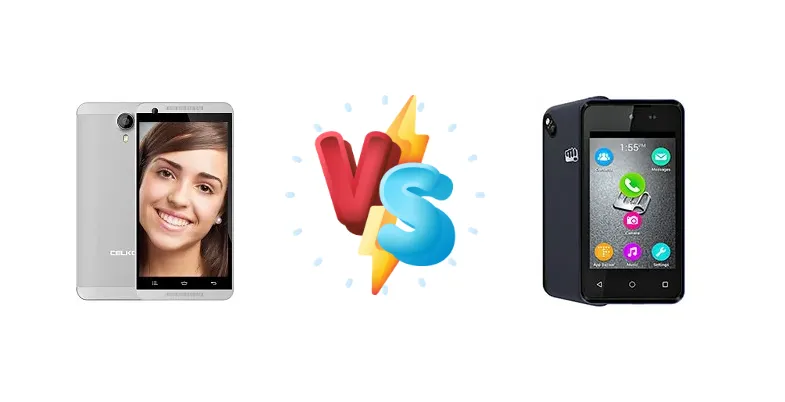
The Celkon Q54+ and Micromax Bolt D303 represent the extreme end of the smartphone market, targeting first-time buyers or those needing a very basic secondary device. Both phones prioritize affordability, but they take different approaches to achieving it, primarily in their chipset choices. This comparison dives deep into the hardware to determine which offers the better user experience for essential tasks.
🏆 Quick Verdict
For the average user prioritizing responsiveness in basic apps, the Celkon Q54+ with its quad-core Spreadtrum 7731 chipset is the better choice. While the Micromax Bolt D303’s Mediatek MT6572M is more power-efficient due to its 28nm process, the Q54+'s additional cores provide a noticeable performance advantage for multitasking and app loading.
| Network |
|---|
| 2G bands | GSM 900 / 1800 - SIM 1 & SIM 2 | GSM 850 / 900 / 1800 / 1900 - SIM 1 & SIM 2 |
| 3G bands | HSDPA | HSDPA 900 / 2100 |
| EDGE | Yes | - |
| GPRS | Yes | - |
| Speed | HSPA | HSPA 21.1/5.76 Mbps |
| Technology | GSM / HSPA | GSM / HSPA |
| Launch |
|---|
| Announced | 2015, March. Released 2015, March | 2015, July. Released 2015, July |
| Status | Discontinued | Discontinued |
| Body |
|---|
| Dimensions | 145 x 73 x 8.8 mm (5.71 x 2.87 x 0.35 in) | - |
| SIM | Dual SIM | Dual SIM |
| Weight | 150.6 g (5.33 oz) | - |
| Display |
|---|
| Resolution | 480 x 854 pixels, 16:9 ratio (~196 ppi density) | 480 x 800 pixels, 5:3 ratio (~233 ppi density) |
| Size | 5.0 inches, 68.9 cm2 (~65.1% screen-to-body ratio) | 4.0 inches, 45.5 cm2 |
| Type | IPS LCD | TFT, 256K colors |
| Platform |
|---|
| CPU | Quad-core 1.2 GHz | Dual-core 1.3 GHz Cortex-A7 |
| Chipset | Spreadtrum 7731 | Mediatek MT6572M (28 nm) |
| GPU | Mali-400 | Mali-400 |
| OS | Android 4.4.2 (KitKat) | Android 4.4.2 (KitKat) |
| Memory |
|---|
| Card slot | microSDHC | microSDHC |
| Internal | 8GB 1GB RAM | 4GB 512MB RAM |
| Main Camera |
|---|
| Features | LED flash | LED flash |
| Single | 5 MP, AF | 3.15 MP |
| Video | Yes | 480p@30fps |
| Selfie camera |
|---|
| Single | 5 MP | VGA |
| Sound |
|---|
| 3.5mm jack | - | Yes |
| 35mm jack | Yes | Yes |
| Loudspeaker | Yes | Yes |
| Comms |
|---|
| Bluetooth | 2.0 | 4.0, A2DP |
| NFC | No | No |
| Positioning | GPS | GPS |
| Radio | FM radio | FM radio |
| USB | microUSB | microUSB 2.0 |
| WLAN | Wi-Fi 802.11 b/g/n | Wi-Fi 802.11 b/g/n, hotspot |
| Features |
|---|
| Sensors | Accelerometer | Accelerometer |
| Battery |
|---|
| Stand-by | - | Up to 245 h (3G) |
| Talk time | - | Up to 4 h 40 min (3G) |
| Type | Li-Ion 2000 mAh battery | Li-Ion 1300 mAh, removable |
| Misc |
|---|
| Colors | Blue, Brown, White, Silver | Black |
| SAR | - | 0.39 W/kg (head) 0.64 W/kg (body) |
| SAR EU | 0.16 W/kg (head) 0.30 W/kg (body) | - |
Celkon Q54+
- Quad-core processor offers better multitasking.
- Likely smoother performance in apps.
- Potentially better for basic social media use.
- May have shorter battery life.
- Spreadtrum chipsets generally have less software support.
Micromax Bolt D303
- More power-efficient chipset for longer battery life.
- 28nm process reduces heat generation.
- Mediatek chipsets often have wider driver support.
- Dual-core processor may struggle with multitasking.
- Slower app loading times compared to the Q54+.
Display Comparison
Neither device boasts a standout display. Given the price point, details like panel type (IPS vs TFT) and resolution are likely similar and not specified. The focus here is on the underlying processing power to drive the UI, rather than display fidelity. Bezels are expected to be substantial on both, maximizing screen real estate within a compact form factor.
Camera Comparison
Camera performance on both devices will be limited. Without sensor size or aperture information, it’s safe to assume both feature basic cameras suitable for casual snapshots in good lighting conditions. Any marketing around megapixel count should be viewed with skepticism, as image quality is far more dependent on sensor size and image processing. The absence of OIS (Optical Image Stabilization) on either device means low-light performance will be poor.
Performance
The core difference lies in the chipsets. The Celkon Q54+ utilizes the Spreadtrum 7731, a quad-core processor clocked at 1.2 GHz. This offers more parallel processing capability than the Micromax Bolt D303’s dual-core Mediatek MT6572M, running at 1.3 GHz. While the MT6572M benefits from a more efficient 28nm manufacturing process, the Cortex-A7 architecture is older and less performant per core than what the Spreadtrum 7731 likely employs. This means the Q54+ will likely exhibit smoother performance when switching between apps or loading moderately complex web pages. The lack of RAM specifications necessitates assuming both devices have a minimal amount, likely 512MB or 1GB, further emphasizing the importance of CPU core count.
Battery Life
Battery capacity is not specified for either device. However, the Mediatek MT6572M’s 28nm process gives it a significant advantage in power efficiency. This means the Bolt D303 will likely offer longer battery life for a given usage pattern, particularly if that pattern involves primarily calls and texts. The Q54+'s quad-core processor will consume more power, potentially requiring more frequent charging, but the performance trade-off may be worthwhile for some users.
Buying Guide
Buy the Celkon Q54+ if you need a phone capable of handling a few apps simultaneously without significant slowdown, or if you anticipate using slightly more demanding applications like basic social media. Buy the Micromax Bolt D303 if battery life is your absolute top priority and your usage is limited to calls, texts, and very light browsing, as the Mediatek chipset’s efficiency will translate to longer runtimes between charges.
Frequently Asked Questions
❓ Will the Mediatek MT6572M in the Bolt D303 struggle with modern web browsing?
The Mediatek MT6572M is a relatively old chipset. While it can handle basic web browsing, loading complex websites with many images or scripts will likely be slow and potentially lead to crashes. It's best suited for text-based browsing or lightweight mobile sites.
❓ Is the Spreadtrum 7731 in the Celkon Q54+ likely to overheat during extended use?
The Spreadtrum 7731 is not a high-performance chip, so significant overheating is unlikely. However, prolonged use of demanding apps (even relatively simple ones) could lead to some thermal throttling, reducing performance slightly. The device's passive cooling design won't offer much mitigation.
❓ Can either of these phones run popular social media apps like Facebook and WhatsApp smoothly?
Both phones *can* run Facebook and WhatsApp, but the experience will be far from fluid. The Celkon Q54+ will likely handle these apps with slightly less lag due to its quad-core processor, but expect occasional slowdowns and delays, especially when loading images or videos.