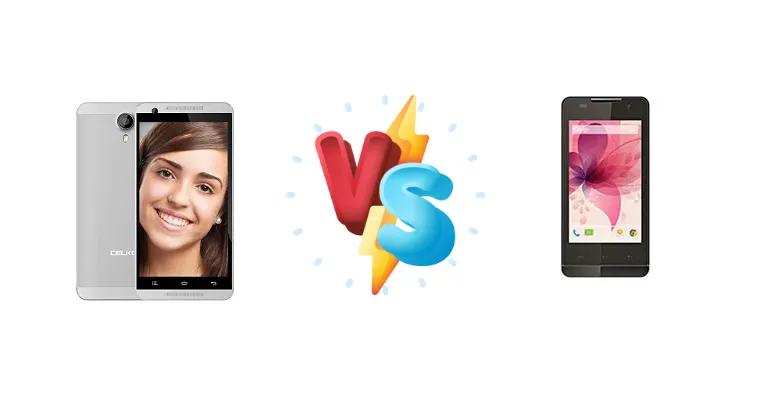
The Celkon Q54+ and Lava Iris 400Q represent the ultra-budget end of the Android smartphone market. Both devices aim to provide essential smartphone functionality at the lowest possible price point. This comparison dissects their similarities and differences, focusing on the core experience for users prioritizing affordability.
🏆 Quick Verdict
For the average user seeking a basic, functional Android experience, the Celkon Q54+ edges out the Lava Iris 400Q. The inclusion of the Spreadtrum 7731 chipset, while still entry-level, provides a slightly more defined performance profile than the Iris 400Q's unspecified chipset, potentially leading to smoother multitasking.
| Network |
|---|
| 2G bands | GSM 900 / 1800 - SIM 1 & SIM 2 | GSM 900 / 1800 - SIM 1 & SIM 2 |
| 3G bands | HSDPA | HSDPA 2100 |
| EDGE | Yes | - |
| GPRS | Yes | - |
| Speed | HSPA | Yes, 384 kbps |
| Technology | GSM / HSPA | GSM / HSPA |
| Launch |
|---|
| Announced | 2015, March. Released 2015, March | 2014, August. Released 2014, August |
| Status | Discontinued | Discontinued |
| Body |
|---|
| Dimensions | 145 x 73 x 8.8 mm (5.71 x 2.87 x 0.35 in) | 129 x 63 x 10 mm (5.08 x 2.48 x 0.39 in) |
| SIM | Dual SIM | Dual SIM |
| Weight | 150.6 g (5.33 oz) | - |
| Display |
|---|
| Resolution | 480 x 854 pixels, 16:9 ratio (~196 ppi density) | 480 x 800 pixels, 5:3 ratio (~233 ppi density) |
| Size | 5.0 inches, 68.9 cm2 (~65.1% screen-to-body ratio) | 4.0 inches, 45.5 cm2 (~56.0% screen-to-body ratio) |
| Type | IPS LCD | TFT |
| Platform |
|---|
| CPU | Quad-core 1.2 GHz | Quad-core 1.2 GHz |
| Chipset | Spreadtrum 7731 | - |
| GPU | Mali-400 | - |
| OS | Android 4.4.2 (KitKat) | Android 4.4.2 (KitKat) |
| Memory |
|---|
| Card slot | microSDHC | microSDHC |
| Internal | 8GB 1GB RAM | 4GB 512MB RAM |
| Main Camera |
|---|
| Features | LED flash | LED flash |
| Single | 5 MP, AF | 5 MP |
| Video | Yes | Yes |
| Selfie camera |
|---|
| Single | 5 MP | VGA |
| Sound |
|---|
| 3.5mm jack | - | Yes |
| 35mm jack | Yes | Yes |
| Loudspeaker | Yes | Yes |
| Comms |
|---|
| Bluetooth | 2.0 | 4.0, A2DP |
| NFC | No | No |
| Positioning | GPS | A-GPS |
| Radio | FM radio | FM radio |
| USB | microUSB | microUSB 2.0 |
| WLAN | Wi-Fi 802.11 b/g/n | Wi-Fi 802.11 b/g/n |
| Features |
|---|
| Sensors | Accelerometer | Accelerometer, proximity |
| Battery |
|---|
| Stand-by | - | Up to 153 h |
| Talk time | - | Up to 9 h 10 min |
| Type | Li-Ion 2000 mAh battery | Li-Ion 1700 mAh, removable |
| Misc |
|---|
| Colors | Blue, Brown, White, Silver | Black, White |
| SAR EU | 0.16 W/kg (head) 0.30 W/kg (body) | - |
Celkon Q54+
- Known chipset (Spreadtrum 7731) provides a predictable performance profile.
- Potentially smoother multitasking due to the defined chipset.
- Likely better software support due to chipset familiarity.
- Still an entry-level chipset with limited performance.
- Display quality likely to be basic.
Lava Iris 400Q
- Potential for localized software optimizations.
- Brand recognition within the Indian market.
- May offer a slightly lower price point.
- Unspecified chipset makes performance prediction difficult.
- Potentially less consistent performance compared to the Q54+.
Display Comparison
Both the Celkon Q54+ and Lava Iris 400Q likely feature similar low-resolution displays, typical of this price segment. Given the lack of detailed display specifications, it's reasonable to assume both utilize TN or low-grade IPS panels. Color accuracy and viewing angles will likely be limited on both devices. The absence of features like high refresh rates or Gorilla Glass is expected, emphasizing cost reduction. The user experience will be focused on functionality rather than visual fidelity.
Camera Comparison
Camera performance on both devices will be basic. Without detailed sensor information, it's safe to assume both feature low-resolution primary sensors (likely 5MP or 8MP) and potentially a VGA front-facing camera. Image quality will be acceptable in well-lit conditions but will suffer significantly in low light. The absence of features like Optical Image Stabilization (OIS) or advanced image processing algorithms is expected. Any secondary cameras (often 2MP macro lenses) are unlikely to provide significant value.
Performance
The Celkon Q54+ is equipped with the Spreadtrum 7731 chipset, featuring a quad-core 1.2 GHz CPU. The Lava Iris 400Q, while also sporting a quad-core 1.2 GHz CPU, lacks a specified chipset. This is a critical difference. The Spreadtrum 7731, while not a powerhouse, is a known quantity, allowing for a more predictable performance profile. The Iris 400Q’s performance is harder to gauge. Both devices will likely struggle with demanding applications and multitasking, but the Q54+ has a slight advantage due to the known chipset architecture. RAM capacity is not specified for either device, but it's likely to be 1GB or 2GB, further limiting performance.
Battery Life
Battery capacity is not specified for either device. However, given the low-power chipsets and basic displays, both phones should offer at least a full day of standby time and moderate usage. Charging wattage is also unknown, but it's likely to be 5W or 10W, resulting in relatively slow charging times. The focus will be on maximizing battery life through efficient power management rather than rapid charging capabilities.
Buying Guide
Buy the Celkon Q54+ if you need a phone primarily for calls, messaging, and light social media use, and appreciate a slightly more defined chipset specification. Buy the Lava Iris 400Q if you prioritize brand familiarity within the Indian market and are comfortable with a less detailed hardware profile, potentially benefiting from localized software optimizations. Both are suitable for first-time smartphone users or as a reliable backup device.
Frequently Asked Questions
❓ Will the Celkon Q54+ be able to run popular social media apps like WhatsApp and Facebook smoothly?
Yes, the Celkon Q54+ with its Spreadtrum 7731 chipset should be capable of running WhatsApp and Facebook without significant issues. However, expect some lag when switching between apps or loading media-heavy content. It's designed for basic social media usage, not intensive multitasking.
❓ Is the Lava Iris 400Q a good choice for someone upgrading from a feature phone?
The Lava Iris 400Q is a reasonable option for a first-time smartphone user transitioning from a feature phone. It provides essential smartphone functionality at a very affordable price. However, be aware that the performance will be limited, and the user experience won't be as smooth as more expensive smartphones.
❓ Can I expect to play games on either of these phones?
While both phones can technically run some games, the experience will be limited. Simple, 2D games will be playable, but demanding 3D games will likely suffer from significant lag and low frame rates. These phones are not designed for gaming.