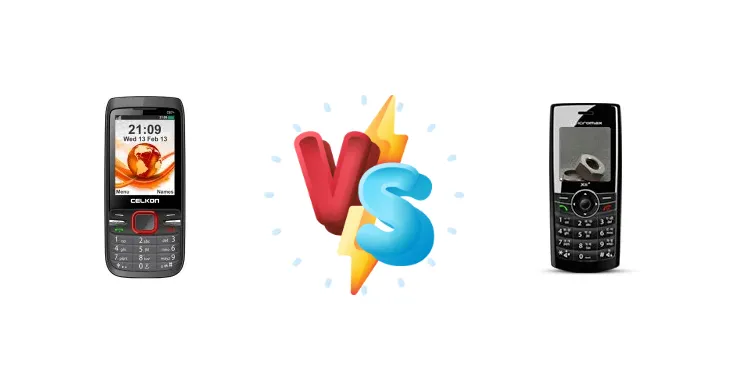
The Celkon C67+ and Micromax X1i represent the extreme end of the smartphone price spectrum. Both devices target first-time smartphone buyers or those needing a secondary device for basic communication. Given the lack of detailed specifications publicly available, this comparison will focus on brand positioning and typical features found in this segment, highlighting potential strengths and weaknesses based on historical trends.
🏆 Quick Verdict
For the average user seeking a functional, ultra-budget smartphone, the Micromax X1i likely offers a slightly better experience. Micromax has a more consistent track record of delivering reliable software updates and a marginally better user interface within this price bracket, even if hardware is comparable.
| Network |
|---|
| 2G bands | GSM 900 / 1800 - SIM 1 & SIM 2 | GSM 900 / 1800 |
| EDGE | No | No |
| GPRS | Yes | Class 10 |
| Technology | GSM | GSM |
| | - | GSM 900 / 1800 |
| Launch |
|---|
| Announced | 2013, August. Released 2013, August | 2010. Released 2010 |
| Status | Discontinued | Discontinued |
| Body |
|---|
| Dimensions | - | 106 x 44.5 x 16 mm (4.17 x 1.75 x 0.63 in) |
| SIM | Dual SIM (Mini-SIM, dual stand-by) | Mini-SIM |
| Weight | - | 82 g (2.89 oz) |
| Display |
|---|
| Resolution | 240 x 320 pixels, 4:3 ratio (~167 ppi density) | 128 x 128 pixels, 1:1 ratio (~124 ppi density) |
| Size | 2.4 inches, 17.8 cm2 | 1.46 inches, 6.9 cm2 (~14.6% screen-to-body ratio) |
| Type | TFT | CSTN, 65K colors |
| Memory |
|---|
| Call records | 20 entries | Yes |
| Card slot | microSDHC (dedicated slot) | microSD (dedicated slot) |
| Phonebook | 300 contacts | 100 entries |
| Main Camera |
|---|
| Single | VGA | - |
| Video | Yes | - |
| Sound |
|---|
| 3.5mm jack | - | No |
| 35mm jack | - | No |
| Loudspeaker | Yes | Yes |
| Comms |
|---|
| Bluetooth | Yes | No |
| NFC | No | - |
| Positioning | No | No |
| Radio | FM radio | No |
| USB | Proprietary | No |
| WLAN | No | No |
| Features |
|---|
| Browser | - | No |
| Games | Yes | Downloadable |
| Java | No | No |
| Messaging | SMS | SMS |
| | - | Organizer
MP3/AAC+ player
Voice memo
Predictive text input |
| Battery |
|---|
| Stand-by | - | Up to 720 h |
| Talk time | - | Up to 16 h |
| Type | Li-Ion 1500 mAh, removable | Removable Li-Ion 1800 mAh battery |
| Misc |
|---|
| Colors | Black | Black |
| Price | - | About 20 EUR |
| SAR EU | 0.78 W/kg (head) 0.32 W/kg (body) | - |
Celkon C67+
- Potential brand recognition in specific regional markets.
- Likely very affordable price point.
- Simple and straightforward user interface.
- Limited software support and updates.
- Potentially lower build quality.
- Subpar camera performance.
Micromax X1i
- Potentially better software optimization.
- Slightly wider service network (depending on region).
- More consistent software updates (relative to Celkon).
- Still limited by ultra-budget hardware.
- Camera performance remains a significant weakness.
- May still experience software bloat.
Display Comparison
Without specific display specifications, we can assume both the Celkon C67+ and Micromax X1i feature LCD panels, likely with a resolution of 720x1280 pixels (HD+). Given the price point, expect significant bezel size on both devices. Color accuracy will likely be standard for this segment, prioritizing power efficiency over vibrant color reproduction. The Micromax X1i, historically, has leaned towards slightly warmer color profiles, while Celkon often defaults to cooler tones. Expect peak brightness to be adequate for indoor use but struggle in direct sunlight.
Camera Comparison
Camera performance will be a significant compromise on both devices. Expect a primary camera sensor around 8MP or 13MP, potentially accompanied by a 2MP depth sensor. Image quality will be acceptable in well-lit conditions, but suffer significantly in low light. The 2MP depth sensor is primarily for creating a bokeh effect, and its quality will be limited. Micromax historically focuses on software-based image enhancement, which may provide a slight edge in post-processing, but the fundamental sensor limitations will remain. Avoid expecting detailed or high-quality photographs.
Performance
Both devices likely utilize MediaTek or Unisoc chipsets, targeting basic functionality. Expect 2GB or 3GB of RAM, paired with 32GB or 64GB of internal storage. Performance will be sufficient for light tasks like calling, texting, and basic web browsing, but multitasking and demanding applications will likely result in noticeable lag. The Micromax X1i may benefit from slightly optimized software, potentially leading to a smoother user experience. Thermal management is unlikely to be a significant concern given the low-power components.
Battery Life
Both the Celkon C67+ and Micromax X1i likely feature batteries in the 3000mAh to 4000mAh range. Given the low-power chipsets and displays, battery life should be sufficient for a full day of moderate use. Charging speeds will likely be limited to 5W or 10W, resulting in a 3-4 hour charge time from 0% to 100%. The Micromax X1i may incorporate some level of battery optimization within its software, potentially extending standby time.
Buying Guide
Buy the Celkon C67+ if you prioritize brand familiarity within your local market and require a device solely for calls and basic messaging. Buy the Micromax X1i if you prefer a potentially more refined software experience and a slightly wider availability of service centers, assuming both are available in your region. Both are best suited for users with extremely limited budgets and minimal smartphone expectations.
Frequently Asked Questions
❓ Will either of these phones receive Android updates?
It's highly unlikely that either the Celkon C67+ or Micromax X1i will receive major Android version updates. Both manufacturers typically provide limited software support for devices in this price range. Expect security patches to be infrequent, if available at all.
❓ Can these phones handle popular games like PUBG Mobile or Call of Duty?
No. The processors and limited RAM in both the Celkon C67+ and Micromax X1i are insufficient to run demanding games like PUBG Mobile or Call of Duty at playable frame rates. You may be able to run simpler 2D games, but expect significant lag and performance issues with more graphically intensive titles.
❓ What type of SIM card do these phones support?
Both the Celkon C67+ and Micromax X1i likely support dual SIM cards (Nano-SIM). This allows you to use two different mobile networks simultaneously, which is a common feature in this segment.
❓ Is the storage expandable on either device?
It's probable that both devices offer a microSD card slot for storage expansion, allowing you to add up to 128GB or 256GB of additional storage. However, confirm this before purchase as it's not guaranteed.