
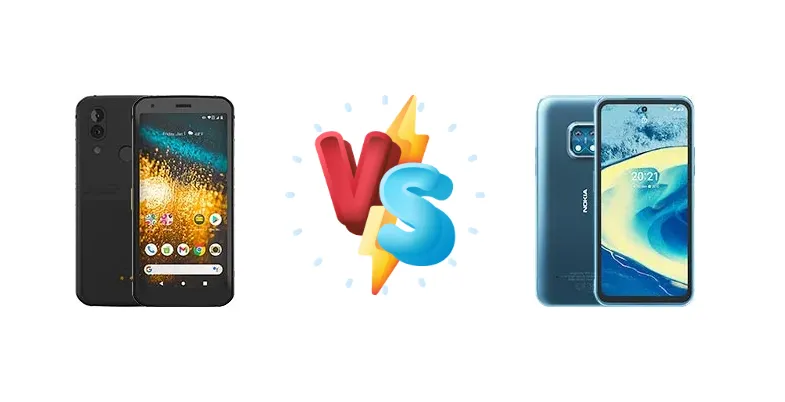
Cat S62 vs Nokia XR20: A Head-to-Head of Rugged Smartphone Power
| Phones Images | |||||
|---|---|---|---|---|---|
|
🏆 Quick Verdict
For users prioritizing established ruggedness and wireless charging, the Cat S62 is the better choice. While its chipset is older, it offers a stable experience. The Nokia XR20 appeals to those needing 5G connectivity and a more modern processor, but sacrifices wireless charging and potentially thermal performance under sustained load.
| PHONES | ||
|---|---|---|
| Phone Names | Cat S62 | Nokia XR20 |
| Network | ||
|---|---|---|
| 2G bands | GSM 850 / 900 / 1800 / 1900 | GSM 850 / 900 / 1800 / 1900 |
| 3G bands | HSDPA 850 / 900 / 1700(AWS) / 1900 / 2100 | HSDPA 850 / 900 / 1700(AWS) / 1900 / 2100 |
| 4G bands | 1, 2, 3, 4, 5, 7, 8, 12, 13, 14, 17, 20, 25, 26, 28, 38, 39, 40, 41, 66, 71 | 1, 2, 3, 4, 5, 7, 8, 12, 13, 14, 20, 25, 26, 28, 30, 38, 40, 41, 48, 66, 71 |
| 5G bands | - | 2, 5, 25, 38, 41, 48, 66, 77, 78 SA/NSA |
| Speed | HSPA 42.2/5.76 Mbps, LTE Cat12 600/150 Mbps | HSPA, LTE, 5G |
| Technology | GSM / CDMA / HSPA / EVDO / LTE | GSM / CDMA / HSPA / EVDO / LTE / 5G |
| CDMA2000 1xEV-DO | CDMA2000 1xEV-DO | |
| Launch | ||
|---|---|---|
| Announced | 2021, June 18 | 2021, July 27 |
| Status | Available. Released 2021, June 18 | Available. Released 2021, August 04 |
| Body | ||
|---|---|---|
| Build | Glass front (Gorilla Glass 6), plastic back, aluminum frame | - |
| Dimensions | 157.5 x 76.2 x 12.7 mm (6.20 x 3.00 x 0.5 in) | 171.6 x 81.5 x 10.6 mm (6.76 x 3.21 x 0.42 in) |
| SIM | Nano-SIM | · Nano-SIM· Nano-SIM + Nano-SIM |
| Weight | 260 g (9.17 oz) | 248 g (8.75 oz) |
| IP68/IP69 dust/water resistant (up to 1.5m for 35 min) Drop-to-concrete resistance from up to 1.8m MIL-STD-810H compliant | IP68 dust/water resistant (up to 1.5m for 60 min) Drop-to-concrete resistance from up to 1.8m MIL-STD-810H compliant | |
| Display | ||
|---|---|---|
| Protection | Corning Gorilla Glass 6 | Corning Gorilla Glass Victus |
| Resolution | 1080 x 2160 pixels, 18:9 ratio (~424 ppi density) | 1080 x 2400 pixels, 20:9 ratio (~395 ppi density) |
| Size | 5.7 inches, 83.8 cm2 (~69.9% screen-to-body ratio) | 6.67 inches, 107.4 cm2 (~76.8% screen-to-body ratio) |
| Type | IPS LCD | IPS LCD, 550 nits |
| Platform | ||
|---|---|---|
| CPU | Octa-core (4x2.2 GHz Kryo 260 Gold & 4x1.8 GHz Kryo 260 Silver) | Octa-core (2x2.0 GHz Kryo 460 & 6x1.8 GHz Kryo 460) |
| Chipset | Qualcomm SDM660 Snapdragon 660 (14 nm) | Qualcomm SM4350 Snapdragon 480 5G (8 nm) |
| GPU | Adreno 512 | Adreno 619 |
| OS | Android 10, upgradable to Android 11 | Android 11, upgradable to Android 13 |
| Memory | ||
|---|---|---|
| Card slot | microSDXC (dedicated slot) | microSDXC (uses shared SIM slot) |
| Internal | 128GB 4GB RAM | 64GB 4GB RAM, 128GB 6GB RAM |
| Main Camera | ||
|---|---|---|
| Dual | 48 MP, (wide), PDAF 2 MP | 48 MP, f/1.8, (wide), 1/2.25", 0.8µm, PDAF 13 MP, f/2.4, 123˚ (ultrawide), 1/3.0", 1.12µm |
| Features | LED flash, HDR, panorama | Zeiss optics, Dual-LED dual-tone flash, second LED flash, HDR, panorama |
| Single | - | 8 MP, f/2.0 (wide), 1/4.0", 1.12µm |
| Video | 4K@30fps, 1080p@30fps | 1080p@30fps |
| Selfie camera | ||
|---|---|---|
| Single | 8 MP | 8 MP, f/2.0 (wide), 1/4.0", 1.12µm |
| Video | 1080p@30fps | 1080p@30fps |
| Sound | ||
|---|---|---|
| 3.5mm jack | Yes | Yes |
| 35mm jack | Yes | Yes |
| Loudspeaker | Yes | Yes, with stereo speakers |
| Comms | ||
|---|---|---|
| Bluetooth | 5.0, A2DP, LE | 5.1, A2DP, LE, aptX Adaptive |
| NFC | Yes | Yes |
| Positioning | GPS, GLONASS, GALILEO, BDS | GPS (L1+L5), GLONASS, BDS, GALILEO, QZSS, NavIC |
| Radio | FM radio | Unspecified |
| USB | USB Type-C 2.0, OTG | USB Type-C 3.0 |
| WLAN | Wi-Fi 802.11 a/b/g/n/ac, dual-band, Wi-Fi Direct | Wi-Fi 802.11 a/b/g/n/ac/6, dual-band, Wi-Fi Direct |
| Features | ||
|---|---|---|
| Sensors | Fingerprint (rear-mounted), accelerometer, gyro, proximity, compass | Fingerprint (side-mounted), accelerometer, gyro, proximity, compass, barometer |
| Battery | ||
|---|---|---|
| Charging | Wireless QC4 | 18W wired 15W wireless |
| Type | Li-Ion 4000 mAh | Li-Po 4630 mAh |
| Misc | ||
|---|---|---|
| Colors | Black | Ultra Blue, Granite Gray |
| Models | - | TA-1368, TA-1362 |
| Price | About 440 EUR | About 270 EUR |
| SAR EU | - | 1.13 W/kg (head) 1.43 W/kg (body) |
Cat S62
- Proven Snapdragon 660 performance
- Wireless charging with QC4 support
- Integrated thermal camera for professional use
- Older chipset technology
- Lacks 5G connectivity
Nokia XR20
- 5G connectivity for faster data speeds
- More modern Snapdragon 480 processor
- Longer software support commitment from Nokia
- Slower 18W wired charging
- No wireless charging
- Potentially lower sustained performance due to thermal constraints
Display Comparison
Neither device boasts a cutting-edge display. Details on panel type and resolution are missing, but both likely utilize IPS LCDs given their rugged focus. The key difference lies in processing power impacting display responsiveness. The Snapdragon 660 in the Cat S62, while older, may provide a smoother experience with UI elements due to its more powerful CPU cores. The Nokia XR20's Snapdragon 480, while newer, has a less capable CPU, potentially leading to slight lag in certain scenarios. Brightness data is unavailable, but both will likely prioritize visibility in direct sunlight over color accuracy.
Camera Comparison
Detailed camera specs are unavailable, making a direct comparison difficult. However, given the target audience, both phones likely prioritize practicality over photographic excellence. The Cat S62’s camera system is likely tuned for quick, reliable image capture in challenging conditions. The Nokia XR20, benefiting from newer image signal processing capabilities within the Snapdragon 480, *may* offer slightly better image quality in ideal lighting. However, the difference will likely be minimal. The presence of a dedicated thermal camera on the Cat S62 is a significant differentiator, catering to professionals needing temperature readings in the field.
Performance
The chipset is where the most significant difference lies. The Cat S62’s Snapdragon 660, built on a 14nm process, features an octa-core CPU with Kryo 260 cores clocked up to 2.2 GHz. This offers a strong balance of performance and efficiency for everyday tasks. Conversely, the Nokia XR20 utilizes the Snapdragon 480 5G (8nm), with a CPU configuration of 2x2.0 GHz Kryo 460 and 6x1.8 GHz Kryo 460 cores. While the 8nm process is more efficient, the Snapdragon 480’s CPU cores are less powerful individually than the Snapdragon 660’s Kryo 260 Gold cores. This translates to potentially slower app loading times and less responsive multitasking on the XR20, despite the newer architecture. The 8nm process *should* result in better thermal efficiency, but the XR20's smaller heatsink (likely due to ruggedization constraints) may negate this advantage under sustained load.
Battery Life
Battery capacity is not specified, but both phones are designed for all-day use. The Nokia XR20 supports 18W wired charging and 15W wireless charging, offering flexibility. The Cat S62 offers wireless charging and QC4 support, potentially allowing for faster wireless charging speeds with compatible chargers. The Snapdragon 660’s efficiency, combined with potentially larger battery capacity, could give the Cat S62 a slight edge in battery life. However, the XR20’s 8nm chipset *should* consume less power during idle usage.
Buying Guide
Buy the Cat S62 if you need a proven, extremely durable phone with wireless charging, and aren't heavily reliant on the latest 5G speeds. It's ideal for construction workers, field technicians, or anyone frequently exposed to harsh environments. Buy the Nokia XR20 if you prioritize 5G connectivity, a more recent processor for app compatibility, and value a phone with a longer software support commitment, accepting the trade-off of slower charging and potentially less consistent performance under heavy load.