
Cat S53 vs Nokia XR20: A Head-to-Head of Rugged 5G Smartphones
| Phones Images | |||||
|---|---|---|---|---|---|
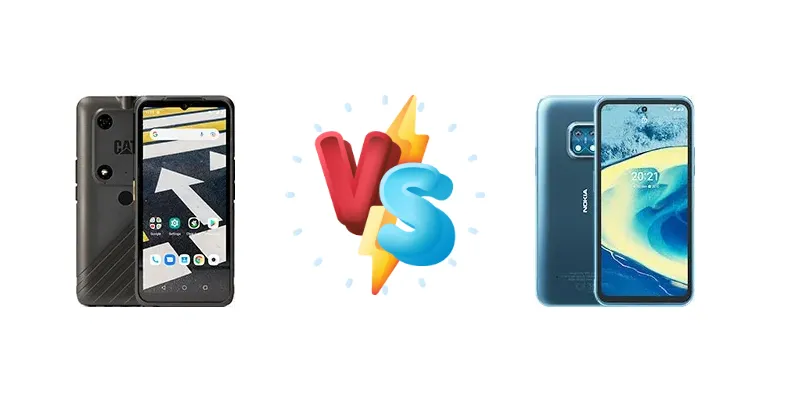
|
🏆 Quick Verdict
For users prioritizing convenience and future-proofing, the Cat S53 emerges as the better choice. Its inclusion of wireless charging, alongside the same Snapdragon 480 performance as the Nokia XR20, provides a valuable feature without a significant price premium. However, the XR20's potentially more robust build quality may appeal to those in extremely demanding environments.
| PHONES | ||
|---|---|---|
| Phone Names | Cat S53 | Nokia XR20 |
| Network | ||
|---|---|---|
| 2G bands | GSM 850 / 900 / 1800 / 1900 | GSM 850 / 900 / 1800 / 1900 |
| 3G bands | HSDPA 800 / 850 / 900 / 1700(AWS) / 1900 / 2100 | HSDPA 850 / 900 / 1700(AWS) / 1900 / 2100 |
| 4G bands | 1, 2, 3, 4, 5, 7, 8, 12, 13, 17, 18, 19, 20, 25, 26, 28, 34, 38, 39, 40, 41, 66 | 1, 2, 3, 4, 5, 7, 8, 12, 13, 14, 20, 25, 26, 28, 30, 38, 40, 41, 48, 66, 71 |
| 5G bands | 1, 2, 3, 5, 7, 8, 28, 41, 66, 77, 78 | 2, 5, 25, 38, 41, 48, 66, 77, 78 SA/NSA |
| Speed | HSPA, LTE | HSPA, LTE, 5G |
| Technology | GSM / HSPA / LTE / 5G | GSM / CDMA / HSPA / EVDO / LTE / 5G |
| - | CDMA2000 1xEV-DO | |
| Launch | ||
|---|---|---|
| Announced | 2022, July 19 | 2021, July 27 |
| Status | Available. Released 2022, July 19 | Available. Released 2021, August 04 |
| Body | ||
|---|---|---|
| Dimensions | 171 x 81 x 16 mm (6.73 x 3.19 x 0.63 in) | 171.6 x 81.5 x 10.6 mm (6.76 x 3.21 x 0.42 in) |
| SIM | Nano-SIM + Nano-SIM | · Nano-SIM· Nano-SIM + Nano-SIM |
| Weight | 320 g (11.29 oz) | 248 g (8.75 oz) |
| IP68/IP69K dust/water resistant (up to 1.5m for 35 min) Drop-to-concrete resistance from up to 1.8m MIL-STD-810H compliant Dedicated flashlight | IP68 dust/water resistant (up to 1.5m for 60 min) Drop-to-concrete resistance from up to 1.8m MIL-STD-810H compliant | |
| Display | ||
|---|---|---|
| Protection | - | Corning Gorilla Glass Victus |
| Resolution | 720 x 1600 pixels, 20:9 ratio (~270 ppi density) | 1080 x 2400 pixels, 20:9 ratio (~395 ppi density) |
| Size | 6.5 inches, 102.0 cm2 (~73.6% screen-to-body ratio) | 6.67 inches, 107.4 cm2 (~76.8% screen-to-body ratio) |
| Type | IPS LCD | IPS LCD, 550 nits |
| Platform | ||
|---|---|---|
| CPU | Octa-core (2x2.0 GHz Kryo 460 & 6x1.8 GHz Kryo 460) | Octa-core (2x2.0 GHz Kryo 460 & 6x1.8 GHz Kryo 460) |
| Chipset | Qualcomm SM4350 Snapdragon 480 5G (8 nm) | Qualcomm SM4350 Snapdragon 480 5G (8 nm) |
| GPU | Adreno 619 | Adreno 619 |
| OS | Android 11 | Android 11, upgradable to Android 13 |
| Memory | ||
|---|---|---|
| Card slot | microSDXC (uses shared SIM slot) | microSDXC (uses shared SIM slot) |
| Internal | 128GB 6GB RAM | 64GB 4GB RAM, 128GB 6GB RAM |
| Main Camera | ||
|---|---|---|
| Dual | 48 MP, f/1.8, (wide) 2 MP (macro) | 48 MP, f/1.8, (wide), 1/2.25", 0.8µm, PDAF 13 MP, f/2.4, 123˚ (ultrawide), 1/3.0", 1.12µm |
| Features | LED flash | Zeiss optics, Dual-LED dual-tone flash, second LED flash, HDR, panorama |
| Single | 16 MP, f/2.0 | 8 MP, f/2.0 (wide), 1/4.0", 1.12µm |
| Video | 1080p@30fps | 1080p@30fps |
| Selfie camera | ||
|---|---|---|
| Single | 16 MP, f/2.0 | 8 MP, f/2.0 (wide), 1/4.0", 1.12µm |
| Video | 1080p@30fps | 1080p@30fps |
| Sound | ||
|---|---|---|
| 3.5mm jack | Yes | Yes |
| 35mm jack | Yes | Yes |
| Loudspeaker | Yes | Yes, with stereo speakers |
| Comms | ||
|---|---|---|
| Bluetooth | 5.1, A2DP, LE | 5.1, A2DP, LE, aptX Adaptive |
| NFC | Yes | Yes |
| Positioning | GPS | GPS (L1+L5), GLONASS, BDS, GALILEO, QZSS, NavIC |
| Radio | No | Unspecified |
| USB | USB Type-C 3.0, OTG | USB Type-C 3.0 |
| WLAN | Wi-Fi 802.11 a/b/g/n/ac, dual-band | Wi-Fi 802.11 a/b/g/n/ac/6, dual-band, Wi-Fi Direct |
| Features | ||
|---|---|---|
| Sensors | Fingerprint (rear-mounted), accelerometer | Fingerprint (side-mounted), accelerometer, gyro, proximity, compass, barometer |
| Battery | ||
|---|---|---|
| Charging | Wireless | 18W wired 15W wireless |
| Type | Li-Po 5500 mAh | Li-Po 4630 mAh |
| Misc | ||
|---|---|---|
| Colors | Black | Ultra Blue, Granite Gray |
| Models | - | TA-1368, TA-1362 |
| Price | About 530 EUR | About 270 EUR |
| SAR EU | - | 1.13 W/kg (head) 1.43 W/kg (body) |
Cat S53
- Wireless charging offers added convenience.
- Same Snapdragon 480 performance as the XR20.
- Potentially more modern feature set.
- Wireless charging wattage unspecified, potentially slower than XR20's wired.
- Battery capacity unknown.
Nokia XR20
- 18W wired charging for faster top-ups.
- 15W wireless charging provides flexibility.
- Potentially more robust build quality (based on brand reputation).
- Wired charging required for fastest speeds.
- Same Snapdragon 480 performance as the S53.
Display Comparison
Display specifications are not provided in the context data. However, given the price point and rugged focus, both devices likely utilize LCD panels. The absence of LTPO or high refresh rate technology is expected. The key differentiator will be peak brightness, which is crucial for outdoor visibility, and the quality of the protective glass covering the display. We anticipate both will prioritize durability over visual fidelity.
Camera Comparison
Camera details are limited. Both phones likely feature a multi-camera setup, but the context data doesn't reveal sensor sizes or lens apertures. Given the target audience, image processing will likely prioritize practicality and reliability over artistic flair. The inclusion of Optical Image Stabilization (OIS) would be a significant advantage for capturing stable photos and videos in challenging conditions, but is unconfirmed. We can assume both will include a standard wide lens and potentially an ultrawide or macro lens, though the utility of a low-resolution macro lens is questionable.
Performance
Both the Cat S53 and Nokia XR20 are powered by the Qualcomm SM4350 Snapdragon 480 5G (8 nm) chipset, featuring an octa-core CPU configuration (2x2.0 GHz Kryo 460 & 6x1.8 GHz Kryo 460). This means CPU performance will be virtually identical in day-to-day tasks and light gaming. The 8nm process node offers a reasonable balance between performance and power efficiency. Thermal management will be critical; while the Snapdragon 480 isn't a power hog, sustained workloads in a ruggedized chassis could lead to throttling. RAM capacity, not specified, will influence multitasking capabilities.
Battery Life
Battery capacity is not specified, but the charging capabilities reveal a key difference. The Nokia XR20 supports 18W wired charging and 15W wireless charging, while the Cat S53 offers wireless charging without a specified wattage. The XR20's 18W wired charging will likely result in faster 0-100% charge times compared to a potentially slower wireless charge on the Cat S53. However, the Cat S53's wireless charging capability provides added convenience, eliminating the need for cables. The actual battery life will depend on the battery capacity and software optimization, which are currently unknown.
Buying Guide
Buy the Cat S53 if you need a rugged phone with the added convenience of wireless charging and appreciate a potentially more modern feature set. Buy the Nokia XR20 if you prioritize a potentially more durable build, prefer a simpler charging experience with 18W wired charging, and are less concerned with wireless power transfer. Both are excellent choices for field work, but cater to slightly different priorities.