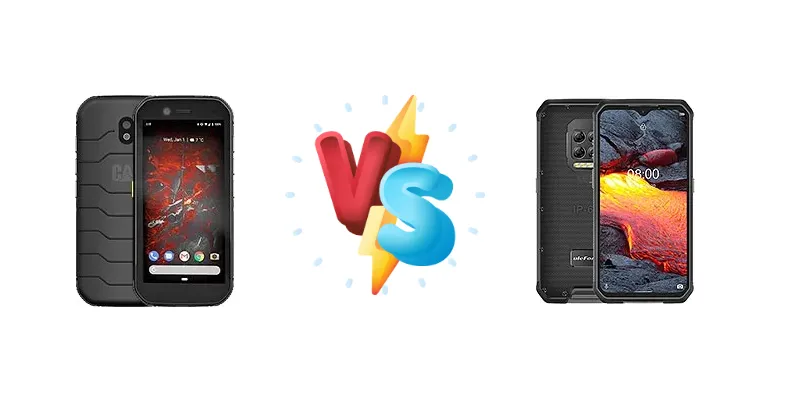
The rugged smartphone market caters to users needing durability, but performance varies greatly. We pit the entry-level Cat S42, focused on essential functionality, against the more ambitious Ulefone Armor 9E, which aims to deliver a more robust experience with a significantly upgraded chipset. This comparison will dissect the core differences to help you choose the right tool for your needs.
🏆 Quick Verdict
For the average user prioritizing basic functionality and affordability, the Cat S42 is a reasonable choice. However, the Ulefone Armor 9E is the clear winner for anyone needing more than basic performance, offering a substantial leap in processing power thanks to its Helio P90 chipset, making it better suited for multitasking and demanding applications.
| Network |
|---|
| 2G bands | GSM 850 / 900 / 1800 / 1900 | GSM 850 / 900 / 1800 / 1900 |
| 3G bands | HSDPA 850 / 900 / 1900 / 2100 - EU | HSDPA 850 / 900 / 1700(AWS) / 1900 / 2100 |
| 4G bands | 1, 2, 3, 4, 5, 7, 8, 20, 28 | 1, 2, 3, 4, 5, 7, 8, 12, 13, 17, 18, 19, 20, 25, 26, 28, 34, 38, 39, 40, 41, 66 |
| Speed | HSPA 42.2/5.76 Mbps, LTE (2CA) Cat6 300/50 Mbps | HSPA 42.2/11.5 Mbps, LTE Cat12 600/150 Mbps |
| Technology | GSM / HSPA / LTE | GSM / CDMA / HSPA / EVDO / LTE |
| | HSDPA 850 / 900 / 1700(AWS) / 1900 / 2100 - USA | CDMA2000 1xEV-DO |
| Launch |
|---|
| Announced | 2020, January. Released 2020, August | 2020, September 08. Released 2020, September 08 |
| Status | Discontinued | Discontinued |
| Body |
|---|
| Build | - | Front glass, aluminum back with rubber, aluminum frame |
| Dimensions | 161.4 x 77.3 x 12.7 mm (6.35 x 3.04 x 0.5 in) | 168.2 x 82 x 15 mm (6.62 x 3.23 x 0.59 in) |
| SIM | · Nano-SIM· Nano-SIM + Nano-SIM | Nano-SIM + Nano-SIM |
| Weight | 220 g (7.76 oz) | 324 g (11.43 oz) |
| | IP69 dust/water resistant (up to 1.5m for 35 min)
Drop-to-concrete resistance from up to 1.8m
MIL-STD-810H compliant | IP68/IP69K dust/water resistant (up to 1.5m for 30 min)
Drop-to-concrete resistance from up to 1.2m
MIL-STD-810G compliant |
| Display |
|---|
| Protection | Corning Gorilla Glass 5 | Scratch-resistant glass, oleophobic coating |
| Resolution | 720 x 1440 pixels, 18:9 ratio (~293 ppi density) | 1080 x 2340 pixels, 19.5:9 ratio (~409 ppi density) |
| Size | 5.5 inches, 78.1 cm2 (~62.6% screen-to-body ratio) | 6.3 inches, 97.4 cm2 (~70.6% screen-to-body ratio) |
| Type | IPS LCD | IPS LCD |
| Platform |
|---|
| CPU | Quad-core 1.8 GHz Cortex-A53 | Octa-core (2x2.2 GHz Cortex-A75 & 6x2.0 GHz Cortex-A55) |
| Chipset | Mediatek MT6761D Helio A20 (12 nm) | Mediatek MT6779 Helio P90 (12 nm) |
| GPU | PowerVR GE8320 | PowerVR GM9446 |
| OS | Android 10, planned upgrade to Android 11 | Android 10 |
| Memory |
|---|
| Card slot | microSDXC (dedicated slot) | microSDXC (uses shared SIM slot) |
| Internal | 32GB 3GB RAM | 128GB 8GB RAM |
| | eMMC 5.1 | UFS 2.1 |
| Main Camera |
|---|
| Features | LED flash | Quad-LED flash, HDR, panorama |
| Quad | - | 64 MP, f/1.9, 26mm (wide), 1/1.72", 0.8µm, PDAF
8 MP, f/2.4, 100˚ (ultrawide), 1/4.0", 1.12µm
2 MP (macro)
Auxiliary lens |
| Single | 13 MP, f/2.0, (wide), PDAF | - |
| Video | 1080p@30fps | 4K@30fps, 1080p@30fps |
| Selfie camera |
|---|
| Features | - | HDR, panorama |
| Single | 5 MP | 8 MP, f/2.2 |
| Video | - | 1080p@30fps |
| Sound |
|---|
| 3.5mm jack | Yes | Yes |
| 35mm jack | Yes | Yes |
| Loudspeaker | Yes | Yes |
| Comms |
|---|
| Bluetooth | 5.0, A2DP, LE | 5.0, A2DP, LE |
| NFC | Yes | Yes |
| Positioning | GPS, GLONASS, BDS | GPS, GLONASS, GALILEO, BDS |
| Radio | FM radio | FM radio, RDS, recording |
| USB | microUSB 2.0, OTG | USB Type-C 2.0, OTG, accessory connector |
| WLAN | Wi-Fi 802.11 b/g/n | Wi-Fi 802.11 a/b/g/n/ac, Wi-Fi Direct |
| Features |
|---|
| Sensors | Accelerometer, proximity, compass | Fingerprint (side-mounted), accelerometer, gyro, proximity, compass, coulombmeter |
| | - | Endoscope mount (camera sold separately) |
| Battery |
|---|
| Charging | - | 18W wired |
| Type | Li-Ion 4200 mAh | Li-Po 6600 mAh |
| Misc |
|---|
| Colors | Black | Black |
| Price | About 300 EUR | About 290 EUR |
Cat S42
- Lower price point makes it accessible.
- Focus on essential functionality ensures long battery life for basic tasks.
- Rugged design provides reliable protection.
- Limited processing power struggles with demanding apps.
- Likely lower-resolution display.
- Slower charging speeds.
Ulefone Armor 9E
- Significantly faster processor for smoother multitasking.
- 18W fast charging reduces downtime.
- Potentially better camera performance due to ISP capabilities.
- Higher price compared to the Cat S42.
- More powerful processor may consume battery faster.
- May be slightly bulkier due to larger components.
Display Comparison
Neither device's display specifications are provided, so a direct comparison is limited. However, given the Cat S42's positioning, it likely features a lower-resolution panel optimized for power efficiency. The Armor 9E, targeting a higher performance bracket, may have a sharper display with better color reproduction. Both will likely prioritize durability over peak brightness or color accuracy, focusing on visibility in direct sunlight rather than cinematic quality.
Camera Comparison
Without detailed camera specifications, a precise comparison is difficult. However, the Armor 9E’s higher processing power allows for more sophisticated image processing algorithms, potentially resulting in better dynamic range and noise reduction. While both phones likely feature a main camera and potentially auxiliary lenses, the Helio P90’s ISP (Image Signal Processor) will be more capable of handling complex scenes and delivering higher-quality images. The Cat S42 will likely focus on basic image capture, while the Armor 9E offers the potential for more creative control and better results.
Performance
The performance gap is the most significant differentiator. The Cat S42’s MediaTek Helio A20, with its quad-core Cortex-A53 CPU, is designed for basic smartphone tasks. The Ulefone Armor 9E’s Helio P90, featuring an octa-core configuration with a mix of Cortex-A75 and A55 cores, represents a substantial upgrade. The A75 cores provide significantly higher single-core performance, crucial for responsive app launches and smoother multitasking, while the A55 cores handle background tasks efficiently. This architectural difference translates to a much more fluid user experience on the Armor 9E, particularly when running multiple applications or demanding software.
Battery Life
Battery capacity isn't specified for either device. However, the Ulefone Armor 9E’s 18W wired charging is a clear advantage. While the Cat S42 likely supports standard charging speeds, the Armor 9E’s faster charging will significantly reduce downtime, allowing users to quickly replenish the battery during breaks. The more powerful Helio P90 will consume more power, but the faster charging mitigates this, offering a more convenient user experience.
Buying Guide
Buy the Cat S42 if you need a dependable, no-frills rugged phone for essential communication and occasional use. It’s ideal for construction workers or outdoor enthusiasts who primarily need call functionality and basic app support. Buy the Ulefone Armor 9E if you prefer a rugged phone capable of handling more demanding tasks like navigation with offline maps, running multiple apps simultaneously, or even light gaming, and appreciate the benefit of faster charging.
Frequently Asked Questions
❓ Will the Ulefone Armor 9E handle graphically intensive games like PUBG Mobile?
The Helio P90 in the Ulefone Armor 9E is capable of running PUBG Mobile, but likely at medium settings to maintain a stable frame rate. The Cat S42’s Helio A20 would struggle significantly with such demanding games.
❓ Is the Ulefone Armor 9E’s faster charging compatible with Power Delivery (PD) chargers?
While the Ulefone Armor 9E supports 18W charging, it's not explicitly stated whether it supports the Power Delivery protocol. It will likely work with standard 18W chargers, but compatibility with PD chargers may vary.
❓ How does the Cat S42 perform with offline navigation apps like Maps.me?
The Cat S42 can run offline navigation apps, but the Helio A20’s limited processing power may result in slower map loading times and occasional lag, especially when searching or rerouting.
❓ What level of multitasking can I expect from the Cat S42?
The Cat S42 is best suited for single-tasking or very light multitasking. Running multiple apps simultaneously may lead to noticeable slowdowns and app crashes.