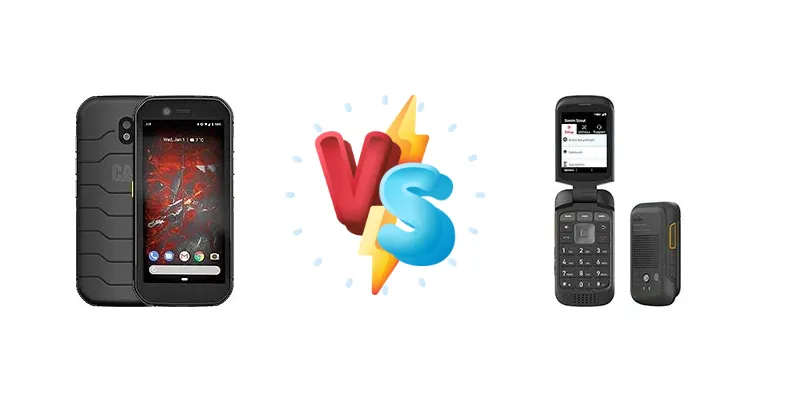
The Cat S42 and Sonim XP3plus both target users needing extreme durability, but their approaches to performance differ significantly. The Cat S42 prioritizes affordability with a Mediatek Helio A20, while the Sonim XP3plus opts for a Qualcomm Snapdragon 662, aiming for a smoother user experience. This comparison dissects these choices to determine which phone delivers the best value for demanding environments.
🏆 Quick Verdict
For the average user prioritizing responsiveness and multitasking, the Sonim XP3plus is the clear winner. Its Snapdragon 662 chipset provides a substantial performance advantage over the Cat S42’s Helio A20. However, if budget is the primary concern and basic functionality is sufficient, the Cat S42 remains a viable, albeit slower, option.
| Network |
|---|
| 2G bands | GSM 850 / 900 / 1800 / 1900 | GSM 850 / 900 / 1800 / 1900 |
| 3G bands | HSDPA 850 / 900 / 1900 / 2100 - EU | HSDPA 850 / 1700(AWS) / 1900 / 2100 |
| 4G bands | 1, 2, 3, 4, 5, 7, 8, 20, 28 | 1, 2, 3, 4, 5, 7, 12, 13, 14, 25, 26, 30, 39, 40, 41, 66, 71 |
| Speed | HSPA 42.2/5.76 Mbps, LTE (2CA) Cat6 300/50 Mbps | HSPA, LTE |
| Technology | GSM / HSPA / LTE | GSM / HSPA / LTE |
| | HSDPA 850 / 900 / 1700(AWS) / 1900 / 2100 - USA | - |
| Launch |
|---|
| Announced | 2020, January. Released 2020, August | 2021, September |
| Status | Discontinued | Available. Released 2021, September |
| Body |
|---|
| Dimensions | 161.4 x 77.3 x 12.7 mm (6.35 x 3.04 x 0.5 in) | 116 x 60 x 28 mm (4.57 x 2.36 x 1.10 in) |
| SIM | · Nano-SIM· Nano-SIM + Nano-SIM | Nano-SIM |
| Weight | 220 g (7.76 oz) | 220 g (7.76 oz) |
| | IP69 dust/water resistant (up to 1.5m for 35 min)
Drop-to-concrete resistance from up to 1.8m
MIL-STD-810H compliant | IP68 dust/water resistant (up to 1.5m for 30 min)
MIL-STD-810H |
| Display |
|---|
| Protection | Corning Gorilla Glass 5 | - |
| Resolution | 720 x 1440 pixels, 18:9 ratio (~293 ppi density) | 240 x 320 pixels, 4:3 ratio (~143 ppi density) |
| Size | 5.5 inches, 78.1 cm2 (~62.6% screen-to-body ratio) | 2.8 inches, 24.3 cm2 (~34.9% screen-to-body ratio) |
| Type | IPS LCD | TFT LCD |
| | - | Cover display:
IPS LCD, 1.3 inches, 240 x 240 pixels |
| Platform |
|---|
| CPU | Quad-core 1.8 GHz Cortex-A53 | Octa-core (4x2.0 GHz Kryo 260 Gold & 4x1.8 GHz Kryo 260 Silver) |
| Chipset | Mediatek MT6761D Helio A20 (12 nm) | Qualcomm SM6115 Snapdragon 662 (11 nm) |
| GPU | PowerVR GE8320 | Adreno 610 |
| OS | Android 10, planned upgrade to Android 11 | Sonim OS (based on AOSP Android 11) |
| Memory |
|---|
| Card slot | microSDXC (dedicated slot) | microSDXC (dedicated slot) |
| Internal | 32GB 3GB RAM | 16GB 2GB RAM |
| | eMMC 5.1 | - |
| Main Camera |
|---|
| Features | LED flash | LED flash |
| Single | 13 MP, f/2.0, (wide), PDAF | 8 MP |
| Video | 1080p@30fps | - |
| Sound |
|---|
| 3.5mm jack | Yes | Yes |
| 35mm jack | Yes | Yes |
| Loudspeaker | Yes | Yes |
| Comms |
|---|
| Bluetooth | 5.0, A2DP, LE | 5.0, A2DP, LE |
| NFC | Yes | No |
| Positioning | GPS, GLONASS, BDS | GPS, GLONASS, GALILEO |
| Radio | FM radio | FM Radio |
| USB | microUSB 2.0, OTG | USB Type-C |
| WLAN | Wi-Fi 802.11 b/g/n | Wi-Fi 802.11 a/b/g/n/ac, dual-band |
| Features |
|---|
| Sensors | Accelerometer, proximity, compass | Accelerometer, barometer |
| Battery |
|---|
| Type | Li-Ion 4200 mAh | Li-Ion 2300 mAh, removable |
| Misc |
|---|
| Colors | Black | Black |
| Price | About 300 EUR | About 240 EUR |
Cat S42
- Most affordable rugged smartphone option
- Durable build quality for harsh environments
- Simple and easy-to-use interface
- Significantly slower performance compared to competitors
- Limited multitasking capabilities
- Lower quality camera performance
Sonim XP3plus
- Faster and more responsive performance
- Improved multitasking and app loading times
- Better camera quality for documentation and photos
- Higher price point than the Cat S42
- May still lack advanced features found in mainstream smartphones
- Rugged design may result in a bulkier form factor
Display Comparison
Neither device is known for display prowess, focusing instead on ruggedness. Specific display specs (resolution, brightness) are not provided, but given the target market, we can assume both utilize durable, scratch-resistant panels. The Sonim XP3plus, benefiting from a more modern chipset, likely has a more efficient display controller, potentially leading to slightly better battery life during screen-on usage. The Cat S42’s older chipset may result in less refined color calibration and viewing angles.
Camera Comparison
Without specific camera specs beyond the presence of cameras, it’s difficult to make a definitive comparison. However, the Snapdragon 662’s image signal processor (ISP) in the Sonim XP3plus is significantly more advanced than the ISP found in the Helio A20-powered Cat S42. This means the Sonim XP3plus will likely produce better image quality, particularly in challenging lighting conditions. Expect improved dynamic range, noise reduction, and overall detail in photos and videos captured with the Sonim XP3plus. The Cat S42 will likely suffice for basic documentation, but won’t compete in image quality.
Performance
The core difference lies in the chipsets. The Sonim XP3plus’s Qualcomm Snapdragon 662 (11nm) is a significant upgrade over the Cat S42’s Mediatek MT6761D Helio A20 (12nm). The Snapdragon 662’s octa-core configuration (4x2.0 GHz Kryo 260 Gold & 4x1.8 GHz Kryo 260 Silver) provides substantially more processing power and efficiency compared to the Cat S42’s quad-core 1.8 GHz Cortex-A53. This translates to faster app loading times, smoother multitasking, and a more responsive user interface on the Sonim XP3plus. The 11nm process node of the Snapdragon 662 also contributes to better thermal management, reducing the likelihood of performance throttling under sustained load.
Battery Life
Battery capacity isn’t specified for either device. However, the Snapdragon 662’s superior power efficiency gives the Sonim XP3plus an advantage. While the Cat S42 might have a slightly larger battery, the Helio A20’s less efficient architecture will likely result in shorter battery life during typical usage. The Sonim XP3plus’s optimized power management, coupled with its more efficient chipset, will likely deliver longer standby times and more hours of screen-on usage.
Buying Guide
Buy the Cat S42 if you need a highly affordable, extremely durable phone for basic communication and limited app usage – think push-to-talk, simple job ticketing, or occasional scanning. It’s ideal for roles where the phone is primarily a tool for voice calls and minimal data. Buy the Sonim XP3plus if you prefer a more responsive experience, require smoother multitasking, and anticipate using more demanding applications like navigation, document editing, or remote access tools. It’s suited for field workers needing a reliable, capable smartphone for a wider range of tasks.
Frequently Asked Questions
❓ Will the Cat S42 struggle with modern navigation apps like Google Maps or Waze?
Yes, the Cat S42’s Helio A20 chipset is likely to exhibit noticeable lag and slowdowns when running demanding applications like Google Maps or Waze, especially with multiple apps open simultaneously. The Sonim XP3plus, with its Snapdragon 662, will provide a much smoother and more reliable navigation experience.
❓ Is the Sonim XP3plus a good choice for push-to-talk (PTT) over cellular?
Absolutely. Sonim phones are renowned for their PTT optimization. The Snapdragon 662 provides the processing power needed for reliable PTT performance, and Sonim’s software is specifically designed to prioritize clear and instant communication, even on congested networks. While the Cat S42 *can* handle PTT, the experience will be less responsive.
❓ How does the processing power difference impact remote access applications (e.g., TeamViewer)?
Remote access applications are resource-intensive. The Cat S42’s Helio A20 will likely struggle to maintain a stable connection and provide a usable experience with remote access software. The Sonim XP3plus’s Snapdragon 662 offers the necessary processing power and memory bandwidth for smoother remote control and screen sharing.